

How to make potting compost aligns with permaculture ethics of Earth care, people care, and fair share. It reduces environmental impact, fosters healthier plants, and empowers growers to create sustainable, self-sufficient growing systems. Learning how to make your own potting mix will save money too.
Whether you’re nurturing seedlings, growing in polytunnels, or maintaining container crops elsewhere in your garden, a well-balanced homemade mix will provide the ideal foundation for plant health and productivity.
Quick facts
- DIY potting mix is more sustainable, cost-effective, and customisable than commercial alternatives.
- Essential ingredients include compost, aeration materials, moisture retainers, and nutrients.
- Homemade mixes reduce reliance on peat-based commercial products, preserving vital ecosystems.
- Organic and permaculture-friendly methods promote soil health and plant vitality.
- Polytunnel growers can adapt recipes to suit different crops and seasonal needs.
Tools
To make your own potting mix, you’ll need:
- A large mixing container (e.g., a wheelbarrow, trug, or sturdy bucket)
- A garden sieve to refine compost
- A scoop or trowel for measuring ingredients
- A watering can or spray bottle for moisture control
- Protective gloves (optional but recommended)
Ingredients
When learning how to make potting compost, a good potting mix should contain a balanced structure, nutrition, aeration, and moisture retention. Key ingredients include:
- Compost
- Leaf mould or well-rotted wood chips
- Charred wood or homemade biochar
- Garden soil (optional)
- Worm castings or well-rotted manure
- Shredded bark or straw
What is potting soil?
Potting soil, also called potting compost, is a specially formulated growing medium designed for plants grown in containers. Unlike garden soil, which can be too dense and compacted, potting soil is created to provide an ideal balance of aeration, moisture retention, and nutrition in containers.
A good potting mix supports strong root growth for plants in pots or other containers by allowing air to reach the roots while maintaining the right amount of moisture to prevent dehydration or waterlogging.
In polytunnel container growing, where plants are cultivated in a controlled environment, using the right potting mix is particularly important. It ensures plants receive the nutrients they need while maintaining optimal soil structure.
Unlike regular garden soil, which can harbour weeds and pathogens, potting soil is a clean and carefully composed medium that gives plants the best possible start.
A well-balanced mix is particularly important for seedlings, as their delicate root systems require a light, well-draining medium that retains enough moisture without becoming compacted.
Why Make Your Own Potting Mix?

Making your own potting mix allows you to take full control over the quality, sustainability, and suitability of the growing medium for your specific needs.
Many commercial potting soils contain unsustainable ingredients such as peat, which is extracted from fragile ecosystems, leading to habitat destruction and carbon release. By creating a homemade mix, you can eliminate reliance on peat-based products and choose renewable, local alternatives that align with permaculture principles.
Another key advantage of DIY potting mix is cost savings. Store-bought options can be expensive, especially when purchasing high-quality, organic blends. By sourcing materials from your own garden or in bulk, you can significantly reduce costs while ensuring a nutrient-rich and chemical-free growing medium.
Customisation is also an important factor. Different plants have varying needs, and a homemade mix allows you to tailor the composition based on specific crops, from fast-growing leafy greens to deep-rooted fruiting plants.
Homemade mixes also provide better quality control. Many commercial potting soils contain synthetic fertilisers, wetting agents, or even pesticide residues that may not align with organic growing practices.
By preparing your own mix, you avoid unwanted additives and ensure the presence of beneficial microbes, which play a crucial role in maintaining soil health.
The ability to recycle organic matter, such as compost and leaf mould, also contributes to a closed-loop growing system, reducing waste and improving soil fertility over time.
The Downside of Store-Bought Potting Soil
While store-bought potting soil offers convenience, it comes with several significant drawbacks. Many commercial mixes still rely on peat, the extraction of which destroys vital peatland ecosystems, releasing stored carbon into the atmosphere and reducing biodiversity. Peat is not a renewable resource on a human timescale, making its continued use unsustainable.
Another concern is the sterility of many commercial mixes. To ensure consistency and prevent disease, some manufacturers sterilise their potting soils using chemical treatments or high heat.
While this may eliminate harmful pathogens, it also destroys beneficial microbes that contribute to plant health. Without these microbes, plants become more reliant on artificial fertilisers, which can disrupt natural soil ecosystems and increase dependency on synthetic inputs.
Store-bought potting soils often contain synthetic fertilisers and wetting agents that are designed to promote plant growth quickly but do not support long-term soil health.
These additives can lead to nutrient imbalances, salt buildup, and the depletion of organic matter, making plants more vulnerable to pests and diseases. Additionally, many commercial mixes are sold in plastic packaging, contributing to single-use plastic waste that is difficult to recycle.
Perlite and vermiculite, two common additives in store-bought potting soils, also raise sustainability concerns.
Perlite is a mined volcanic glass that must be superheated to create the lightweight granules used for aeration. This process consumes large amounts of energy and contributes to environmental degradation at mining sites.
Similarly, vermiculite is extracted from mineral deposits, often in environmentally sensitive areas, and requires high-energy processing to expand it into the form used in gardening.
Both of these materials, while effective in improving soil structure, have high environmental costs associated with their production and transport.
By making your own potting mix, you avoid these unsustainable practices and can instead rely on locally available, renewable materials that align with permaculture principles.
Homemade alternatives, such as shredded bark, leaf mould, and biochar, provide the same benefits as mined aeration materials without contributing to environmental destruction.
The Role of Potting Mix Ingredients
Understanding the function of each component helps create a balanced mix:
- Compost: Provides nutrients and beneficial microbes (homemade, well-aged compost is ideal).
- Leaf mould or well-rotted wood chips: Enhances water retention while remaining lightweight.
- Charred wood or homemade biochar: Improves aeration and drainage sustainably.
- Garden soil (optional): Can add structure, but may need to be sterilised to prevent problems.
- Worm castings or well-rotted manure: Boosts fertility and microbial activity.
- Shredded bark or straw, or even cork fragments: Provides aeration without relying on mined materials.
How To Make Potting Compost Recipe Method
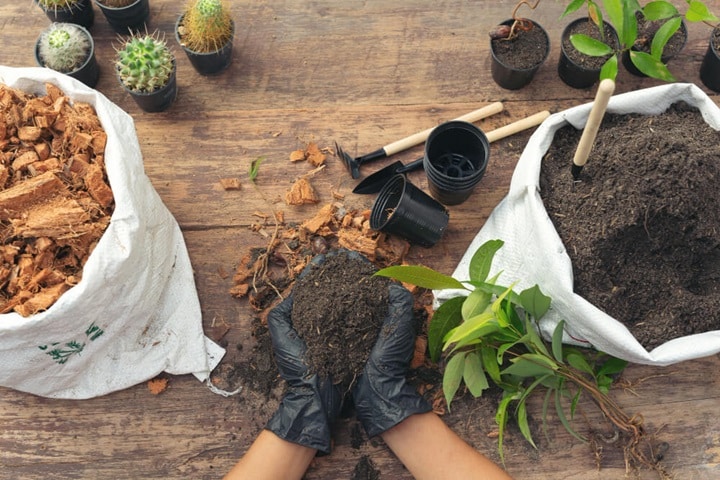
- Basic All-Purpose Soil-less Potting Mix:
- 2 parts (by volume) compost (sieved for a finer texture)
- 1 part leaf mould or well-rotted wood chips (moist but not soggy)
- 1 part charred wood or shredded bark (for drainage and aeration)
- ½ part worm castings or well-rotted manure (for extra nutrients)
- Optional: A sprinkle of mycorrhizal fungi or seaweed meal for additional microbial support
- Variations for Different Plants
- Seed-starting mix: Use 3 parts sieved compost, 1 part leaf mould, and 1 part biochar. This provides a light, fine-textured mix suitable for delicate roots.
- Moisture-loving plants (e.g., basil, coriander): Increase leaf mould or add coconut coir for enhanced water retention.
- Cacti and succulents: Reduce compost to 1 part and add 1 part coarse sand or crushed charcoal for better drainage.
- Heavy feeders (e.g., tomatoes, peppers): Add extra worm castings or aged manure to enrich nutrients.
Method:
- Prepare compost: Start by sieving your compost to remove large chunks, sticks, or un-composted material. This will create a fine, even texture that supports root development, especially for seedlings.
- Hydrate dry ingredients: If using leaf mould or biochar, check the moisture content. If they are too dry, lightly mist them with water before mixing to prevent them from drawing moisture away from plants once in use.
- Layer ingredients: Add compost, leaf mould, charred wood, and other dry ingredients in alternating layers in your mixing container. This helps with even distribution when mixing.
- Mix thoroughly: Using a shovel or trowel, blend the ingredients together until you achieve a uniform mix. Ensure that the aeration materials are evenly distributed to prevent clumping and maintain consistency.
- Test the moisture level: Grab a handful of the mix and squeeze it lightly. It should hold together without releasing excess water. If it crumbles apart, add a little more moisture. If it drips, mix in more dry material such as shredded bark or additional compost.
- Fine-tune for specific plants: If needed, adjust the composition at this stage based on what you are growing. Adding extra amendments like worm castings for nutrient-hungry plants or coarse sand for improved drainage will help create the ideal mix.
- Store properly: Once mixed, store your potting compost in a breathable container, such as a burlap sack or an aerated plastic tub with ventilation holes. Keeping it in a cool, dry place will preserve its structure and microbial life until use.
- Use as needed: Before using, fluff the mix to restore aeration. If it has dried out during storage, lightly moisten it before filling pots or seed trays.
Learn more about potting mixes and compost in our blog guides –
FAQs
How to turn bagged garden soil into potting soil?
You can enhance bagged garden soil to create a well-draining potting mix by following these steps:
Add organic matter: Mix in compost or well-rotted manure to improve fertility and structure.
Incorporate aerating materials: Garden soil can become too dense for pots.
Increase drainage: With charred wood or homemade biochar, for example.
Mix thoroughly: Combine all ingredients evenly for a balanced, well-draining potting soil.
Can I use straight compost as potting soil?
While compost is nutrient-rich, using it straight as potting soil is not ideal for most plants. Here’s why:
Too dense: Pure compost can become too heavy, which can lead to poor drainage and root suffocation.
Imbalanced texture: Compost often lacks the necessary balance of aeration, drainage, and moisture retention that potting soil requires.
Potentially too nutrient-rich: High nutrient content can sometimes burn delicate plant roots.
Tip: To make compost suitable for potting, mix it with other materials like leaf mould, wood chip etc…
What’s better, vermiculite or perlite?
Both perlite and vermiculite have benefits, such as improving aeration, drainage, and water retention, but neither is the most sustainable choice. Perlite is often produced through the mining of volcanic glass, which is an energy-intensive process. Vermiculite, while naturally occurring, is also mined and can have environmental impacts.
Instead, choose more sustainable alternatives like well-aged compost, which can improve soil structure, fertility, and moisture retention, making it an excellent substitute for both perlite and vermiculite, particularly when mixed with other materials like wood chips, straw fragments, or bark for aeration.
Sources
Kelly, T., (2024) How to use wine corks in your garden – 7 ways to reuse the sustainable material. Woman and Home. [online] Available at: https://www.womanandhome.com/homes/how-to-use-wine-corks-in-your-garden/