


Intercropping is a term that may not be familiar to all home growers. But it is useful in gardens as well as on farms to understand this type of companion planting. Knowing the benefits and risks of intercropping will also be essential to know before we continue further with this guide.
What is Interplanting/Intercropping?
In simple terms, interplanting or intercropping is the practice of growing two or more crops alongside one another in the same field or growing area. This is a type of polyculture, integral to sustainable farming practice and, in gardens, a form of companion planting.
There are a number of different reasons why plants are placed in close proximity to one another, and a number of different ways in which they can be combined.
But the key goals typically remain the same: to increase overall yield in a given land area, to boost biodiversity and embrace diversity in general, and to gain benefits from the ecological interaction between the plant species.
Types Of Intercropping
In order to understand intercropping better, we can take a look at the different types of intercropping that farmers and gardeners might consider:
Row Cropping
One of the simplest forms of intercropping simply involves interspersing rows of certain crops – alternating between rows of the different crops.
The crop rows can be wide enough to allow for cultivation with agricultural machinery, or be single plant rows in a vegetable garden, but this term is most often used when intercropping occurs at a smaller and non-mechanised scale.
One common example of row cropping at garden scale is when gardeners sow rows of carrots between rows of onions or garlic which is beneficial because each repels the pests that can plague the other.
Strip Intercropping
Strip intercropping is very similar to the above, but is the name sometimes given to intercropping of crops in wider strips or rows in an agricultural context.
The rows or strips in this type of intercropping are typically wider – wide enough to allow them to be tended with contemporary agricultural machinery.
Alley Cropping
Alley cropping is a type of strip cropping, but rather than interspersing two arable crops in one field, the strips or rows of an arable crop are placed between rows of trees – and the trees may often be a crop in their own right – producing fruit or nuts, for example.
As well as being a form of intercropping, alley cropping is also a type of agroforestry – an important sustainable solution in agriculture that can also be interesting to home gardeners.
Relay Cropping
Relay cropping brings an element of time into the equation when it comes to intercropping. In intercropping of this sort, two crops or more are placed into the same field or growing area but they are not sown at the same time.
Rather, a second crop tolerant of the first might be planted at a slightly later stage, say after the first one has flowered. Basically, you are getting started with a second crop before the first one is harvested.
Temporal Intercropping
Two species may also be intercropped which mature at different speeds and which have very different harvest times. In this type of intercropping, the species are sown/planted at the same time, but one, which matures much more quickly, will be harvested before the slower-maturing one needs the space.
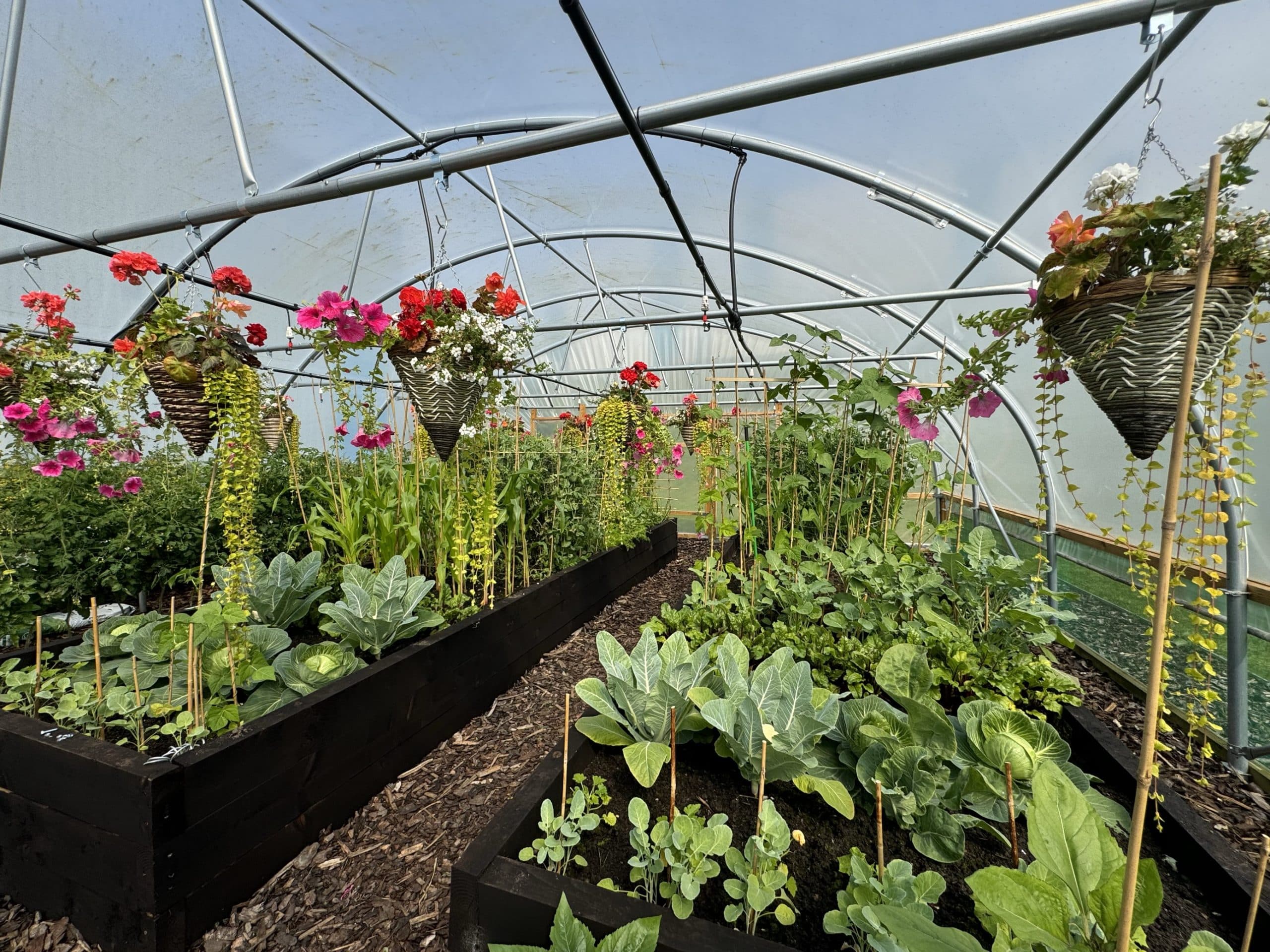
One common example of this in vegetable gardens is when lettuce is planted between cabbages or broccoli to make the most of the space. The lettuce is a quicker crop, harvested before the cabbage family crops grow to require the space and resources.
Mixed Intercropping
Mixed intercropping, also known as maslin, is another intercropping approach that has been adopted for millennia. In this type of intercropping, multiple crops are mixed freely within the field or growing area.
For example, mediaeval English farmers used to mix oats and barley to create a seed mix to create dredge for livestock feed. French peasants sowed a mix of wheat and rye to make bread with mixed grains.
Mixing grains in this way is still a common practice in some countries around the world today, though it fell out of favour here and elsewhere due to harvesting mechanisation practices and consumer preference.
On a smaller scale, we can adopt this approach when we sow a mixture of different salad greens and radishes for example by mixing the seeds together and broadcasting them over a container or growing area.
Trap Cropping
Another thing that defines different types of intercropping is the reason why the combination of those specific crops or plants is a good idea. One key reason that certain plants are included in such a scheme is for pest control purposes.
All of the above schemes focus on intercropping of more than one crop or source of a yield. But a primary crop might also be intercropped with what is known as a trap crop. A trap crop is not grown primarily for the yield it itself can provide, but is instead grown as an (often sacrificial) attractant for pest species.
Pests are drawn to the trap crop and therefore tend to go for it and not for the more valuable crop nearby. Trap crops, by attracting pests, can also attract predatory creatures that help to keep pest numbers down.
Trap crops are shown to be effective at a smaller scale in gardens and market gardens but have reportedly proved less effective at scale.
However, trap crops have been used successfully at large commercial scale, especially where management practices reduce dispersal back from a trap crop to the main crop, and when this strategy is combined holistically with other sustainable land management and farming practices.
Trap crops may also be combined with repellent intercrops that repel, or confuse, specific pest species.
Marigolds are just one example of many companion plants often used for pest control purposes in intercropping planting schemes in an organic garden.
Undercropping
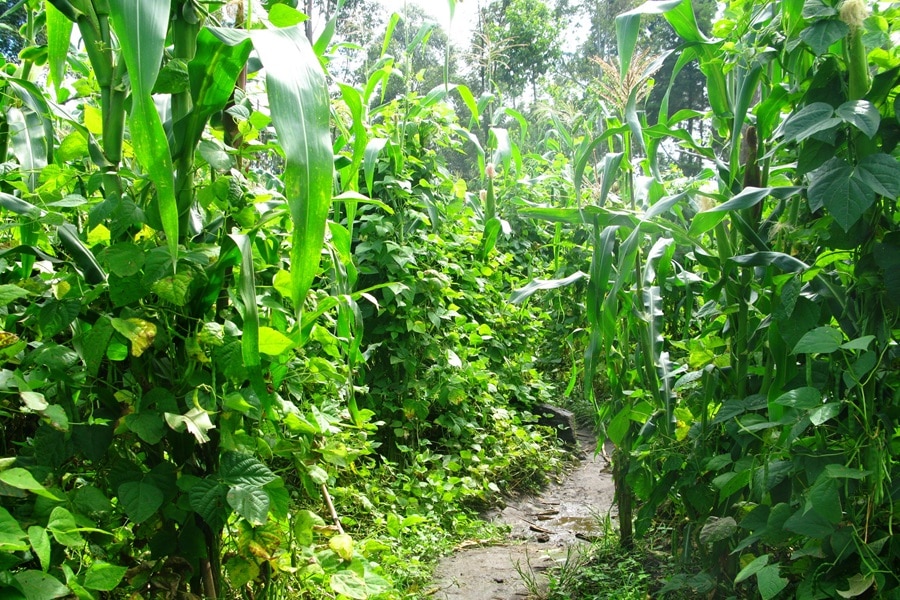
With undercropping, our final type of intercropping, the idea is that the two or more crops in the planting scheme occupy different layers, or tiers of the space, thinking about the vertical dimension.
When two plants are intercropped in this way, the idea is that one casts shade for the other, and the lower species provides good groundcover for the first.
One example of this involves planting spinach below sweetcorn and beans or other taller plants that can provide shade to reduce the chance of the spinach bolting in summer.
These are examples of the many ways in which two plant species can not only be grown in the same field of growing area without excessive competition becoming a problem but can also aid one another.
In intercropping, we are often looking to see how plants can benefit one another, or how one benefits another, in order to gain more from the system as a whole.
How to Start Garden Intercropping
To understand how to use different types of intercropping in your garden, you first need to think about the goals of such practices, and what precisely you want to achieve. Remember, it is important to take a holistic view, and to consider not only intercropping but also different types of companion planting.
There are many reasons why it can be better to grow two or more types of plant together rather than growing them apart.
Diversity is good in general. Increasing diversity of crops in a garden increases the number of beneficial interactions within an ecosystem, making it more stable and resilient. And it also means we are not putting all of our eggs in one basket.
Intercropping can also increase the overall yield we are able to achieve from a given area, due to the benefits of mutualism between species bringing benefits that exceed the possible lowering of yield brought through any competition for water, nutrients, space etc…
When the benefits to yield and the garden’s function in general outweigh any detriments due to competition, we might call that a successful intercropping combination.
To start intercropping successfully in your own garden you need to think about:
- Spacing guidelines for specific crops where you live and in the conditions you can provide.
- The root systems and growth habits of those crops and what they need to thrive.
- The timings of the growing year from sowing to harvest for particular crops.
- Combinations of plants said to be beneficial by other gardeners in your area or those gardening in similar conditions to you.
Gaining deeper knowledge in each of these key areas is a good place to begin.
Vegetable Intercropping Considerations
Understanding some of the most common beneficial interactions in intercropping schemes can help us begin to see why some intercropping schemes can work well in a garden.
Those beneficial interactions include:
- Improving the soil through nitrogen fixation/ providing other valuable nutrients and through boosting its biodiversity.
- One crop providing shade for another, or otherwise improving the environmental conditions. For example, by covering the soil – reducing moisture loss and suppressing weed growth.
- One crop providing valuable nutrients for another (nitrogen fixation).
- Crops aiding one another in pest control, either by repelling, confusing or distracting pest species and/or by attracting predatory wildlife to keep pest numbers down.
- One crop attracting pollinators for another.
Other Factors for Interplanting and Intensive Gardening
The most important thing to remember when interplanting two or more species in the same growing area is that excessive competition should be avoided.
Not all plants make good companions for one another, of course, and we need to make our planting plans carefully to make the most of our growing areas without introducing too much competition for resources.
When we are planting intensively and making full use of our growing areas, we also have to make sure that we take care of the soil, rotating certain crop families and making sure that nutrients are not depleted and are always replenished over time through the addition of plenty of organic matter.
Remember, intercropping is just one form of companion planting.
We can expand from this idea, integrating not segregating, to create a garden filled with vibrant and diverse polycultures of plants that all thrive in one another’s company, whether those are largely perennials in a fruit tree guild or forest garden, or polyculture beds in a vegetable garden.
FAQs
What is the benefit of intercropping?
Intercropping can boost biodiversity and increase resilience, increase our yields from a given land area, reduce plant losses to pests and other problems, and allow us to make full use of the resources available throughout the growing season and, in a polytunnel garden, potentially all year round.
What crops are best for intercropping?
Some of the most common examples of intercropping in an agricultural setting involve sowing legumes (peas and beans) with a number of other crops, such as cereal grains or vegetables, because of their nitrogen fixing capabilities. Legumes are among the most important crops for intercropping on farms, and can also work well in a vegetable garden.
What vegetables are good for interplanting?
Some of the most common examples of intercropping in a vegetable garden, aside from combinations with legumes, are:
Carrots and onions (which benefit one another when it comes to pest control).
Cabbages and lettuce (which work well because lettuces are harvested before cabbages need the space).
Tomatoes and basil (basil is an aromatic herb for pest control, tomatoes provide some shelter, and the two are even said to make each other taste better).
Sources
C P Huss, K D Holmes, C K Blubaugh, Benefits and Risks of Intercropping for Crop Resilience and Pest Management, Journal of Economic Entomology, Volume 115, Issue 5, October 2022, Pages 1350–1362, https://doi.org/10.1093/jee/toac045 [accessed 26/02/24]