

When researching what are fava beans uk, you may come across two names for the same plant. In the UK, fava beans are commonly known as broad beans, and both names refer to Vicia faba.
For me, that small difference in language is part of what makes gardening interesting. A crop that feels completely familiar in a British vegetable garden can suddenly seem unfamiliar when it appears under another name.
“Broad bean” is the name most UK gardeners know, while “fava bean” is widely used internationally, particularly when talking about mature or dried beans. Once you know that, the mystery largely disappears.
And there is more to this crop than the name suggests. Fava beans have a long history as a food crop, they are useful plants for productive gardens, and as legumes they have an interesting relationship with the soil.
Key takeaways
- Fava beans and broad beans are the same species, Vicia faba.
- “Broad bean” is the familiar UK gardening term, while “fava bean” is widely used internationally.
- The plants produce long pods containing several large beans.
- The beans can be harvested young and green or allowed to mature and dry.
- As legumes, fava beans have an important relationship with soil nitrogen.
What Are Fava Beans?
Fava beans are the seeds of Vicia faba, a legume also commonly known as the broad bean or faba bean.
So, if you have grown broad beans in a UK garden, you have already grown fava beans.
That is worth making clear because I think gardeners sometimes encounter the word “fava” and assume it refers to another crop altogether. It does not. It is simply another name for this very familiar member of the bean family.
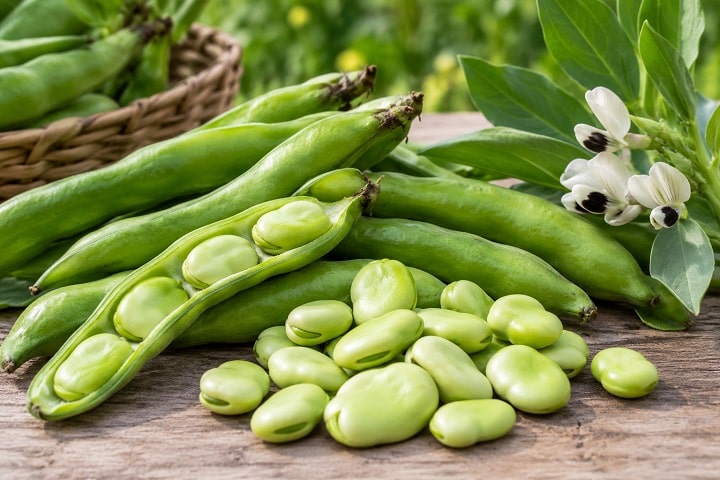
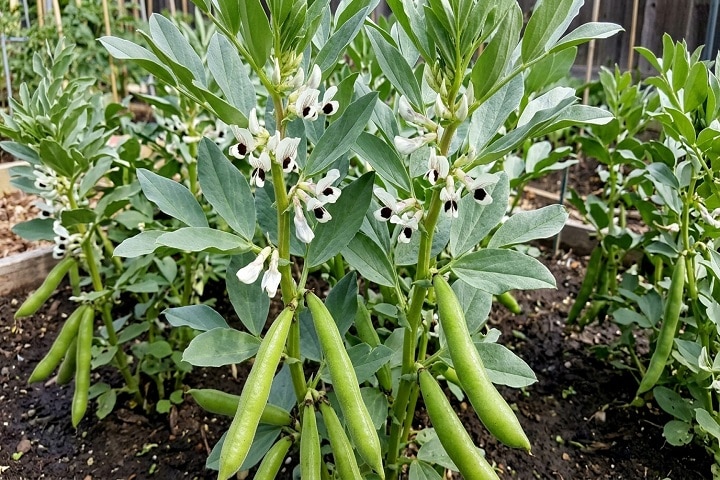
The plant itself is quite distinctive. It produces upright stems with blue-green leaves, clusters of flowers and long pods containing several large seeds. The pods are around 15 to 30cm, which are usually harvested green but become black as they mature.
Those seeds give us two rather different foods. We can pick them young and green for eating fresh, or allow them to mature and dry them for use as a pulse.
That simple change of harvest stage is one of the things I find particularly useful about growing beans. One plant can have a place in both the summer vegetable garden and the store cupboard.
Are Fava Beans the Same as Broad Beans?
Yes. Fava beans and broad beans are names for the same species, Vicia faba.
The difference is largely one of language and context.
| Broad beans | Fava beans | |
|---|---|---|
| Botanical species | Vicia faba | Vicia faba |
| Common UK usage | Very familiar | Less common, but increasingly encountered |
| Fresh form | Usually called broad beans | May be called fresh fava beans |
| Mature/dried form | Less common in everyday UK gardening language | Often called fava or faba beans |
So when you see a recipe, seed description or article referring to fava beans, you do not need to go looking for a completely different plant.
It is the same crop.
What Do Fava Beans Look Like?
A fava bean plant has an upright, sturdy appearance, with blue-green leaves and square-section stems. The flowers are usually white with dark markings, although varieties can differ. After flowering, the plant develops long, substantial pods.
Open one of those pods and you will find several large, flattened seeds.
When they are young, the beans are usually green and tender. Leave them longer and they become larger and firmer, eventually drying down into the beans commonly sold as fava or faba beans.
For anyone learning to identify vegetables in the garden, the combination of the upright stems and unusually large pods makes broad beans fairly easy to recognise.
Quick identification
- Plant: upright with sturdy stems
- Leaves: blue-green
- Flowers: commonly white with dark markings
- Pods: long and relatively broad
- Seeds: several large beans within each pod
- Mature seeds: larger, firmer and suitable for drying
There is variation between varieties, of course. Vicia faba is a diverse crop, so not every broad bean plant will look exactly the same.
Fresh Fava Beans vs Dried Fava Beans
The terminology becomes particularly interesting when we look at maturity.
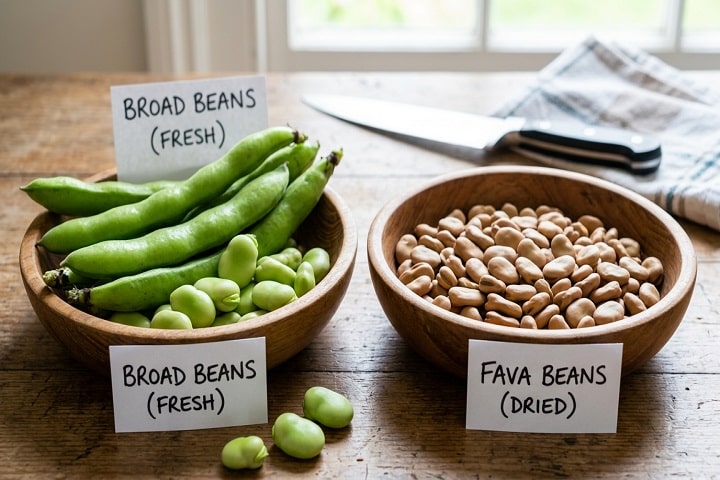
Fresh broad beans are harvested while the seeds are still green and tender. This is probably the form most UK gardeners picture when they hear “broad bean”.
But the crop does not have to stop there.
The beans can be allowed to mature and dry. At that point they become a dried pulse, and the name fava or faba bean becomes more common in food and agricultural contexts.
| Feature | Fresh beans | Mature/dried beans |
|---|---|---|
| Appearance | Green and tender | Dry and mature |
| Texture | Soft and creamy when cooked | Firm until prepared |
| Typical use | Vegetable dishes, salads and sides | Soups, stews, purées and pulse dishes |
| Names you may see | Broad beans, fresh fava beans | Fava beans, faba beans, dried broad beans |
Both the immature green seeds and mature dry seeds are eaten in different parts of the world.
I like this dual role of the plant. We often think of the vegetable garden as somewhere that produces food for immediate eating, but some crops can bridge the gap between fresh harvests and foods that can be stored. Broad beans give us both possibilities.
What Do Fava Beans Taste Like?
Fresh fava beans have an earthy, slightly nutty flavour and a creamy texture when cooked.
Young beans tend to be tender and fresh, while older beans become firmer and more substantial. Their flavour also changes as they mature.
They can be used simply as a seasonal vegetable, while dried beans are treated more like other pulses.
There is something satisfying about eating them fresh from the garden. You open a pod, see the beans sitting neatly inside and know exactly where your food has come from. That connection is easy to lose when we only encounter vegetables in packets or supermarket shelves.
Where Do Fava Beans Come From?
Fava beans have a remarkably long history.
Kew describes Vicia faba as an ancient cultivated crop, with evidence suggesting origins in Western Asia thousands of years ago. It subsequently spread into Europe, Africa and central Asia and is now cultivated widely in temperate and subtropical regions.
The crop therefore has a long relationship with human food growing.
The RHS also describes broad beans as a crop of ancient origin, with evidence of cultivation dating back at least 4,500 years.
That history is interesting when we grow them today. A row of broad beans in a British garden can look like an entirely ordinary part of the vegetable patch, but the plant belongs to a crop lineage that stretches back thousands of years.
There is something rather grounding about that.
Why Are Fava Beans Grown in the UK?
Broad beans have a useful place in the UK garden not just because they produce food, but because they are legumes.
Legumes form relationships with bacteria in nodules on their roots that allow atmospheric nitrogen to be fixed into forms the plant can use. This gives beans a different role from many other vegetable crops.
That does not mean that growing a few broad beans will magically fertilise the whole garden. Soil fertility is much more complicated than that. But legumes are an important part of many productive growing systems, particularly when we start thinking about crops as part of a wider rotation rather than as isolated plants.
This is one reason I think broad beans deserve more attention. They give us a harvest while also belonging to a plant family with an important ecological relationship beneath the soil.
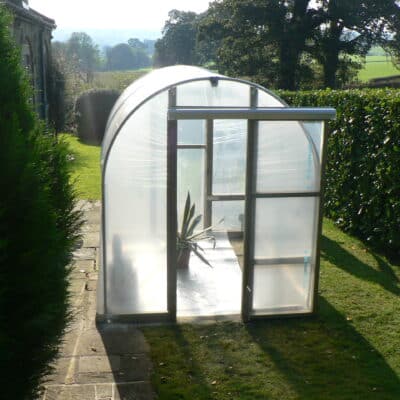
For gardeners who want to take that crop into protected growing, you can learn more about growing broad beans in a polytunnel.
How Are Fava Beans Used?
The same crop can be used in different ways depending on when it is harvested.
Fresh
Fresh fava or broad beans can be used in:
- Seasonal vegetable dishes
- Salads
- Simple side dishes
- Pasta and grain-based meals
- Soups and purées
Mature or dried
Dried fava beans are used as pulses in traditional dishes in many parts of the world. Kew records their use across regions including the Middle East, Mediterranean, China and Ethiopia.
So again, we are not talking about two different crops.
We are looking at different stages in the life of the same crop.
Growing Broad or Fava Beans in a UK Garden
If you are looking for seeds or growing advice in Britain, broad bean is generally the term you will encounter.
There is no separate fava bean plant to search for. Look for Vicia faba or broad bean varieties.
I would also resist the temptation to make growing more complicated than it needs to be. Broad beans are one of those crops where understanding the seasons and your own growing conditions is more useful than following a rigid calendar.
The RHS notes that broad beans can be sown at different times from autumn through to spring, depending on variety and conditions.
If you are deciding when to start, find out when to sow broad beans in the UK.
And once you know what you want to grow, giving plants enough room to develop is part of creating a healthy, productive growing space. You can get the right spacing for your bean plants before you plant.
There is no need to turn this article into a full growing guide. The important thing is simply to know that broad beans and fava beans are the same crop, so the advice you find under either name relates to Vicia faba.
Conclusion
So, what are fava beans in the UK?
They are broad beans.
The two names refer to Vicia faba, with “broad bean” being the familiar British gardening term and “fava bean” more commonly encountered internationally and in discussions of mature or dried beans.
For me, that makes this a particularly useful crop to understand. It connects the everyday vegetable garden with a much longer history of food growing, while also having a role in the life of the soil.
You can harvest the young green beans for a seasonal meal, allow some to mature for drying, and grow the plant as part of a diverse and productive garden.
Sometimes a little change in language is all it takes to see a familiar crop in a new way.
Frequently Asked Questions
Are fava beans the same as broad beans?
Yes. Both names refer to Vicia faba. Broad bean is the familiar UK gardening name, while fava or faba bean is widely used internationally.
What are fava beans called in the UK?
They are most commonly called broad beans. You may also encounter fava bean or faba bean, particularly in food, agricultural and international gardening contexts.
What do fava beans taste like?
Fresh fava beans have an earthy, slightly nutty flavour and a creamy texture when cooked. Their flavour and texture change as they mature.
Can you eat fava beans fresh?
Yes. The immature green seeds can be eaten fresh, while mature seeds can be dried and used as pulses.
Are fava beans grown in the UK?
Yes. Broad beans are a well-established crop for UK gardeners and can be sown at different times depending on variety and local conditions.
Are fava beans a type of pulse?
Mature, dried fava beans are pulses. The Food Standards Agency classifies dry broad beans as dried legumes.
Sources
Royal Horticultural Society (RHS) (n.d.) Vicia faba. Available at: https://www.rhs.org.uk/plants/105463/vicia-faba/details (Accessed: 30 September 2026).
Royal Botanic Gardens, Kew (n.d.) Vicia faba L. Plants of the World Online. Available at: https://powo.science.kew.org/taxon/524737-1 (Accessed: 30 September 2026).
Food Standards Agency (FSA) (n.d.) Broad beans (dry). Foodtype Codes. Available at: https://data.food.gov.uk/codes/foodtype/id/A013H (Accessed: 30 September 2026).