

Among hardy annuals for UK gardeners, the strawflower stands out for its vibrant hues, and the naturally papery texture of the blooms which makes them a great choice for household displays of cut flowers.
Key facts about strawflowers
Xerochrysum bracteatum, commonly referred to as the golden everlasting or strawflower, is a flowering plant belonging to the Asteraceae family and is indigenous to Australia. Initially described by Étienne Pierre Ventenat in 1803, it was recognized under the name Helichrysum bracteatum for an extended period before being reclassified into the genus Xerochrysum in 1990.
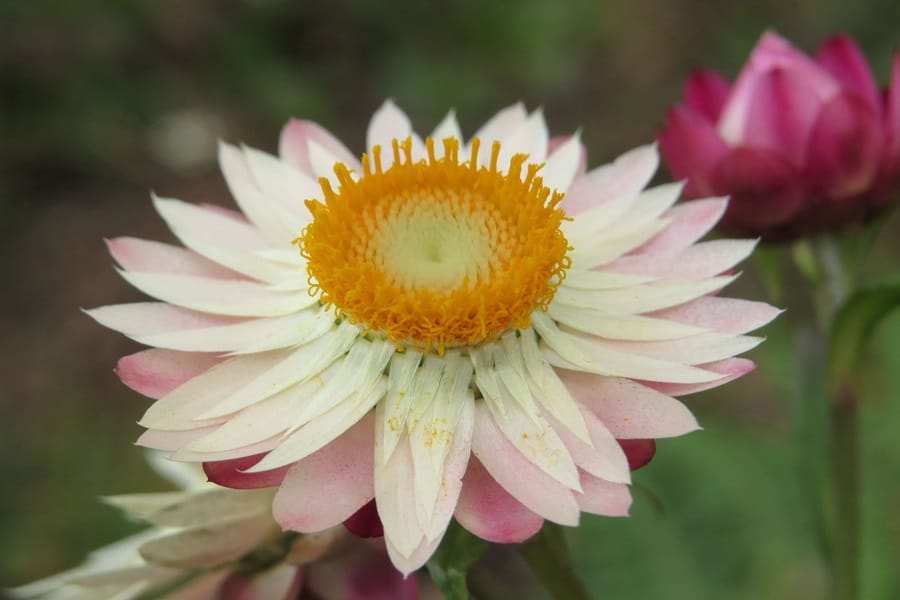
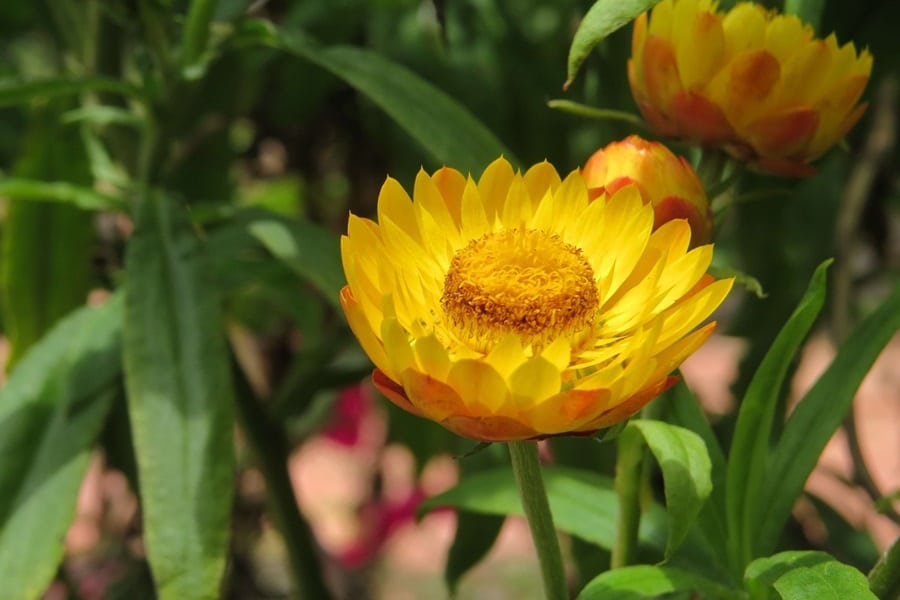
Strawflowers grow quickly and easily in the UK garden, with an upright growth habit and branching stems topped with beautiful blooms around 8cm across, in a wide range of hues.
PROS
- Extremely easy to grow, even for gardening novices.
- Good drought resilience.
- Very varied in their colours and sizes, so they work well in a wide range of ornamental garden displays.
- Abundant blooms from summer into autumn.
- Possibility of self-seeding (especially in a commercial polytunnel where winter wet won’t be an issue).
- Good for cut flowers.
- One of best flowers for dry flower arrangements.
CONS
- A non-native plant (Australian)
- Intolerant of wet/ waterlogged conditions.
- Can get downy mildew, especially in wet conditions, and rot.
- Named varieties do not usually come true from seed.
How to grow strawflower
Strawflower, as mentioned above, is generally very easy to grow, though it will be easiest in the drier regions of the UK and slightly more challenging where conditions are prone to be wettest.
Strawflowers are typically grown from seed, which can be sown directly where the flowers are to grow or earlier, undercover or indoors, in modular trays or small soil blocks, for later hardening off or transplantation.
If you prefer, you can also often purchase some plug plants or ready-grown strawflower seedlings in the spring to plant out into your garden.
Where to grow strawflower
When deciding where to grow strawflower, you need to take the plant’s environmental requirements into account. Strawflowers thrive in a location that is in full sun, with a reasonably fertile and well-drained soil that does not get waterlogged. You could grow strawflowers in a bed or border, or in containers filled with a good quality, peat-free multipurpose potting mix with coarse grit added to improve drainage.
It could be a good idea to grow strawflowers in a cut flower garden, perhaps alongside other flowers that might be used in the same arrangements.
You can also use the plants between shrubs and perennials in your borders to fill in gaps between plants that will remain in the garden over multiple years, and to provide some late summer and early autumn interest.
But perhaps strawflowers are best placed among other sun-loving annuals – perhaps even as companion plants for edible crops? Though not as effectively as some other, especially native plants, these flowers should draw in some pollinators.
If you are a commercial grower, strawflowers might be a good addition for a cut flower or dried flower business, and could be grown on a larger scale in polytunnels or another suitable location for sale to wholesalers and florists, or direct to consumers.
How to plant strawflower
Strawflowers can be planted out in April or May in the UK. Remember to harden off those sown indoors before planting out and keep an eye on the weather forecast.
Dig a planting hole or holes in your chosen location and carefully place the plants into them. As a rough guideline, you should space the plants around 25-30cm apart. Carefully firm the soil back into place around the base of the plants and water them in well.
How to care for strawflower
Strawflowers do not take a great deal of care, but you do need to make sure they have the conditions they require to thrive to see their beautiful blooms.
Light
Strawflowers crave light and need a position in full sun.
Soil
They need a free-draining and reasonably fertile soil or growing medium, ideally one that is neutral to alkaline in pH. When growing in containers, these should be filled with a peat-free multi-purpose potting mix, either one you have purchased or one you have made yourself. Just be sure to add some grit to make sure the mix can drain freely.
Water
Strawflowers are reasonably tolerant of drought and can survive without watering for all but the longest of dry spells. However, you should be sure to water well for a few weeks after planting until they are well established in the growing location you have chosen.
Temperature and Humidity
Strawflowers thrive in temperatures ranging from 18-21 degrees C. during the day and around 15 degrees C. at night. They are not tolerant of frost, making them most suitable for cultivation in warm climates, and they prefer environments with low humidity. As annuals, we grow them over the summer here in the UK.
Fertilizer
Strawflowers growing in a moderately fertile soil will not typically need additional feeding. Those growing in pots or other containers, however, may benefit from the application of an organic liquid plant feed high in potassium every couple of weeks in summer to promote good flowering.
How to propagate strawflower
Strawflowers are typically grown from seed. Seeds should be sown to a depth of around 1cm, and thinned where necessary to leave plants around 15cm apart. Make sure that you use a suitably free-draining seed-starting potting mix.
Remember however that named varieties typically won’t come true from seed, so you may get a range of surprises if you choose to propagate your plants in this way, with offspring that may look very different to the parent plant.
Self seeding is possible though only in areas or locations that do not get too wet in winter, as this leads to low survival rates.
How to harvest strawflower as a cut flower
Ideally, you should aim to harvest the flowers just as they first begin to open. If you wish to use the fresh flowers in a display, it is best to harvest them early in the morning if possible, when they are still holding more water and will last longer.
How to dry strawflowers
Drying the strawflowers to use in dried arrangements, you will cut the flowers, again, just as they begin to open but before they open fully. The flowers will continue to open further during the drying process.
To dry the flowers, remove the lower foliage from the stems and hang them in small bunches upside down, in a cool, dry and dark, well-ventilated space. After around 3 weeks or so the stems should be dry and brittle – take care when handling these dried flower stalks as they can break easily. These flower stems are now ready for you to use in your arrangements.
Pests and diseases
Though when grown in the right location, strawflowers do not often experience problems with pests or diseases, downy mildew and other fungal problems can arise in wet, waterlogged or overly damp conditions and plants can rot.
Strawflower Varieties
Here are some strawflower varieties to consider:
‘Bright Bikini’ – a variety which has been awarded an award of garden merit by the RHS. It has double, everlasting flower-heads, reaching up to 8cm in diameter. These flowers come in various hues including white, yellow, orange, red, and pink, typically blooming during the summer and autumn seasons.
‘Helios Flame’ – This variety features fiery red-orange blooms with golden centres, adding a bold splash of colour to borders and containers. It’s a vigorous grower and performs well in the UK.
‘Monstrosum’ – This variety has fully double flowers in orange, pink, red, and white. These vibrant and impressive blooms are a favourite with crafters.
‘Paper Daisy Mixed’ – This mix includes a variety of colours, from soft pastels to vibrant hues, making it a versatile choice for UK gardens. The flowers are ideal for drying and using in crafts, adding beauty to arrangements long after the growing season has ended.
‘Strawburst Mixed’ – With its large, double flowers in shades of pink, red, orange, and yellow, this variety creates a stunning display. It is easy to grow and tolerant of a range of growing conditions, which means it could be a good choice for beginners.
‘Sundaze Golden Yellow’ – Known for its striking golden-yellow blooms, this variety is a favourite among gardeners for its long-lasting flowers and compact growth habit.
‘Tom Thumb’ – This diminutive strawflower is much shorter in height than most other varieties, meaning that it is a perhaps a good choice for window boxes or container gardens.
Of course, these are just some of the many attractive strawflower varieties that you might consider growing in your polytunnel or elsewhere in your garden.
FAQs
Are strawflowers invasive?
Strawflowers are not native to the UK, but rather Australia, and can self-seed when they are given the right conditions and protected from winter wet. But these flowering plants are not considered to be invasive.
Do you pinch out strawflowers?
Pinching out strawflowers, especially when they’re young, can stimulate them to grow more bushy and produce an abundance of flowers. When you trim off the tips of the stems, it encourages the plant to develop lateral shoots, resulting in a denser, more compact appearance. This practice can also help prevent the plant from becoming overly tall or sprawling.
However, it’s worth mentioning that not all gardeners may feel the need to nip back the growing tips of their strawflowers, as some varieties naturally maintain a compact growth pattern without intervention.
Do strawflowers close at night?
Mature Strawflowers (Xerochrysum bracteatum) nearing the end of their lifecycles sometimes close their blooms at night and on dark, overcast days to preserve their reproductive centres for potential pollinators, though this is not always observed with flowers before they reach peak maturity.
When should I cut strawflowers for drying?
Strawflowers should be harvested when only two to three layers of petals have unfurled and the blooms are still in the process of opening fully. Cutting them at this stage ensures that they retain their shape and integrity during the drying process. If harvested too late, the flowers may become brittle and fall apart while they are drying.
Sources
Geerts, S., (2023) The 15 Best Flowers for Dried Arrangements You Can Grow at Home. Better Homes and Gardens. [online] Available at: https://www.bhg.com/gardening/flowers/best-dried-flowers/ [accessed 26/04/24]