

When planning what to grow in a polytunnel, many gardeners focus on annual fruit and vegetable crops. But a polytunnel or fruit cage can also be beneficial when growing a wide range of perennial plants. Planning a perennial garden bed in your polytunnel can be a great way to increase and diversify the food that you grow.
Why Grow Perennial Plants in Your Polytunnel?
One of the big decisions that new polytunnel growers (and all food-growing polytunnel gardeners for that matter) will need to make is whether to grow annual crops, perennial plants, or a mixture of both. Annual plants are those which are sown fresh each year, while perennial plants will come back or remain year after year.
While you will most likely want to grow at least some annual vegetables, which are usually the produce that we eat include regularly in our diets in the UK, those who are short on time and energy, or simply want to have an easier time of things in their polytunnel, might want to consider growing at least some edible perennials to provide food for many years for far less investment in time and energy.
Perennial plants can:
-
Provide a yield year after year.
-
Require less maintenance and care than annual crops.
-
Provide a higher yield than annual vegetable beds.
-
Be easier to propagate, and do not necessarily have to be grown from seed, meaning that you can obtain a yield from a polytunnel more quickly in some cases.
Types of Perennial Plant To Grow
When planning a perennial garden bed, one of the main decisions that you will have to make is which perennial plants you would like to grow. Which types of perennial plant you wish to include in your garden design will have a bearing on the design of your beds, their size, shape and the composition of the growing medium.
If your main focus is growing your own food, perennial plants for your polytunnel or fruit cages are likely to include:
Fruit Trees
Fruit trees are a staple of many kitchen gardens. While many, such as apple trees, plum trees, cherry trees and pear trees will do well when grown outside and uncovered in most of the UK, providing them with some level of cover to protect them can make it easier to keep them healthy, especially in areas where certain pests or diseases are rife. A polytunnel or fruit cage can be ideal for this purpose.
Other fruit trees, such as, for example, peach trees, apricots, citrus fruits and other warm climate or tropical varieties, will require the protection of a polytunnel (and perhaps even a heated one) in order to thrive.
In most domestic polytunnels, it is likely that any fruit trees you include in your perennial planting scheme will be dwarf varieties. Full sized trees are better grown outside or under netting in a cage. It is important to pay attention to the rootstock of a tree, as this will determine how large it will grow. In addition to determining the rootstock of fruit trees you are considering, you will also need to determine:
-
The best fruit trees and varieties for the soil type and conditions where you live.
-
Whether trees are self-fertile (if not, you will need to plant more than one, choosing cross-pollinating types).
-
How quickly trees will fruit after planting, and how much fruit each will provide.
Fruiting Shrubs & Other Perennial Fruits
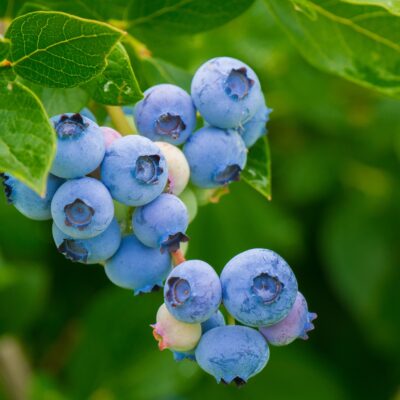
Fruiting shrubs, vines and other perennial fruits such as strawberries are also great plants to grow in a polytunnel or fruit cage. Soft fruits that are great for polytunnel growing include:
-
raspberries (or other similar plants such as Tayberries, boysenberries and wineberries)
-
blackberries (thornless is best)
-
currants (red, black, white or golden)
-
gooseberries
-
grapes
You could also consider growing more unusual fruiting shrubs to supplement your polytunnel-grown diet. More usual fruit bushes for a perennial garden bed include:
-
Gaultheria shallon
-
Goumi
-
Autumn olives
-
Chokeberries
-
Barberries
When selecting fruiting canes, shrubs and vines for your polytunnel, it can be helpful to think about what other benefits each of the plants you choose can offer. For example, goumi and autumn olives both also fix nitrogen, for the benefit of plants grown nearby, while grape vines and other plants can provide useful shade to their neighbours during the summer months.
You may be able to successfully grow most if not all of the above options, and many more, outside in your garden. However, growing under cover can make it easier to protect your crop from birds and other pests who can often take the fruit before you can.
Perennial Vegetables
In addition to considering well-known fruit trees and fruiting shrubs for your perennial garden beds, you could also consider planting some perennial vegetables. Perennial vegetables such as rhubarb, globe artichokes and asparagus are well known. What is less well known is that there are also a range of other perennial vegetables to choose from.
For example, there are a range of perennial greens, such as:
-
Daubenton’s kale
-
Nine star perennial broccoli
-
Ewiger kohl
-
Sea kale
-
Good King Henry
There are also a number of perennial members of the onion family.
When well cared for, such plants can continue to provide a yield year after year.
Perennial Herbs
Perennial herbs are other beneficial additions to any polytunnel garden. You can create a dedicated herb garden for perennial herbs, or scatter herbs throughout other annual or perennial garden beds. There are a wide range of perennial herbs that you could grow.
Growing herbs, wherever you choose to place them, will not only provide you with culinary or medicinal herbs. It will also help you to create a thriving polytunnel ecosystem, in which the natural balance is maintained. This is one of the most important elements in natural pest control.
When choosing which perennial herbs to grow, it is important to consider not only how you will use the herbs, but also how they can benefit the garden as a whole. Check out our articles on growing and using herbs to find out more.
Creating Perennial Polycultures
As well as considering which perennials you would like to grow in your polytunnel or fruit cage, it can also be helpful to think about a perennial system as a whole. When selecting your plants, it is important to consider the beneficial interactions that can be created between them.
Creating polycultures has a number of different names. Sometimes it is simply called ‘companion planting’. When choosing companions for a fruit tree, it is often referred to as ‘creating a guild’, while creating a fully-fledged perennial garden system is sometimes called ‘creating a forest garden’.
Any of the perennial plants mentioned above could form part of a perennial garden bed polyculture. A polyculture could be a polytunnel bed containing perennial vegetables and herbs, or a more complex perennial system encompassing a fruit tree and fruiting shrubs underplanted with a range of perennial herbs, vegetables, and perhaps also some flowers.
When creating a perennial polyculture it is important to consider:
-
The needs of the individual plants in the system. (Their inputs, outputs and characteristics.)
-
The environmental benefits one plant could provide to its neighbours. (Ie. shade, ground cover to reduce water loss from the soil.)
-
Pest control advantages afforded by certain plants (such as herbs, flowers or alliums).
-
How certain plants can dynamically gather nutrients for the system.
-
How some plants can attract and encourage beneficial wildlife.
In addition to determining which plants to grow together, you should also consider (thinking about the needs of individual plants) where your perennial garden bed should go. For example, will you grow in raised beds, in containers, or directly in the soil.
Maintaining a Perennial Garden Bed
The best way to make sure that your perennial plants continue to produce a yield year after year is to take care of the soil (or growing medium) and maintain fertility levels over time. Unlike annual fruits and vegetables, perennial plants will not be moved from one location to another in a crop rotation plan.
This means that taking care of fertility is one of the most important things in a perennial polytunnel garden. It will help ensure the sustainability of your perennial garden bed. Mulching is one of the most important activities in an organic garden – the corner-stay of ‘no-dig’ gardening.
You can find plenty of information about mulching elsewhere on this site. You can create your own organic mulches using compost and other organic materials. You can also create your own home-made liquid plant feeds to give perennial plants a boost.
Take care of the watering needs and other basic requirements of your perennial plants and you can create a thriving edible garden that will produce food year after year.
Do you have a perennial garden bed in your polytunnel or elsewhere in your garden? Share what you grow, and your tips and suggestions for sustainable success, in the comments below.