

There are many different types of daisies to grow in a garden in the UK. A number of flowering plants are colloquially referred to as ‘daisies’ and one of these are Livingstone daisies, Cleretum bellidiforme. These are sometimes also referred to as mesembryanthemums though they are no longer usually included as members of that genus.
Cleretum bellidiforme, commonly known as Livingstone daisy, is a flowering plant species belonging to the Aizoaceae family. Native to the Cape Peninsula in South Africa, it is a low-growing succulent annual that typically reaches heights of up to 25 cm.
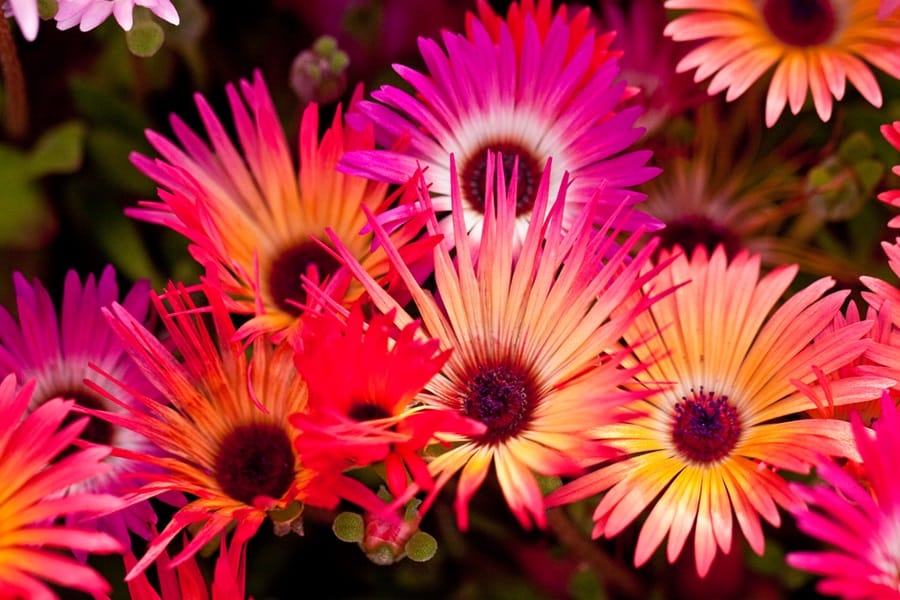
These succulent annuals may be a good choice for dry, well-drained, sun-baked southern gardens, and can also work well when grown in containers. They have daisy-like flowers which come in a wide range of pink, purple, cream, orange and yellow hues.
| JAN | FEB | MAR | APR | MAY | JUN | JUL | AUG | SEP | OCT | NOV | DEC | |
| SOW | ✅ | ✅ | ✅ | |||||||||
| PLANT | ✅ | ✅ |
Advice on Buying Livingstone Daisies
When purchasing Livingstone daisies, look for healthy plants with vibrant foliage and abundant blooms. Choose plants that are well-established in their pots, with roots that are not root-bound. Check for any signs of stress, such as wilting or yellowing leaves, which could indicate poor health.
Buy from reputable nurseries or garden centres in order to ensure you receive good quality plants free from pests or diseases.
You can if you wish purchase seeds rather than plants. These plants can be grown from seed sown at temperatures between 16 and 19 degrees C. in the late winter or in the spring.
Where to Grow Livingstone Daisies
They prefer full sunlight, so choose a location in your garden that receives direct sunlight for most of the day. Livingstone daisies are tolerant of coastal conditions, making them suitable for gardens near the sea.
They also do well in rock gardens, containers, or as ground cover in sunny borders. Ensure the soil is not waterlogged, as they are susceptible to root rot. In colder regions, consider planting them in containers that can be moved indoors during winter or provide frost protection.
Livingstone daisies like similar conditions to a range of Mediterranean herbs and flowers, and of course will also thrive alongside other South African plants that share the same or similar habitats within their native range. In the native areas, these flowers sometimes grow alongside low-growing Oxalis and Senecio species.
How To Grow Livingstone Daisies
These plants are relatively easy to grow as long as you provide them with the right growing conditions and once established, will typically require little care.
Livingstone daisies are usually purchased and introduced as bedding plants for the summer, but they can also be grown from seed sown in the spring.
Soil
One of the most important things to remember when it comes to placement and care is that these plants cannot tolerate damp or waterlogged conditions. They require a soil or growing medium in pots that is free-draining. They thrive in a low-fertility soil.
If you have a heavy clay soil where you live, choose other daisies or grow these plants in containers. In higher rainfall areas, consider growing these daisies undercover in a greenhouse or polytunnel.
Position
A position in full sun is essential for these plants, and you may find that they do best in a position with a south facing aspect, where they get the heat and light that they require.
Frost Tolerant?
Livingstone daisies have a hardiness rating of H3. This means that they are winter hardy in coastal and relatively mild parts of the UK and can cope with winter temperatures that drop to -5 to 1 degree C. They are annuals in the UK and will remain in the garden only during a single growing season.
Feeding
These are not plants that will require any feeding when they are grown in raised beds or in the ground and they thrive in low-fertility conditions. Even in containers, feeding will not generally be needed, but occasionally, where growth is poor, container grown plants may benefit from occasional feeding with a dilute, organic liquid plant feed.
Spacing
As a general rule of thumb, Livingstone daisies should be spaced approximately 15 to 30 centimetres apart when planting them in the garden.
This spacing allows enough room for the plants to spread and grow without overcrowding, ensuring good air circulation and reducing the risk of disease.
However, if you’re planting them in containers or pots, you can space them a bit closer together, around 10 to 15 centimetres apart.
Maintenance of Livingstone Daisies
Though Livingstone daisies are relatively drought tolerant, and in the ground rarely require watering since natural rainfall will be more than sufficient.
Undercover or when growing in containers, however, it is best to water moderately but regularly, keeping the soil evenly moist but not waterlogged. When watering, water at the base of the plant to avoid wetting the foliage, which can lead to disease.
Trim back any leggy or straggly growth to maintain a compact, tidy appearance. You can also trim the plants lightly after flowering to encourage bushier growth. Remove spent flowers regularly to encourage continuous blooming throughout the growing season.
Pests and Disease Problems for Livingstone Daisies
Monitor your Livingstone daisies carefully, look out for pests such as aphids or slugs, and work to boost biodiversity in your garden to ensure a natural balance and lessen pest problems. Ensure good air circulation around the plants to prevent fungal diseases like powdery mildew.
Propagating Livingstone Daisies
Cleretum bellidiforme, commonly known as Livingstone daisy, can be propagated through several methods. One common method is by collecting seeds from mature flower heads and sowing them in well-draining soil in spring after the last frost. Seeds should be lightly covered with soil or growing medium and kept moist until germination, which typically takes 7-14 days at 16 to 19 degrees C..
Another propagation method is by taking softwood cuttings from the stems of healthy plants in spring or summer. Cuttings should be planted in a well-draining rooting medium and kept consistently moist until roots develop.
How to Prune Livingstone Daisies
Trim back any leggy or straggly growth to maintain a compact, tidy appearance. You can also trim the plants lightly after flowering in order to encourage bushier growth. Though pruning is not often required at all with these low-growing, mat-forming groundcover plants.
Troubleshooting
The most common issues with Livingstone daisies arise due to problems relating to water, or sunlight. When troubleshooting any issues, look first at these things and other features of the environmental conditions.
Make sure that the soil is well-drained and that excess water can drain away freely, but make sure, too, that the soil remains evenly moist throughout especially hot and dry periods.
Also, ensure that the plants are in full sun and are receiving at least 6-8 hours of sunlight per day, or they will not tend to bloom well.
Uses for Livingstone Daisy
Livingstone daisies, also known as Cleretum bellidiforme, are commonly used as colourful additions to gardens and containers, providing vibrant blooms in shades of pink, purple, orange, white, and yellow.
They make excellent ground covers, adding a splash of colour to rock gardens, borders, and slopes. So they can be very useful where rainfall is limited over the summer months and drought-tolerant plants are required.
Additionally, Livingstone daisies are often used in hanging baskets and mixed planters to create compact cascades of flowers. In such a setting, of course, their drought-tolerance also comes in handy and you will need to water them less frequently than many other plants.
Due to their tolerance of coastal conditions, they are also suitable for seaside gardens and they can cope well even when there are exposed conditions as long as the temperatures are sufficiently mild and the soil suitably free-draining.
Livingstone Daisy Related Species
Cleretum bellidiforme, commonly known as the Livingstone daisy, belongs to the family Aizoaceae, which includes several other genera and species. Some related species within the Aizoaceae family include:
- Dorotheanthus bellidiformis: Also known as Livingstone daisy or ice plant, this species is closely related to Cleretum bellidiforme and is often grown as an annual in gardens.
- Lampranthus spp.: This genus includes numerous species of succulent plants known for their bright, daisy-like flowers. They are often grown as ground covers or in rock gardens.
- Delosperma spp.: Commonly known as ice plants, Delosperma species are low-growing succulents, also with daisy-like flowers. They are valued for their ability to tolerate hot, dry conditions.
- Mesembryanthemum spp.: This genus includes a variety of flowering plants native to southern Africa. They are also commonly cultivated for their flowers and drought tolerance.
- Conophytum spp.: These small, low-growing succulents are known as living stones or pebble plants. They are valued for their unique appearance and are often grown in rock gardens or succulent collections.
Livingstone Daisy Varieties
In the UK, there are several named varieties of Livingstone daisies to consider. Some popular varieties include:
- ‘Peach Star’: This variety produces stunning peach-hued flowers with white centres, adding a soft and delicate touch to garden beds and containers.
- ‘Giant Mixed’: As the name suggests, this variety produces large blooms in a mix of vibrant colours, including shades of pink, purple, orange, and yellow. This variety might be perfect for adding a bold splash of colour to your garden.
- ‘Sunset Mix’: This mix features flowers in warm sunset hues, such as oranges, yellows, and reds, creating a vibrant and cheerful display.
- ‘Purple Sun’: With its striking purple blooms and contrasting yellow centres, ‘Purple Sun’ adds a dramatic flair to garden borders and rockeries.
- ‘Yellow Glow’: This variety features bright yellow flowers that radiate warmth and cheerfulness, making it an excellent choice for sunny borders and containers.
Can You Grow Livingstone Daisies in a Polytunnel?
Yes, you can grow Livingstone daisies in a polytunnel. In fact, this can be a good choice where rainfall levels are higher since the polytunnel can provide the optimal free-draining growing conditions that these flowering plants require. Are you new to polytunnels, and only have a small garden? Try our mini polytunnels or domestic polytunnels to start off your journey in style.
FAQs
Do Livingstone daisies come back every year?
Livingstone daisies are commonly regarded as annuals, requiring replanting each season as they do not return year after year.
When should Livingstone daisies be planted?
Livingstone daisies should be planted out after the last frost date in your area, typically in late spring or in early summer.
Do you deadhead Livingstone daisies?
Deadheading Livingstone daisies can be a good idea because this will encourage further blooms to form and extend the flowering period.
Is Livingstone Daisy a perennial or annual?
Livingstone daisy is an annual succulent plant and so will complete its lifecycle in a single season rather than remaining in place in a garden over multiple years. It is commonly grown as a half-hardy summer season annual bedding plant in the UK and in other temperate climate regions.
Sources
Cooper, M., (2024) 13 Types of Daisy Flowers to Brighten Your Garden. Love To Know. [online] Available at: https://www.lovetoknow.com/home/garden/types-daisies [accessed 22/05/24]