

There is no single insect-proof mesh size that will keep out every garden pest. The right aperture depends on the size of the insect you are trying to exclude.
But I would not start with mesh, as this alone is not the best strategy for pest management in a regenerative organic garden.
In a healthy garden, insect-proof mesh is best thought of as one tool among many. Before reaching for a physical barrier, it is worth looking at the growing conditions, the health of the plants, the diversity of the garden and whether natural predators are already keeping a pest population in balance.
Sometimes a little damage is simply part of gardening. At other times, a particular pest can seriously affect a crop, and a well-chosen barrier is a sensible form of protection.
The aim, then, is not to exclude every insect from the garden. It is to protect vulnerable crops when protection is genuinely useful, while leaving room for the wider garden ecosystem to function.
Key points
- Start by identifying the pest rather than automatically choosing the finest mesh.
- Use healthy soil, crop diversity, rotation, good growing conditions and natural predators as your first line of defense.
- Use insect-proof mesh as a targeted physical barrier when a particular pest warrants it.
- Finer mesh excludes smaller insects but can restrict airflow and increase humidity.
- Secure the barrier properly and consider pollination before covering flowering crops.
Start With Integrated Pest Management
Regenerative gardening is not about creating a garden where no insect ever eats a leaf.
In fact, that would be an impossible goal, and probably not a particularly healthy one either.
Gardens are living systems. They contain plants, fungi, bacteria, insects, birds and countless other organisms, and many of those relationships are useful. Aphids, for example, are food for ladybirds and their larvae, hoverfly larvae and other predators. A garden with plenty of habitat and plant diversity can support those natural controls.
I always recommend an integrated approach to pest management, using cultural and biological methods alongside physical barriers where appropriate, while accepting some level of plant damage.
Insect-proof mesh is not about trying to sterilise a growing space. It is about protecting a particular crop from a particular problem.
What is insect-proof mesh and how does it work?
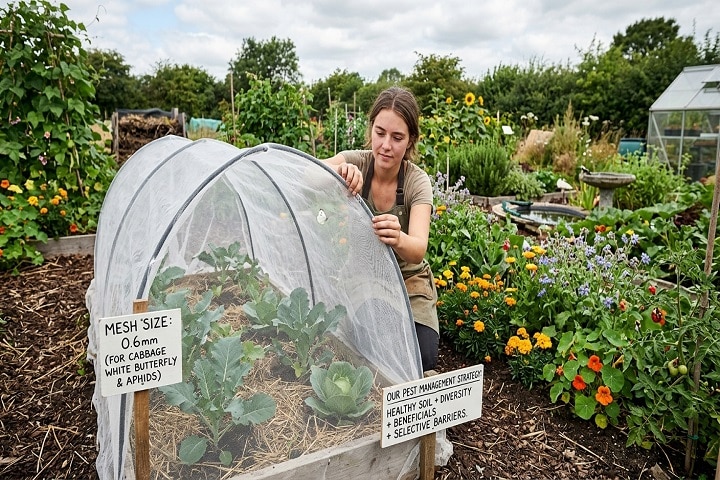
Insect-proof mesh is a physical barrier between your crops and insects that might feed on them or lay eggs on them.
The critical measurement is the aperture, or size of the openings in the mesh. Smaller insects require smaller openings if you want to exclude them.
This is why “insect-proof” is not really enough information on its own. A mesh that stops a larger flying pest may still allow a much smaller insect through.
It is also worth checking the stated aperture rather than relying only on a mesh-count number. The actual opening tells you more about what the barrier is capable of excluding.
And there is a useful distinction between insect mesh and larger-hole netting used for fruit cages or bird protection. Those barriers have their own purposes and should not be treated as interchangeable.
What mesh size do you need for common garden pests?
The RHS gives four useful mesh ranges:
| Mesh aperture | Broad use | Pest examples |
|---|---|---|
| 4 to 7 mm | Butterfly and larger-pest netting | White butterflies and larger pests |
| 1.3 to 1.4 mm | Standard insect-proof mesh | Carrot fly, cabbage root fly, onion fly, bean seed fly |
| 0.8 mm | Fine insect mesh | Flea beetles, leaf miners, aphids and whitefly |
| 0.3 to 0.6 mm | Ultrafine mesh | Very small pests such as thrips |
These are useful guidance ranges rather than guarantees for every pest or every product. Pest size varies, and the effectiveness of a barrier also depends on how well it has been installed.
For many common vegetable pests, 1.3 to 1.4 mm mesh provides a useful starting point. Smaller pests may require around 0.8 mm, while ultrafine mesh around 0.3 to 0.6 mm is more appropriate for very small insects such as thrips.
If carrot fly is a recurring problem, for example, targeted exclusion can be a much more sensible approach than trying to protect every crop in the garden. You can prevent carrot fly infestations in a polytunnel with physical exclusion as part of a wider pest-management strategy.
The important thing is to identify the pest before choosing the barrier.
Standard, fine or ultrafine mesh?
It can be tempting to assume that finer must always mean better.
I would not approach it that way.
The smaller the opening, the smaller the insect you can potentially exclude. But finer mesh can also restrict airflow and increase temperature and humidity beneath the covering.
So I would ask:
- What pest am I actually trying to exclude?
- Is the problem serious enough to justify a physical barrier?
- What aperture is appropriate?
- Does the crop need good airflow?
- Does it need insect pollination?
- Can I secure the mesh properly?
That usually leads to a more useful answer than simply buying the finest mesh available.
Think about the garden before you cover the crop
A regenerative approach asks us to look for the cause and context of a problem rather than treating every insect as an enemy. These approaches can sometimes prevent a pest problem without requiring a physical barrier at all.
Healthy plants are generally better able to withstand pest and disease pressures, while diverse gardens can provide habitat for beneficial organisms.
This does not mean that mesh is somehow less natural or should never be used. Quite the opposite. A physical barrier can be a very targeted way of protecting a crop without affecting insects elsewhere in the garden.
The key is targeted protection rather than blanket exclusion.
How to install insect-proof mesh effectively
Once you have decided that mesh is appropriate, installation matters enormously.
There is little point choosing a suitably fine mesh if insects can simply walk underneath it.
Installation checklist
- Secure the mesh around the entire perimeter.
- Check carefully for gaps at ground level.
- Secure joins and openings.
- Support the mesh so it does not collapse onto the crop.
- Leave enough slack for plants to grow.
- Check regularly for tears and damage.
- Keep the mesh from resting directly on foliage where possible.
There is also a wildlife consideration. Loose netting can cause problems for birds and other animals, so barriers should be properly secured and managed rather than left hanging around the garden.
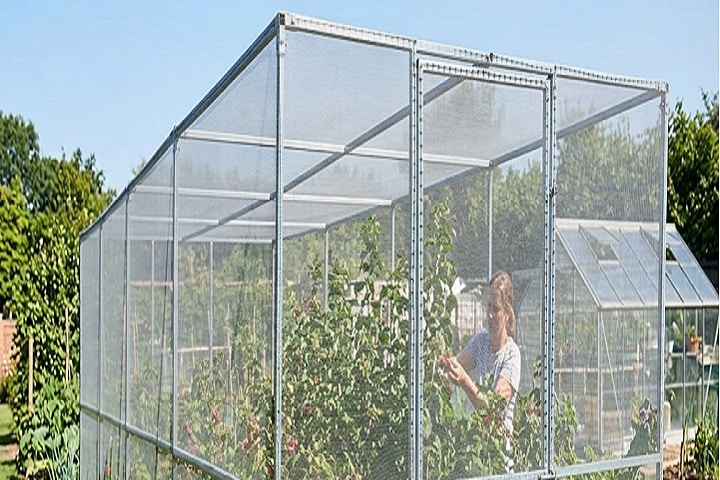
If you are protecting fruit or crops where a larger physical structure is more appropriate, you can protect crops with rigid fruit cage netting.
What are the downsides of finer mesh?
Finer mesh has an obvious benefit: it can exclude smaller insects.
But there are costs.
Less airflow
Small openings create a more restrictive barrier. This can matter in a polytunnel or other protected growing environment.
Greater humidity
Reduced air movement can contribute to warmer and more humid conditions. That is not necessarily helpful for every crop.
More management
Mesh is not a fit-and-forget solution. Plants need space to grow, beds need weeding, and the covering may need to be lifted periodically. Every time the barrier is opened, there is an opportunity for pests to enter.
Pollination
Some crops need insect pollination. Strawberries and courgettes, for example, are not well suited to remaining under insect-proof mesh throughout their flowering period.
So before covering a flowering crop, think about how it will be pollinated. The answer may be to remove or adjust the mesh at the appropriate stage rather than keeping the barrier in place continuously.
When should you use insect-proof mesh?
Ideally, mesh should be used before a pest establishes itself on the crop.
There is little value in creating a beautifully sealed barrier around a plant if the insects you are trying to exclude are already inside it.
This is particularly important with pests that lay eggs on or near the crop. Prevention is often much easier than trying to deal with an established population later.
But preventative does not mean permanent.
Keep checking the plants beneath the mesh. Look for signs of damage, monitor whether the barrier is still secure, and consider whether it is still needed as the crop develops.
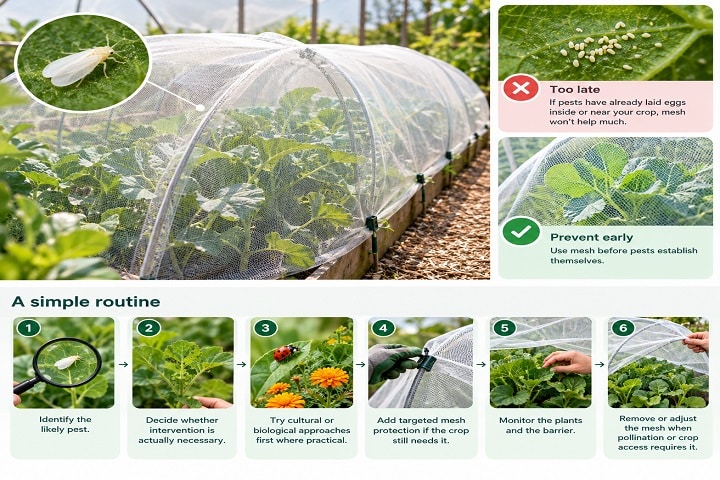
A simple routine is:
- Identify the likely pest.
- Decide whether intervention is actually necessary.
- Try cultural or biological approaches first where practical.
- Add targeted mesh protection if the crop still needs it.
- Monitor the plants and the barrier.
- Remove or adjust the mesh when pollination or crop access requires it.
A regenerative approach to pest protection
For me, the most useful way to think about insect-proof mesh is as a last line of physical protection, not the starting point.
That does not mean waiting until a crop is devastated. It means paying attention early and using the least disruptive intervention that is likely to work.
A healthy garden should contain insects. It should also contain predators, pollinators, decomposers and a diversity of plants that supports those relationships.
Sometimes a few holes in a leaf really do not matter.
Sometimes a particular pest can make growing a crop almost impossible without some protection. Carrot fly, for example, is a good candidate for targeted physical exclusion, and the RHS notes that insect-proof mesh can be more appropriate for some root-feeding pests than pesticide use.
The important distinction is between protecting a crop and excluding nature.
We can do the first without trying to do the second.
If you want to understand the wider range of approaches, you can learn more about common garden pests and how to deter them before deciding whether mesh is necessary.
Quick guide: choosing the right insect-proof mesh
| Mesh type | Approximate aperture | Useful for | Main consideration |
|---|---|---|---|
| Standard | 1.3 to 1.4 mm | Common flying vegetable pests | Will not exclude the smallest insects |
| Fine | 0.8 mm | Smaller insects | Greater restriction of airflow |
| Ultrafine | 0.3 to 0.6 mm | Very small pests | Greater potential effect on airflow and humidity |
But before buying anything, ask one final question:
Do I actually need a mesh barrier for this problem?
If better soil, healthier plants, crop rotation, greater plant diversity, natural predators or a change in timing can solve the problem, those approaches may be more in keeping with a resilient, regenerative garden.
Where they cannot, targeted mesh can be an extremely useful tool.
If you need a larger crop-protection structure, you can find fruit cages for protecting your crops as another option.
Conclusion
Insect-proof mesh has a useful place in the garden, but it does not need to be the first response to every pest. Start by understanding the problem and supporting healthy plants, living soil and garden biodiversity. If a particular pest still threatens a crop, choose a mesh aperture suited to that insect and install it carefully.
The best barrier is not necessarily the finest one. It is the one that solves the problem while allowing the rest of the garden to keep doing what a healthy garden does.
Frequently Asked Questions
What mesh size keeps out aphids?
The RHS identifies 0.8 mm fine mesh as suitable for smaller pests including aphids. Effectiveness also depends on how securely the barrier is installed.
What mesh size keeps out carrot fly?
The RHS identifies 1.3 to 1.4 mm standard insect-proof mesh as suitable for carrot fly.
What mesh size keeps out flea beetles?
The RHS identifies around 0.8 mm fine mesh as suitable for flea beetles, while ultrafine mesh can provide protection against very small invertebrates.
Can insects get through insect-proof mesh?
Yes. The effectiveness depends on the insect’s size, the aperture of the mesh and how securely the barrier has been installed.
Does insect-proof mesh reduce airflow?
Finer mesh can restrict airflow and increase temperature and humidity beneath the covering. This is one reason not to automatically choose the finest mesh available.
Can crops be pollinated while covered with insect-proof mesh?
It depends on the crop. Insect-pollinated crops may need access to pollinators during flowering, so mesh may need to be removed or adjusted. The RHS specifically identifies strawberries and courgettes as crops for which insect-proof mesh is unsuitable during flowering.
SOURCES
Royal Horticultural Society (RHS) (n.d.) Insect-proof mesh. RHS. Available at: https://www.rhs.org.uk/prevention-protection/insect-proof-mesh (Accessed: 25 August 2026).