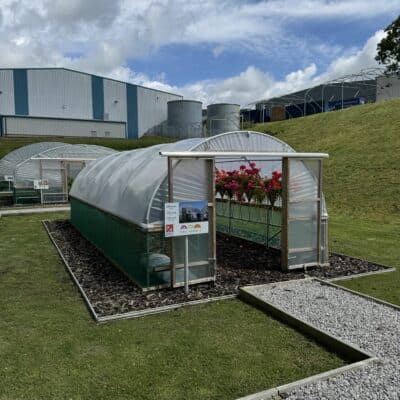


Here in the UK, we may initially welcome a heat wave of hot summer weather. But a heat wave can wreak havoc on your crops. Especially if they are growing undercover in a polytunnel. Of course, when the weather outside is warm, inside a polytunnel temperatures can quickly become stifling.
Heat waves can make it difficult to work inside a polytunnel. But more importantly, it can pose a threat to your plants. Remember, we can dive out quickly when temperatures become too much – but plants can’t!
Most common polytunnel crops require temperatures within a certain range. When temperatures inside the polytunnel soar to more than around 35 degrees C., you may well begin to see a range of problems. Wilting plants can sometimes recover when temperatures come back down. But in extreme conditions, plants can really suffer and some may even succumb.
If you are not prepared, and you don’t take steps to deal with the heat, there way well be some casualties. So how do you deal with a heat wave in your polytunnel garden? Read on for some tips.
1. Plan Your Planting Appropriately for the Summer Heat Wave Months
First of all, preparation and good planning are essential to avoid problems when temperatures become extreme. As temperatures globally continue to rise, it is likely that most of us will have hotter summers over the coming years. This is certainly something to consider when it comes to choosing which plants (and which cultivars) to grow in your polytunnel.
Heat and watering obviously go hand in hand, so you should think about choosing those with lower water requirements for the period when you expect higher temperatures.
Another important factor is how you combine various different plants. Think about tall or vining plants that might provide shade for leafy lettuces, spinach and other crops that might bolt in higher temperatures. Plant shade could be crucial during a heat wave.
2. Make Sure Plants Are Not Overcrowded – Stay on Top of Weeds
Companion planting can be key to success in a polytunnel garden. But be careful not to overcrowd the plants within your polycultures. Growing areas should be planned carefully to fill the space without overcrowding. Sometimes this is a delicate balancing act.
In high temperatures, overcrowding can sometimes stress plants, and could increase the incidence of disease and pest problems. Make sure you stay on top of weeds too. While weeds are not always an issue – they can become one when they outcompete your crops, or harbour or attract pests.
The more you can do to keep your plants strong and healthy, the more likely they are to survive the heat.
3. Make Sure You Mulch Around Your Plants During a Heat Wave
Mulching is always a good strategy. But it is especially important when hot weather is forecast and during a heat wave. A thick layer of organic mulch around your fruits, vegetables etc. can help to add slow release fertilizer. As it breaks down, it will add nutrients to your growing areas. This is another way to keep plants as healthy and strong as possible.
Crucially, this will also help retain moisture – so the soil in your beds and other growing areas won’t dry out so quickly. And watering needs will be reduced in your polytunnel.
4. Increase the Amount of Water You Provide During a Heat Wave
This might sound obvious, but many gardeners forget just how much different temperature makes to the water needs of a range of plants. Make sure you water as often as is needed – making sure you know which plants need most water, and which need the least.
It is also very important to make sure that you deliver the water to where it is needed – around the roots. Watering from above can mean less water gets where it needs to be. And watering foliage can also scald leaves – especially during very hot and sunny weather.
5. Consider Adding Automated Irrigation if You Don’t Have it Already
In a heat wave, you might even find that certain plants in a polytunnel need to be watered more than once a day! It can be difficult to keep up with watering if you are doing it all by hand. If you don’t already have it installed, it might be a good idea to consider polytunnel irrigation.
But there are also other measures you might take to make your life easier. For example, you might sink pots into the soil at the base of plants so you can water into those vessels to make sure plants roots really get access to the water they need. You could consider clay pot irrigation too. Or you could use watering globes (or bottles that serve the same function), to give plants water slowly as it is required.
6. Make Sure You’re Ventilating as Much as Possible
How much ventilation there is in your polytunnel will depend on its features. Some polytunnel designs allow for you to open up vents and increase ventilation when the weather gets really warm. At the very least, make sure doors are open at both ends of the tunnel, to let the air flow through.
Thinning and judicious pruning can also help to improve circulation and air flow in your polytunnel. So where things are looking a little congested, get in there to clean things up a little. Make sure you stay tidy too – don’t leave tools or pots lying around which may impede air flow through your polytunnel.
7. Consider a Solar Powered Fan For Better Air Flow in a Heat Wave
If your polytunnel really is stifling, you might want to consider investing in an eco-friendly solar-powered fan to improve air flow. By integrating a fan with a box filled with damp cloth/ material, you might also be able to try evaporative cooling. There are a range of different DIY solutions to help you make your own simple polytunnel AC.
8. Add Thermal Mass To Regulate Temperatures
Another way to help make sure that temperatures don’t get out of control is to work to improve temperature regulation in your polytunnel. Using the principles of passive solar design, you can keep temperatures in your polytunnel more stable.
Materials with good thermal mass (which are good at catching and storing heat energy from the sun) are great for temperature regulation. These materials like, for example containers filled with water, stone, brick and clay, catch heat during the day, keeping the air cooler, then release it slowly at night when temperatures fall.
9. Damp Down Hard Surfaces To Bring Heat Wave Temperatures Down
Another tip to help you deal with a heat wave in your polytunnel involves increasing humidity. Damp down your paths, staging or other hard surfaces with water. As the water evaporates, this will have a cooling effect on the space.
10. In Extreme Conditions, Consider Excluding Sunlight During the Hottest Part of the Day
If you have tried lots of the above but are still finding that your polytunnel gets too hot during a heat wave, you could potentially consider adding shade netting to exclude sunlight during the hottest part of the day. You could use shade cover to exclude sunlight from all of your polytunnel, or use it selectively to protect certain plants within the space.
These are just some of the things you can do to deal with a heat wave in your polytunnel. But remember, it is always better to prepare and plan for a problem rather than trying to tackle it once it has arrived.
If you are considering getting a polytunnel, remember that where you position it will have a bearing on how hot it gets. How well it will do and how much you can grow will depend on a range of environmental factors.
For example, it is very important to think about sunlight, and how it falls on the polytunnel each day and throughout each year. The orientation and position of your polytunnel should also be decided with reference to wind, to the surrounding landscape, and to any plants or structures nearby. Remember, there are different polytunnel covers which should be chosen for different circumstances too.
Have you had issues with your polytunnel during a heat wave? How did you deal with it where you live? Share your comments, tips and suggestions for other readers below.