


Wind is one of the most underestimated challenges in UK gardens. It dries soil, damages plants, and disrupts growth in ways that aren’t always immediately visible. While windbreak netting is often seen as a quick fix, it’s rarely the best long-term solution on its own.
In this guide, I’ll walk through practical, proven garden windbreak ideas, explain how wind really behaves, and help you choose solutions that work with nature, not against it.
For a deeper dive into practical setups, explore the best windy garden solutions.
Key Takeaways
- Wind reduces yields by drying soil and stressing plants
- Slowing wind is more effective than blocking it completely
- No single solution works everywhere – context matters
- Layering windbreaks gives the best results
- Living windbreaks outperform artificial ones over time
Why Wind Protection Matters in the Garden

When thinking about wind protection for plants, it helps to understand what wind is actually doing in your space.
Wind doesn’t just “blow”, it disrupts your entire growing system:
- Moisture loss
Wind strips moisture from leaves and soil, increasing watering needs
- Physical damage
Plants bend, snap, or develop weak stems
- Reduced pollination
Pollinators struggle in exposed areas
- Slower growth
Plants divert energy into survival rather than productivity
- Lower yields
Stressed plants produce less — and often poorer-quality crops
The microclimate effect

A well-designed windbreak creates a calmer, warmer microclimate. Even a small reduction in wind speed can:
- Increase soil temperature
- Improve germination rates
- Extend the growing season
Blocking vs slowing wind
This is where many gardeners go wrong:
- Blocking wind completely – creates turbulence and stronger gusts behind the barrier
- Slowing wind gradually – protects plants over a wider area
What Makes an Effective Garden Windbreak?
Not all windbreaks are equal. The most effective ones share a few key traits:
- Permeability matters most
Aim for around 40–50% airflow. This reduces wind speed without creating damaging turbulence
- Avoid solid barriers
Solid fences deflect wind upwards and create swirling gusts behind them
- Height determines coverage
A windbreak protects an area up to 5–10 times its height downwind
- Position is critical
Always place windbreaks on the windward side (where wind comes from)
- Think in layers
Multiple living barriers at different heights work better than one single structure.
Living Windbreak Ideas (Natural Solutions)
From a sustainable, nature-first, permaculture perspective, living windbreaks are always the most resilient and beneficial option. They do not just protect, they actively improve your garden ecosystem.
Best natural windbreak options:
- Hedges (evergreen vs deciduous): Evergreen: year-round protection
- Deciduous: seasonal filtering, more light in winter
- Dense shrubs
Great for lower-level wind protection around beds
- Trees (for larger spaces)
Create long-term shelter and habitat
- Shelterbelts (layered planting)
A mix of trees, shrubs, and ground cover for maximum effect
Creating a windbreak hedge is one of the most effective long-term strategies for reducing exposure, but success comes down to thoughtful design rather than simply planting a row of shrubs. I always start by observing the prevailing wind direction and planting on the windward side, allowing enough space for the hedge to mature.
A staggered, double-row planting works far better than a single line. It creates density at different heights and improves airflow filtration. Mixing species is key too. Combining evergreens for year-round shelter with deciduous plants for seasonal light creates a more balanced, adaptable barrier that works with the changing conditions throughout the year.
Establishment is where patience pays off. Preparing the soil well, mulching well, and watering consistently in the first year helps young plants root deeply and grow faster.
Spacing should allow each plant to develop fully since overcrowding leads to weak growth and gaps later on.
Light pruning in the early stages encourages bushier, denser growth at the base, which is exactly where wind protection is most needed. Over time, a well-planned hedge becomes more than just a windbreak. It forms a living boundary that supports biodiversity, stabilises the microclimate, and quietly strengthens the entire garden system.
Why living windbreaks work best:
From a permaculture perspective, living windbreaks aren’t just barriers, they are active, evolving systems that improve your garden year after year.
Pros:
- Improve soil health
Living windbreaks slow wind at ground level, reducing soil erosion and moisture loss. Over time, leaf litter and root activity build organic matter, improving soil structure and fertility naturally.
- Support wildlife and pollinators
A mixed hedge or shelterbelt creates habitat for birds, insects, and beneficial predators. This leads to better pollination and natural pest control, something no artificial barrier can provide.
- Maintains wildlife corridors: Living windbreaks allow wildlife to move freely through the landscape, rather than blocking or trapping them. Birds, hedgehogs, and beneficial insects can pass through or shelter within the planting, helping to connect habitats between neighbouring gardens. This continuity is vital for biodiversity, supporting natural feeding, nesting, and migration patterns while keeping your garden part of a wider, healthy ecosystem.
- Self-repairing and long-lasting
Unlike fencing or netting that degrades, plants grow stronger with time. If damaged, they regrow. With the right species mix, a living windbreak can last decades with minimal intervention.
- Naturally permeable
The varied structure of leaves, stems, and branches creates ideal airflow. Wind is filtered and slowed gradually, avoiding the turbulence caused by solid or uniform materials.
Cons:
- Take time to establish
This is the main drawback. However, you can speed things up by planting larger specimens. That said, smaller, younger plants often establish more successfully and adapt better to local conditions — so there’s a balance to strike.
- Require planning and maintenance
Choosing the right species, spacing, and layout takes some thought. Occasional pruning and care are needed, especially in the early years.
In my experience, even a modest mixed hedge will outperform artificial barriers within a few years and, crucially, it continues to improve over time. What begins as a simple windbreak becomes a resilient, multi-functional part of your garden ecosystem.
Garden Screening and Fence-Based Windbreaks
If you need quicker results, structural solutions can help but they must be used carefully. Placing the wrong type of fence, or positioning windbreaks incorrectly can do more harm than good.
Options to consider:
- Willow or hazel screening
- Bamboo or brushwood panels
- Slatted fencing (preferred over solid panels)
- Retrofitting screens onto existing fences
Make sure, whatever options you choose, that you maintain gaps for wildlife to pass through.
Quick comparison:
| Type | Pros | Cons |
|---|---|---|
| Slatted fencing | Good airflow, durable | Higher cost |
| Brushwood screening | Natural look, semi-permeable | Shorter lifespan |
| Solid panels | Privacy | Causes turbulence |
Important tip:
If you’re protecting structures like polytunnels, securing them properly is just as important as wind reduction.
Learn more about how to stop a polytunnel blowing away.
Structures That Provide Built-In Wind Protection
Some garden features can double as windbreaks when used thoughtfully:
- Pergolas and arbours
- Trellises with climbing plants
- Archways and framed structures
Why these work well:
- They filter wind rather than block it
- Climbing plants add layered protection
- Provide additional benefits like shade and vertical growing space
Temporary and Budget Windbreak Ideas
For immediate protection, especially in exposed plots or allotments:
Quick, low-cost solutions:
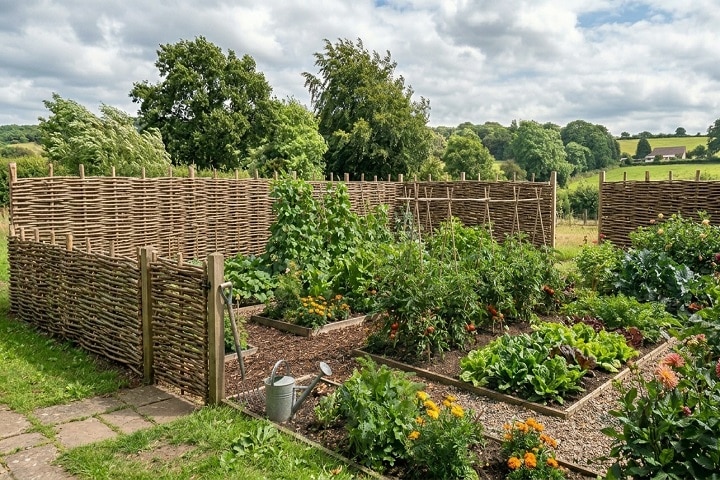
- DIY woven fencing (which could be made from sticks and branches you already have on your property or can collect nearby).
- Repurposed pallets for temporary fencing.
- Mesh or netting (used carefully and temporarily). But remember that wasteful plastic use comes with a terrible environmental cost.
When these are useful:
- Protecting young plants
- Seasonal growing
- Testing wind patterns before installing permanent solutions
How to Position Your Windbreak for Maximum Effect
Even the best windbreak will fail if poorly placed.
Step-by-step approach:
- Identify prevailing wind direction
(In the UK, often south-westerly)
- Place windbreak on windward side
- Allow space between barrier and plants
Avoid placing it too close
- Layer your protection
Combine hedges, screens, and structures - Avoid creating wind tunnels
Watch for gaps that funnel windAdjust seasonally if needed
Temporary solutions can shift with conditions
Choosing the Right Windbreak for Your Garden
The best solution depends on your specific situation but living plants are almost always the best option, no matter where you live and the conditions to be found there.
Decision table:
| Garden Type | Best Approach | Timeframe |
|---|---|---|
| Small garden | Slatted fence + climbers or hedge | Medium–long |
| Allotment | Fruiting hedge/ shrubs | Medium–long |
| Large garden | Trees + shelterbelt planting | Long-term |
| Exposed coastal | Layered hedge + structural support | Medium–long |
Key decision factors:
- Garden size
- Wind exposure
- Budget
- Time (instant vs long-term results)
For more robust protection in exposed areas, consider heavy duty polytunnel covers for harsh weather conditions as part of a wider strategy.
So, Why Isn’t Windbreak Netting the Best Solution?
Windbreak netting has its place occasionally, but it’s often misunderstood and in general, is widely over-used.
Where netting falls short:
- Too uniform – doesn’t adapt to changing wind patterns
- Limited durability in strong, exposed sites
- Single-layer approach – lacks the depth of natural systems
- Can still create turbulence if poorly installed
- No ecological benefit compared to living solutions
When netting may work:
- While netting isn’t usually the best standalone solution, it can still play a useful role as a short-term or supporting element within a wider wind protection strategy.
- As a temporary windbreak
Netting is quick to install and can help protect young plants or newly planted hedges while they establish. This can make a noticeable difference in those critical early weeks.
- As part of a layered system
It works best alongside living windbreaks, helping to gently reduce wind speed while trees and shrubs grow into their role.
- For seasonal flexibility
Lightweight netting can be adjusted or removed as conditions change, allowing you to respond to shifting winds throughout the year.
Choosing the right type of netting
- Natural netting (e.g. jute, coir)
This is the only option I’d recommend. It’s breathable, biodegradable, and integrates far more harmoniously into a garden setting. Over time, it breaks down naturally, avoiding waste while serving its purpose during the establishment phase.
In practice, netting is best seen as a transitional tool, something that supports your garden in the short term, while longer-lasting, living windbreaks take shape and ultimately do the job far more effectively.
For more detailed structural guidance, see how to protect a polytunnel from strong winds.
Conclusion
Wind is not something to fight head-on. Rather, it is something to work with intelligently.
The most effective gardens don’t rely on a single barrier. Instead, they use a layered approach:
- Living windbreaks for resilience
- Structural elements for support
- Temporary fixes where needed
Over time, this creates a calmer, more productive growing environment — one that improves year after year.
Frequently Asked Questions
What is the best windbreak for a garden?
A layered system combining hedges, shrubs and other planting is the most effective and resilient solution.
Should a windbreak be solid or allow air through?
It should allow airflow. Permeable windbreaks reduce wind speed without creating turbulence.
How tall should a garden windbreak be?
As a rule, it protects an area up to 5–10 times its height downwind.
Can I use netting to protect plants from wind?
Yes, but only as a temporary or supplementary solution, not a standalone fix.
What plants are best for windy gardens?
Hardy hedging plants (like hawthorn or privet), tough shrubs (like escallonia), and wind-tolerant grasses and perennials.
Sources:
Royal Horticultural Society (RHS) (2025) Windbreaks and shelterbelts. Available at: https://www.rhs.org.uk/plants/types/hedges/windbreaks-shelterbelts (Accessed: 24 April 2026).