Small Trees To Consider for UK Gardens
There are numerous small trees that you might consider for UK gardens, that are sufficiently small in size to grow easily in a limited about of space, and which offer a lot for the amount of space that they occupy.
One interesting thing to think about is that even larger trees can be restricted, trained and pruned to curtain their size and limit the amount of space that they take up. Remember, trees that grow into mammoth trees can also be used to create hedging. And fruit tree that can grow big can also be kept in check if you use the right training and pruning techniques.
But if you are looking for a low maintenance option, smaller and less vigorous trees are often the right way to go. Fortunately, there are plenty of small trees that are ideally suited to growing in a small garden.
Concentrating on:
- Small Trees With Edible or Other Useful Yields
- Small Trees With Beautiful Blossom/ Blooms
- Small Trees With Beautiful Bark
- Small Trees With Exquisite Autumn Foliage
- & Small Trees for Winter Appeal (Evergreens or trees with interesting branches…)
Here are some of the best options to consider, which offer more than one, and often several of the above, and which are not too challenging for even novice gardeners to grow:
Acers
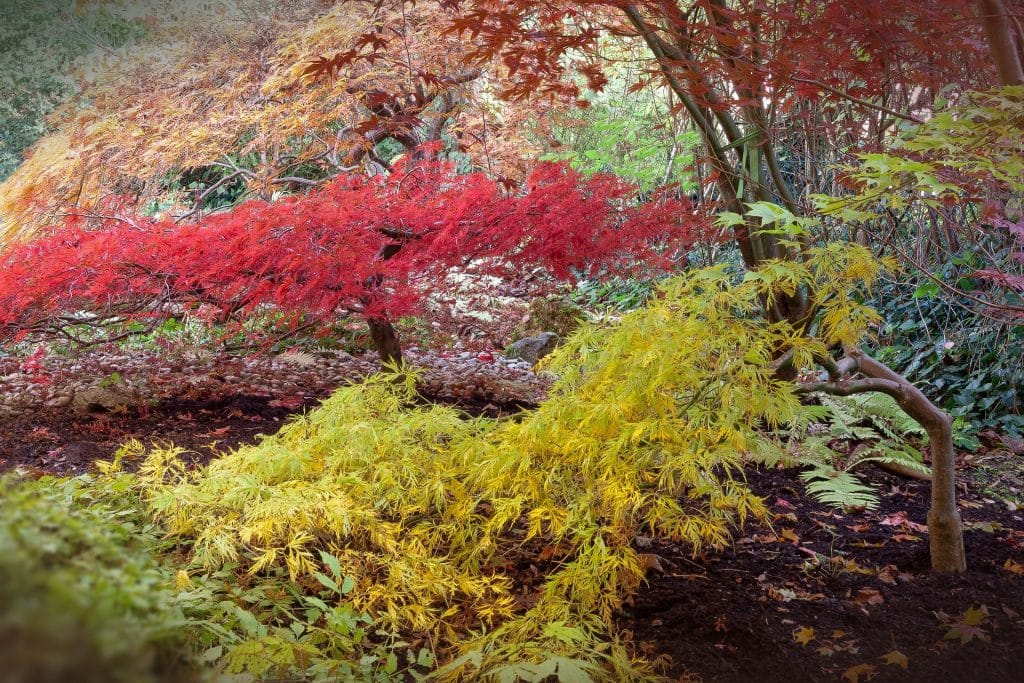
When it comes to small trees with exquisite autumn foliage, Acers like Acer palmatum and other Japanese Acers often top the lists. These are small enough to fit in many gardens, in a sheltered spot, in partial or dappled shade, and they are even suited to growing in containers.
There are also plenty of other smaller Acers (maples) to grow, including the Paperbark maple, Acer griseum, which not only has exquisite autumn foliage but also beautiful bark, chestnut coloured, which has winter appeal when it flakes off to reveal new, bright orange-red bark below.
Bay
There are a number of evergreen trees that can be shaped to maintain them in a small enough size for almost any garden. Providing not only winter appeal with its evergreen foliage but also an edible yield, Bay, Laurus nobilis, can grow large but can be kept very compact if regularly trimmed.
Perfect in a sunny spot adjacent to a more formal herb garden, or other food producing area, you can purchase bays as small lollipop trees, pyramidal shaped specimens, or in a number of other forms. And the bay leaves can be used as a pot herb and in a number of dishes.
Cercis

Commonly known as redbuds, Cercis trees are prized for their spring and summer blossom, and some also have attractive bronze or purple leaves.
There are a number of named cultivars of Cercis Chinensis, Cercis canadensis and Cercis siliquastrum that can work well in UK gardens and remain relatively small in size. These are predominantly grown as ornamental trees in the UK.
Cherry Trees
There are of course plenty of small ornamental cherry trees to grow. But to obtain a worthwhile edible yield as well as an attractive display of spring blossom and foliage, you should consider growing a fruiting cherry on a dwarfing rootstock in your garden. Even if you do not eat the cherries yourself, birds and other wildlife will certainly benefit.
Crab Apples (Or Dwarf Apple Trees)
Another wonderful fruit tree for small spaces is the crab apple. Crab apples can provide fruit for you to make jams, jellies and other preserves, and also provide a feast for the wildlife with whom you share your space. Crab apples also have beautiful blossom in spring.
If you would prefer eating apples, or larger cooking apples, you should also remember that you can still grow these in surprisingly small spaces. Choosing apple trees on dwarfing rootstock, and training and pruning in specific ways, can allow you to fit in apple trees even in the smallest of gardens.
Dogwoods

Many dogwoods, including Cornus kousa (Japanese Dogwood), Cornus florida and Cornus mas, can be great value ornamental plants in a garden, with beautiful blossom in early summer, vivid autumn foliage, and in the case of Cornus kousa and Cornus mas, even edible fruits.
Cornus kousa var. chinensis fruits best in the UK, and is best suited to our growing conditions.
Hawthorn
Hawthorn trees are a great native choice for a wildlife-friendly garden. Crataegus monogyna is of course a common hedgerow plant. But it can also be a great choice for a small standard tree in a small garden.
Hawthorn has beautiful flowers for visual appeal and for pollinators in spring, followed by beautiful red berries loved by birds in the autumn. There are a number of named hawthorn cultivars to choose from.
Hazel
Another of my favourite small trees for a wildlife-friendly garden is hazel. Hazel is another native tree that can be used both as a stand-alone tree and as part of a native hedgerow. Even in smaller gardens, a hazel tree can be coppiced to provide an attractive multi-stemmed tree that won’t take up too much space. Typically, hazel reaches 3-8m tall.
Hazel trees have attractive catkins very early in spring, and of course the potential of edible nuts later in the year. They provide habitat and food for a wide range of creatures that might be found in UK gardens.
Magnolia (Smaller Ones)
Many Magnolia are far too large for smaller UK gardens. But there are also some small Magnolia that can make extremely attractive additions even in very small spaces.
For example, look at cultivars of Magnolia grandiflora, Magnolia macrophylla x Magnolia macrophylla subsp. ashei, Magnolia stellata, or named Magnolia cultivars such as ‘Alexandrina’ or ‘Sayonara’, for example.
Magnolias are among the most spectacular of flowering trees that can be grown in UK gardens.
Rowan
Rowans are another native tree that you can grow even in a small garden. These forgiving trees are very easy to grow and can cope with a wide range of conditions. Another of my own favourites, I love rowans for their beautiful delicate spring flowers and of course for the bright red berries.
Rowans are not only attractive to us. They are also a boon for the wildlife that shares your garden. And rowans can work even where a number of other small trees on this list will not necessarily thrive.
Serviceberries
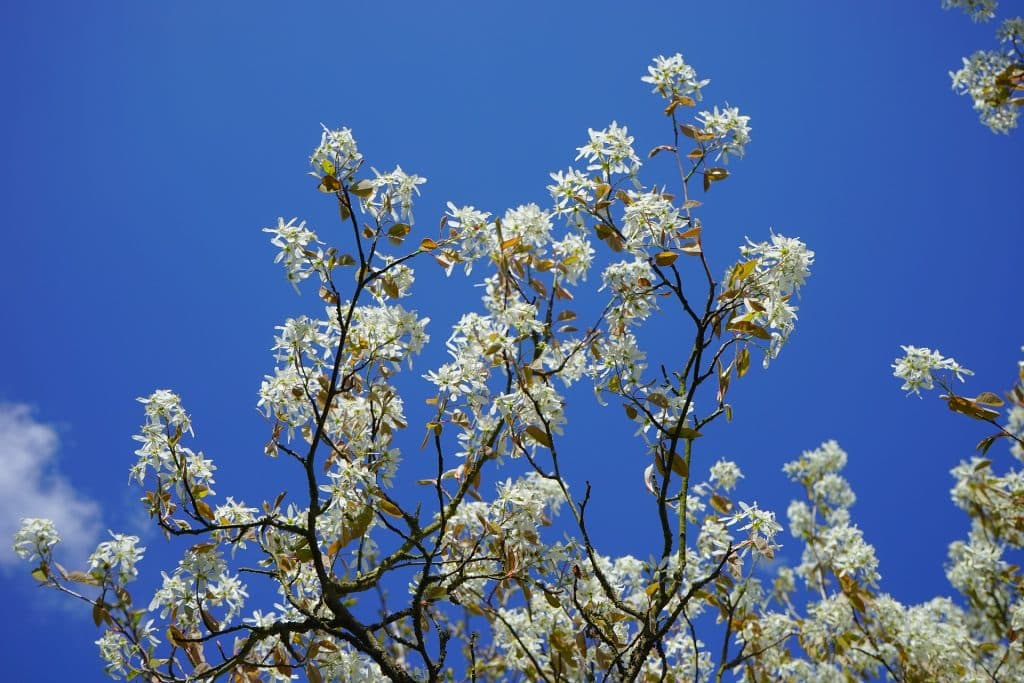
Amelanchier, also known as serviceberries, are another fantastic small tree to consider. Though not native, these can also work well with the conditions in many UK gardens. Trees such as Amelanchier canadensis and Amelanchier lamarkii are very popular for their showy spring blossom, and the fruit that follows, as well as providing autumn colour with leaves that fade from green to gold.
What is more, serviceberries also provide edible fruit for us, so these can also be great trees to consider if you would like to create a food forest or other food-producing design.
Siberian Pea Tree
Caragana arborensis is a useful non-native tree to consider for UK gardens, because it is not only small in size but also a nitrogen fixer. Co-operating with bacteria, it can be used to make sure that there is plenty of nitrogen in the soil in your garden, which can be beneficial for other trees and other plants growing close by.
(Another nitrogen fixing plant to consider, usually considered a shrub, can be formed to be more like a tree and less like a large shrub: Elaeagnus species, such as the autumn olive. This also produces edible fruits. I have one in my small forest garden that nestles like a small tree between two larger apple trees, with other planting in layers below.)
Spindle
The European spindle, Euonymus europaeus, is another small tree that you might consider growing in your garden both for its appeal to wildlife and for its ornamental appeal. It grows typically only to around 4m in height.
‘Red Cascade’ is one named cultivar to consider. It has small and relatively inconspicuous flowers but these develop into bright rose pink fruits which open to reveal bright orange seeds inside. And oval leaves that turn red in the autumn.
Strawberry Tree
If you would like an evergreen tree then Arbutus unedo, strawberry tree, could be a great choice, especially for relatively mild, coastal areas. Though it can grow 8m tall, it will often remain quite a lot smaller in the UK.
It can grow into a very attractive multi-stemmed tree, and as well as having leaves that remain on the tree year-round, it also has white bell shaped flowers and plump red fruits that look superficially a little like strawberries in the autumn. These fruits have a rather insipid taste, but can be used in jams, jellies etc…
The list of small trees that you can grow in small gardens in the UK is obviously much, much longer. The RHS gives many example here. But if you are looking for inspiration, the list above provides a good place to start.