
A polytunnel can transform the way you grow. It creates a more protected and productive environment, extends the growing season, and helps gardeners achieve more reliable harvests. But one of the biggest misconceptions I come across is the idea that a polytunnel completely overrides local conditions. It doesn’t. A polytunnel can narrow the gap between climates, but it does not erase it completely. Typical polytunnel growing conditions depend on the climate baseline you already have. 

My Scottish polytunnel garden, for example, will never experience exactly the same growing conditions as one in the south of England. Even with similar structures, differences in temperature, daylight hours, wind exposure, and seasonal warmth still shape what grows well and how long the growing season lasts. 

The growing season may begin later, winter light levels may be lower, and heat-loving crops can need more protection or patience. Meanwhile, growers further south may spend more time managing ventilation and overheating than worrying about frost protection.

Your location still shapes almost everything that happens inside the tunnel. Temperature, sunlight, wind exposure, rainfall, soil type, and even the slope of your garden continue to influence how successfully crops grow.

A polytunnel changes the growing environment, but it always works from the climate baseline you already have. Understanding that makes it far easier to make sensible decisions, set realistic expectations, and adapt your growing approach naturally over time.


Key Takeaways

  • Polytunnels create a controlled environment, but not a completely uniform one 
  • Your local climate still defines much of your growing potential 
  • Temperature, light, wind, and soil conditions vary significantly by location 
  • Microclimates can change conditions even within the same garden 
  • Successful growing comes from adapting your setup to your environment 
P1010620

WHAT A POLYTUNNEL REALLY DOES TO YOUR GROWING ENVIRONMENT

A polytunnel creates a modified microclimate around your crops. It traps warmth, reduces wind exposure, and gives growers more control over watering and humidity.

In practical terms, this usually means plants experience:

  • Warmer daytime temperatures 
  • Less wind stress 
  • Reduced rain damage 
  • More controlled moisture levels 
  • Better protection from frost and cold snaps 

Inside the tunnel, conditions become more stable than outdoors. Crops are less exposed to sudden weather changes, and the growing season can often begin earlier and continue later into the year.

However, a polytunnel is not a sealed artificial environment. It still responds constantly to the outside climate.

A tunnel in northern Scotland behaves differently from one on the south coast of England. A tunnel in a windy coastal site performs differently from one sheltered within an urban garden.

That distinction matters.

Key Point: A polytunnel modifies your local climate. It does not erase it.

From a permaculture perspective, this is important because successful growing comes from working with natural conditions rather than constantly trying to fight against them.

Why Location Still Matters (Even With a Polytunnel)

The biggest factor many gardeners overlook is what I think of as the “starting climate baseline”.

Every location begins with certain environmental advantages and limitations. A polytunnel improves those conditions, but it still works from that original starting point.

For example:

  • A colder northern site may still struggle with winter light levels 
  • A warm southern site may experience overheating in summer 
  • Coastal gardens may face stronger winds and salt exposure 
  • Frost pockets remain colder than surrounding areas 

Polytunnels narrow the gap between locations, but they do not make every site equal.

Why Location Continues to Matter in Your Polytunnel Growing Conditions

  • Temperature ranges still vary regionally 

  • Day length differs depending on latitude 

  • Wind exposure changes dramatically between sites 

  • Humidity levels vary with climate 

  • Soil conditions remain highly localised 

I often find gardeners become frustrated when comparing results online without considering location differences. Two growers using identical tunnels may still see very different outcomes simply because their environmental conditions are different.

WEATHER

Temperature: The Biggest Location-Dependent Factor

Temperature usually has the greatest impact on polytunnel growing conditions or rather, how a polytunnel performs.

The difference between northern and southern regions, inland and coastal locations, or exposed and sheltered gardens can be substantial throughout the year.

snow
6ft 1

Cooler Regions

In colder areas, a polytunnel helps:

  • Raise daytime temperatures 
  • Reduce frost damage 
  • Extend the growing season 
  • Protect tender crops 

But colder regions still tend to have:

  • Lower winter light levels 
  • Cooler overnight temperatures 
  • Slower spring warm-up

Warmer Regions

In warmer locations, growers often face the opposite problem:

  • Excessive summer heat 
  • Higher humidity 
  • Increased watering needs 
  • Overheating risks 

This is where ventilation becomes especially important. In many southern or sheltered gardens, keeping temperatures down can become more challenging than keeping warmth in.

Key Point: A polytunnel amplifies existing conditions. Cool places become warmer. Warm places can become very hot.

Understanding regional conditions helps growers adapt ventilation, shading, and planting choices more effectively throughout the year.

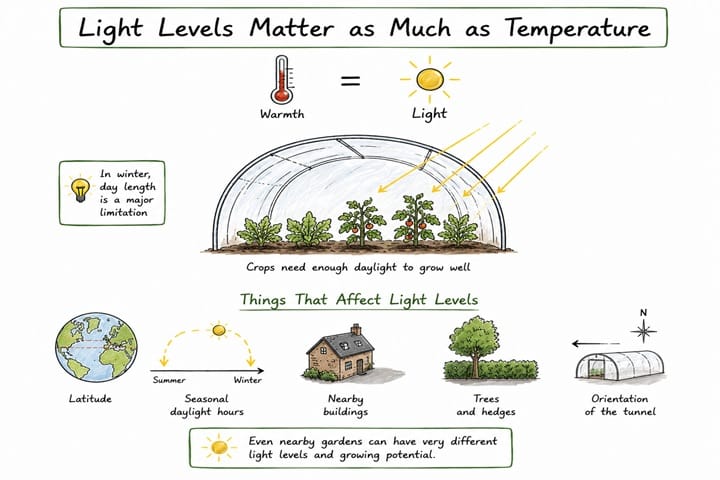
Things That Affect Light Levels


  • Latitude 
  • Seasonal daylight hours 
  • Nearby buildings 
  • Trees and hedges 
  • Orientation of the tunnel 

Even within the same area, one garden may receive several more hours of sunlight than another.

Polytunnel growing conditions sunlight

Sunlight & Day Length: The Hidden Limiter

Many people focus heavily on temperature while overlooking light levels. But even with warmth, crops still need sufficient daylight to grow productively. In winter especially, day length becomes one of the biggest limitations in UK growing.

 Simple Sunlight Assessment Checklist

  • Does the tunnel receive full sun for most of the day? 
  • Are nearby trees casting winter shadows? 
  • Will buildings block low winter sunlight? 
  • Is the tunnel oriented to maximise light exposure? 

I always encourage growers to observe the garden across different seasons before positioning a tunnel permanently.

Light matters just as much as warmth.

Wind Exposure and Shelter

Wind has a surprisingly strong effect on polytunnel performance.

Even if temperatures remain reasonable, constant wind can cool the structure, increase heat loss, and create stress for both crops and the tunnel itself.

Exposed Sites Often Experience

  • Lower internal temperatures 
  • Faster heat loss overnight 
  • Increased structural strain 
  • Greater moisture loss from plants 

Coastal and elevated sites tend to experience the biggest challenges.

Ways to Reduce Wind Impact

  • Position tunnels beside natural shelter 
  • Use hedging or windbreak planting 
  • Avoid exposed hilltops where possible 
  • Align the tunnel carefully with prevailing winds 

However, there is always a balance to strike. Too much shelter can reduce airflow and increase humidity problems.

For growers considering where to position a polytunnel for the best growing conditions, observing natural wind movement across the site is often just as important as sunlight.

Rainfall, Drainage and Soil Conditions

One of the major changes a polytunnel creates is rainfall exclusion.

While crops gain protection from excessive rain, the grower also becomes fully responsible for watering and moisture management.

This changes the relationship between soil and climate quite significantly.

Soil and Drainage Still Matter

Clay-heavy soils may remain:

  • Cold 
  • Slow draining 
  • Prone to compaction 

Sandy soils may:

  • Drain quickly 
  • Dry out rapidly 
  • Require more organic matter 
hands holding soil
 
soil
Site Assessment Checklist
  • What type of soil is present? 
  • Does water pool after rain? 
  • Is irrigation easily available? 
  • Does the site dry out quickly in summer? 

I often think healthy soil is one of the most overlooked climate adaptation tools available to gardeners.

Soils rich in organic matter generally cope better with both excessive moisture and drought conditions. From a permaculture perspective, improving soil resilience often solves multiple growing problems at once.

Microclimates: Why Your Garden Might Be Unique

Even gardens within the same town can behave very differently.

This is because of microclimates, the small-scale environmental variations created by buildings, slopes, surfaces, trees, and surrounding structures.

Common Microclimate Examples

  • South-facing walls storing heat 
  • Urban gardens remaining warmer at night 
  • Low-lying frost pockets 
  • Sheltered courtyards reducing wind 
  • Slopes altering cold air movement 

Sometimes a few metres can make a noticeable difference.

I’ve seen one side of a garden escape frost while another side freezes heavily simply because cold air settled differently overnight.

Understanding your own microclimate is often more useful than relying solely on regional climate averages.

Key Point: Your garden has its own climate personality. Learning to observe it carefully is one of the most valuable gardening skills.

How Location Affects What You Can Grow

Polytunnels expand growing possibilities, but crop suitability still varies depending on location and conditions.

Some climates are naturally better suited to certain crops than others.

Location TypeCrops Often SuitedKey Limitation
Cool northern regionsLeafy greens, brassicas, peasLower winter light
Warm southern gardensTomatoes, peppers, melonsSummer overheating
Coastal gardensSalads, herbs, beetrootWind exposure
Sheltered urban gardensHeat-loving cropsHumidity buildup

One important distinction is whether the tunnel is extending crops or truly enabling them.

For example:

  • Tomatoes may grow earlier in cooler regions 
  • But melons may still struggle without sufficient warmth and light 

Realistic expectations matter. Polytunnels improve reliability enormously, but they cannot completely eliminate environmental limitations.

I always encourage experimentation, though. Careful observation often reveals unexpected opportunities within a particular site.

Adapting Your Polytunnel to Your Location

The most successful growers usually adapt their setup continually rather than expecting one fixed solution to work everywhere.

Practical Ways to Adapt

  • Increase ventilation in warmer climates 
  • Add thermal mass in colder areas 
  • Use shading during heatwaves 
  • Improve wind protection carefully 
  • Adjust planting schedules seasonally 

Simple Seasonal Management Checklist

  • Monitor temperatures regularly 
  • Adjust airflow throughout the year 
  • Observe humidity levels 
  • Adapt watering to local conditions 
  • Modify crop choices seasonally 

Small changes often make the biggest difference.In permaculture gardening, the focus is usually on observation first. Rather than forcing the environment into a rigid system, growers adapt gradually to what the site naturally allows and supports.

For growers looking at common polytunnel mistakes to avoid in different climates, many problems arise not from the tunnel itself, but from using the same growing approach regardless of local conditions. Likewise, these domestic polytunnels suited to different environments can help growers create more adaptable and resilient growing spaces depending on site conditions.

A month-by-month polytunnel growing guide can also help gardeners adjust timing more realistically according to local climate patterns. Polytunnels are incredibly useful growing tools, but they are not climate reset buttons. Your location still shapes temperatures, light levels, humidity, wind exposure, and soil behaviour. Understanding that helps create far more realistic expectations and often leads to better long-term growing results.

The key is not trying to create identical conditions everywhere. Instead, successful growing usually comes from observing your environment carefully and adapting naturally over time. A well-managed polytunnel works with local conditions, softening limitations and extending possibilities while still respecting the realities of place, climate, and season.

frequently asked questions

Does a polytunnel work the same in every climate?

No. While polytunnels improve growing conditions almost everywhere, local climate still affects temperature, humidity, light, and ventilation needs.

It varies significantly depending on weather, sunlight, ventilation, and location. Daytime temperatures can rise substantially in sunny conditions.

Generally, the best location is sunny, sheltered from strong winds, well-drained, and positioned to maximise year-round light exposure.

Not always. Some crops still depend heavily on regional temperatures and available light levels, even under cover.

No. They reduce exposure to wind, rain, and frost, but extreme temperatures, storms, poor ventilation, and unsuitable site conditions can still create challenges.

Sources:

Treehugger (2022) Lessons learned from polytunnel gardening. Available at: https://www.treehugger.com/lessons-learned-polytunnel-gardening-5207539 (Accessed: 20 May 2026).

Herefordshire Council (2018) Polytunnels Planning Advice: Appendix 1. Available at: https://councillors.herefordshire.gov.uk/documents/s50058045/Appendix%201%20for%20Polytunnels%20Planning%20Advice.pdf (Accessed: 20 May 2026).

Royal Horticultural Society (RHS) (2026) Ventilation and shading greenhouses. Available at: https://www.rhs.org.uk/garden-features/ventilation-and-shading-greenhouses (Accessed: 20 May 2026).

Trustpilot

Useful Guides