

As gardeners, we are in a position to help solve many of the world’s most pressing problems. Learning how to garden in a way that will trap more carbon (carbon sequestration) is one way that you can help combat our climate crisis.
As you are already no doubt aware, growing at least some of your own food is a great way to lower your carbon footprint. It can help you reduce your impact by helping you to avoid purchasing food grown in damaging ways. And it can help you reduce the massive problem of food waste.
But you might not be aware that you can also help in climate change mitigation by making the right choices when it comes to what we grow, and the methods we choose to grow it.
Why We Need to Trap (Sequester) More Carbon
As a gardener who grows at least some of your own food, you are helping to bring down emissions of greenhouse gases. The basics are clear. We urgently need to reduce our greenhouse gas emissions to halt climate change and avoid a runaway catastrophe. But scientists are clear that a reduction in emissions alone will not be enough. In addition to cutting carbon emissions, we also need to find ways to trap more carbon in our gardens, on our farms, and in our wider ecosystems.
Carbon is naturally taken in and stored in plants, and in the soil. Human activities have increased the amount of carbon in the atmosphere. And they have also reduced the amount of carbon that is naturally sequestered by vegetation and soil on our planet. Deforestation, ecosystem degradation, and poor land management practices all contribute to this problem.
What is Carbon Gardening?
Carbon gardening is all about trying to redress the balance. It is about finding ways to make sure our gardens can trap more carbon, for longer. And about making sure that we do what we can to keep it out of the atmosphere where it contributes to rising temperatures.
In carbon gardening, there are a range of strategies we can employ and choices we can make to achieve this goal. The most important of these strategies and choices involve the types of plants we choose to grow, and how we take care of, maintain and build the soil in our gardens.
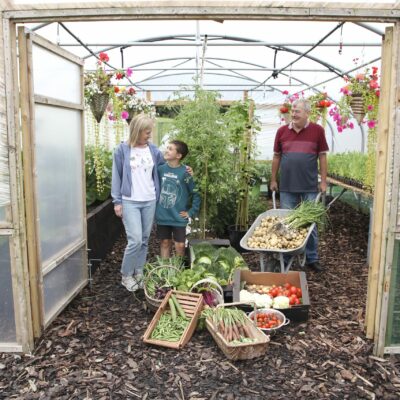
Whether we are growing in a polytunnel, or outside, many of these strategies and choices remain the same. In this article, we’ll explore some of the basics of carbon gardening. So read on to learn more about how you can trap more carbon in your garden.
Trap More Carbon in Plants
All plants draw in and trap carbon to some degree. But when it comes to carbon sequestration, not all plants were created equal. Some plants will catch and store far more carbon than others, and will store it for a longer period of time.
Trees and Carbon Sequestration
Of course, the power houses of carbon sequestration in any garden are trees. Trees catch and store carbon as lignin in their trunks, branches and roots. These large plants are particularly effective in carbon sequestration – drawing in particularly high quantities when they are aged between around 10 and 45.
When choosing trees for carbon sequestration, one common strategy is to choose quick-growing species, that will grow larger more quickly, and therefore draw in more carbon short term. But the best strategy is to choose a wider range of trees – some quicker growing and shorter-lived species, and some that will ramp up more slowly, but which are more long-lived and so will sequester carbon over a much longer period of time.
Understanding exactly how much carbon a tree will store is a complex business. It depends on a huge range of factors – not just the species and tree type, but also the temperatures and other environmental conditions.
But one of the most important things to bear in mind when choosing trees to trap carbon is now long they will remain in position, doing this job. It is not enough to plant trees today. We also need to think about what will become of them in the years to come.
Choosing trees that are useful to human beings in other ways while in growth is a good way to make it less likely that trees will be chopped down in future. Particularly pertinent to polytunnel gardeners are fruit and nut trees – that will not only sequester carbon but also provide humans with an edible yield. Dwarf varietals can work well, even inside a polytunnel.
Shrubs and Carbon Sequestration
Trees are often the focus when it comes to learning how to trap more carbon in your garden. But they are not the only extremely useful plants to consider. Shrubs or bushes and other woody plants like bamboo can also play a very important role. Like trees, these plants can grow and trap carbon in your garden for years, having a surprisingly significant impact over time.
Like trees, these plants store carbon as lignin in their branches and roots. Growing a wide range of woody shrubs is therefore another important way to trap and store more carbon in your garden. Since they will grow for years in your garden, they won’t break down and release all of that carbon back into the atmosphere.
Choosing Perennials Rather than Annual Plants
In addition to planting trees and shrubs, carbon gardeners will also plant plenty of herbaceous perennials. Whether they are perennial flowers, vegetables or herbs, these plants also play key roles in trapping carbon in your garden.
Those with deep, thick roots are particularly useful in carbon management. Deep and woody roots will generally remain in place for quite some time. So they should help keep carbon locked up below the soil for years to come.
Annual crops typically have lower root biomass than perennials because they do not need to store energy in the same way. On average, annual plants allocate 76% of carbon stocks to shoots and only 24% to the roots. However, this can vary considerably due to differing climates and environmental conditions. Nonetheless, it is clear that growing more perennials and fewer annuals is a good way to go if you want to trap more carbon in your garden.
Trap More Carbon in the Soil
You might be very surprised to hear, however, that the plants you choose to grow are not the most important thing when it comes to carbon sequestration. Soil holds four times the amount of carbon stored in the atmosphere, and more than is held in vegetation. So how we care for the soil in our gardens is even more important than what we choose to grow within it. Soil can act as an effective carbon sink and offset a significant proportion of man-made carbon dioxide emissions annually.
Trapping carbon in the soil in our gardens involves thinking about two different things. Firstly, we need to think about how we can increase soil organic carbon levels. We can add carbon to the soil by:
-
Adding ‘green’ organic matter. (Such as mulches, and chopped and dropped cover crops/ green manures.)
-
Making use of ‘brown’ organic matter. (Such as compost or manures.)
-
Incorporating ‘black’ organic matter. (Biochar.)
Secondly, we need to think about how we can reduce the amount of carbon lost from the soil ecosystem. We can do this by adopting ‘no dig’ and organic gardening approaches. A no dig approach can help avoid areas of bare soil that will lose carbon more quickly. It can minimise issues with compaction and erosion. And it can boost bacterial and fungal systems, ensuring a healthy soil biota that helps keep carbon trapped there.
It is important to realise, therefore, that by thinking about how we grow as well as what we grow, we can contribute to a better world. We can help to fight the climate crisis while staying home, and effectively managing our own gardens. No matter how small and insignificant our spaces can seem – every little step can make a surprisingly big difference.
Are you a carbon gardener? Have you taken steps to trap more carbon in plants and soil in your garden? Let us know in the comments below.