


Tansy, Tanacetum vulgare, is a traditional herb garden plant that can also be beneficial as a companion plant in a vegetable garden, look good in a wildlife-friendly border, or be part of a wildflower meadow mix. It can also be grown in containers. This article will focus on how to grow a tansy plant – for more advice, look no further than our growing section on our blog.
Key Information
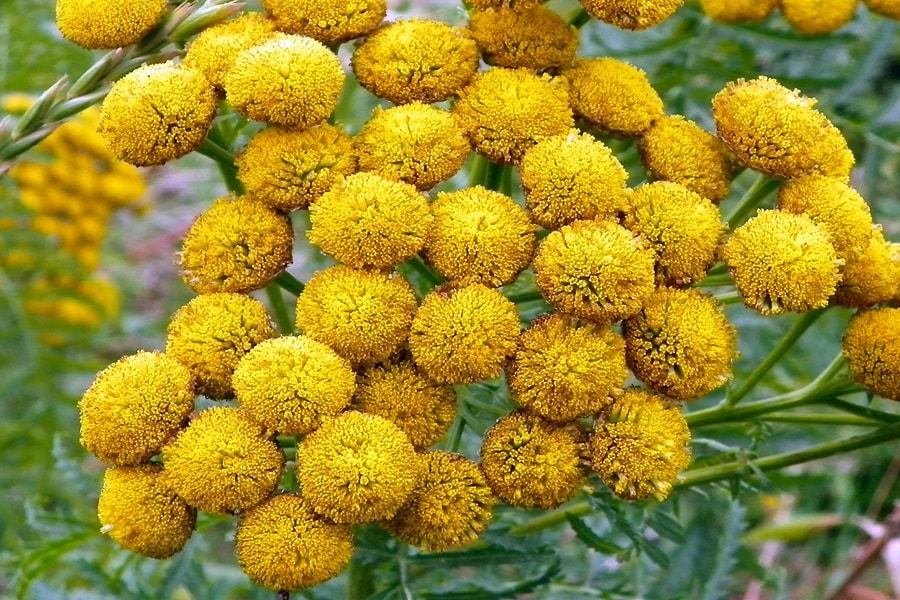
Tansy is a plant native to the UK, often found growing in the wild along roadsides and on disturbed ground. It has fern-like foliage and deep yellow button-like flowers that bloom from July and into autumn.
As you will learn as we continue with this guide, it is a plant with a dark side as well as a light side, and can be both dangerous and extremely useful to grow.
You definitely do need to be careful about where you grow it, both due to its toxicity to people and animals and due to its tendency to spread throughout a garden. But it can also be beneficial for gardeners, wildlife and other nearby plants in a number of different ways, as you will discover as you read on.
| JAN | FEB | MAR | APR | MAY | JUN | JUL | AUG | SEP | OCT | NOV | DEC | |
| SOW | ✅ | ✅ | ✅ | |||||||||
| HARVEST | ✅ | ✅ | ✅ | ✅ |
What Is A Tansy Plant?
The name tansy is usually used to refer to common tansy, Tanacetum vulgare, but it is a name that can also be used of other member of the same genus.
In this guide, when we talk about tansy we are talking about Tanacetum vulgare. But note that tansy plants might also be related species in the Tanacetum genus, which are often known collectively as tansies. Most of these are also perennial herbs, though some are annuals and some subshrubs too.
Note that the plant Jacobaea vulgaris is known as tansy or tansy ragwort in the western United States, though it only has a superficial resemblance to true tansy.
How to Identify
Tansy’s reddish stem has alternating leaves, each one adorned with numerous finely toothed leaflets that have a delicate fern-like charm. Atop the stems, clusters of small, rounded yellow flower heads, comprised of myriad tiny blossoms, that resemble dainty buttons.
Did you know?
Tansy leaves were traditionally eaten at Easter to help kill the worms that were ingested while eating the fish eaten at this time. Their bitterness was masked by mixing them into pancakes or omelettes.
What Soil or Growing Medium to Use
If you are interested in growing tansy in your polytunnel or elsewhere in your garden, you first need to know the conditions it requires.
In addition to needing a location in full sun, tansy needs a moist but free-draining soil or growing medium. This is not a plant that is fussy about specific soil type or pH level but it will not thrive in waterlogged nor overly dry conditions.
It can be grown in a container as well as in the ground, which can sometimes be a good idea in places where it may have a tendency to take over and spread, and be difficult to control. In containers, a peat-free multipurpose potting mix with a little grit added to improve drainage should work just fine.
How to Grow Tansy

Tansy is usually grown from seed. Individual plants can also sometimes be purchased if you prefer not to grow from seed. But tansy seeds are easy to sow and germinate relatively readily – indeed, they will often sow themselves if you let them once you have some tansy in your garden.
Sow and Plant
Tansy seeds are sown in spring, earlier indoors, or directly where they are to grow once the weather has warmed somewhat.
The strategy you choose will depend on where you are growing the tansy and whether it is grown as individual plants for pots or companion planting, or in a wilder and more natural wildlife border or meadow scheme. In meadow schemes, of course, tansy will only be one of a number of species in a seed mix.
Remember when planting out seed grown tansy or tansy plants you have purchased that they can spread easily. So choose your location carefully. Place plants c. 40cm apart and if you are creating rows, the rows should be at least 90cm apart.
Tanacetum and Wildlife
When choosing where to plant tansy, it is a good idea to consider local wildlife than might benefit from the addition.
Tansy is known as an excellent plant for a wildlife-friendly garden. It attracts many beneficial insects including bees, butterflies and moths, and other insect pollinators.
Interestingly, however, the plant also repels, confuses or distracts a number of insect pests with its aromatic foliage.
This is why it can be beneficial as a companion plant for a range of common crops. For example, tansy is often used as a companion plant for potatoes, for cucurbits, or in perennial schemes for raspberries and for fruit trees.
Is Tanacetum Poisonous?
Before we get carried away with all the benefits of growing tansy in the garden, however, it is important to take a look at the dark side of this plant.
As with so many medicinal herbs, tansy can also be poisonous when consumed in high quantities. Sadly, deaths have occurred when strong teas have been drunk as abortifacients. All parts of the plant are toxic to humans if consumed in large amounts, and the foliage can also irritate the skin.
It is also important to note that tansy is toxic to pets and livestock.
Care Tips for Tansy
Providing that you have chosen a suitable location in which to grow this herb, tansy can be a very easy perennial plant to grow and will not require a great deal of care.
Natural rainfall will usually be sufficient for this plant, and feeding is not usually required when growing in the ground. In containers, and of course when growing undercover, you will need to take care of watering – maintaining moist but not waterlogged conditions.
Like other herbaceous perennials, tansy will die back over winter before growing again in the spring. Dead stems can be left for wildlife over the winter months.
Harvesting
The leaves can be taken as required, and the flowers are harvested before they set seed. Though caution is advised when using tansy in any way beyond the garden, as you will find out below there are a number of ways that you might use them.
Troubleshooting
Before we get to how you might use tansy beyond using it as a wildlife-attractant and companion plant, lets take a quick look at why and how things might go wrong when trying to grow this plant.
Tansy is generally not plagued by pests or diseases. But it will not thrive in waterlogged conditions not if the soil or growing medium dries out entirely.
Remember at all times, however, that due to the plants toxicity to people and a number of different creatures including dogs, cats, horses and other farm animals, care is definitely required when growing and handling this plant.
Reasons Not to Grow Tansy in Your Garden:
- Tansy is poisonous to people when ingested in large qualities, and also toxic to pets and farm animals.
- It can cause contact skin rashes in some people who are allergic to the plant.
- It is a prolific self-seeder if you let it do so, and spreads through underground rhizomes too, so spreads very easily and can become invasive or problematic in some cases.
Reasons to Grow Tansy:
- Tansy is a wonderful attractant for bees, butterflies and other beneficial insects.
- But it can also help to repel species we do not want, like ticks, fleas, flies and mosquitoes.
- So it is a great companion plant for fruit trees, fruiting shrubs and canes, and a number of annual crops including potatoes.
- Tansy may also be a dynamic accumulator, and can be used to enrich compost and to improve soil health.
- The leaves and flowers have other uses beyond the garden (see below).
- Tansy is an attractive flowering plant that can look good in ornamental planting schemes.
- It is also a remarkably easy, unfussy and low maintenance plant to grow.
Uses of Tansy
Traditionally, tansy has had both edible uses, and many uses in herbal medicine. Today, internal use is not usually recommended, and extreme caution is advised. But some do still use tansy in traditional ways, in moderation.
I recommend that you do not do so unless under the advisement of a professional herbal healer. Note, however, that it is now little used in modern herbalism.
Edible Uses
Ingesting tansy is considered possibly unsafe, and is definitely not a good idea if you are pregnant. The essential oil present in the leaves is toxic to humans and can even kill, though traditionally the young leaves were eaten in small quantities both raw and cooked and the leaves and flowering stems were used to make a bitter, lemony tea.
Notes on Herbal Uses
Tansy was traditionally used to stimulate menstrual bleeding or to treat menstrual irregularities, and as an abortifacient – though this is extremely dangerous as doses required for this can potentially kill the mother. Though little used in modern herbal medicine, tansy is occasionally still used to expel intestinal worms from the body.
Externally, tansy is used to kill lice, fleas, scabies etc. though it should be noted that there is still the risk of toxicity even when the plant is used externally.
Tansy might also be used (where not a risk to pets or children) as a strewing herb to keep insects away and as an effective insecticide. A green dye is also derived from young shoots, and a yellow dye from the flowers.
Can You Grow a Tansy Plant in a Polytunnel?
Tansy could indeed be grown in a polytunnel, both domestic polytunnels and commercial polytunnels, providing that it is provided with the moist yet free draining conditions that it requires.
To prevent it from taking over, it would be best to keep it in a container, and to make sure that the flowers are removed before seeds are set.
It is also important to maintain good ventilation and space to avoid overcrowding. This helps to prevent high humidity from causing any disease issues.
Consider using tansy as a companion for fruit trees, fruiting shrubs, or annual crops growing in your polytunnel garden.
FAQs
What is tansy used for?
Traditionally used as an edible and medicinal herb, tansy today is mostly used to attract wildlife in a garden, as a companion plant, as a good addition to a compost heap, or as a chopped and dropped mulch material in a pet-and child-free space.
Is tansy good for the garden?
Tansy is an excellent wildlife attractant and also helps in organic pest control by repelling a number of insect pests. It can also improve compost and help maintain healthy soil. Note, however, that it can have a tendency to take over, and so needs to be managed carefully to prevent its excessive spread.
Is tansy safe to touch?
Most people can touch tansy with no ill effect, but some people are allergic and may get a skin rash, so caution is advised.
What is tansy poisonous to?
Tansy is poisonous to people, dogs, cats, horses and farm livestock like cows. It can be extremely dangerous if ingested in large quantities but internal use is not generally recommended at all.
Sources
WebMD. (2020) Tansy Ragwort – Uses, Side Effects, and More. [online] Available at: https://www.webmd.com/vitamins/ai/ingredientmono-256/tansy-ragwort [accessed 26/02/24]