Rain falling on a polytunnel roof can be a valuable source of water. With the right guttering for polytunnels, rainwater can be collected instead of simply running off the sides, where it can create muddy paths and lead to wasted runoff. The best guttering system is not necessarily the cheapest. It is the one that suits your tunnel, your growing needs and what you want to do with the water.
Guttering can turn rainfall into a useful resource, particularly when connected to water storage and irrigation. Here I compare the main options, including purpose-made and DIY approaches, and explain what to consider before installing one.
If you want more detailed guidance, you can choose the best guttering system for your polytunnel.
Key Takeaways
- Guttering captures rainwater that would otherwise run away from the tunnel.
- Purpose-made systems generally offer the best fit and straightforward installation.
- DIY solutions can work for smaller or existing structures but need careful fitting.
- Collected rainwater can be stored and used for irrigation.
- Good installation and regular maintenance matter as much as the guttering itself.

Why Install Guttering on a Polytunnel?
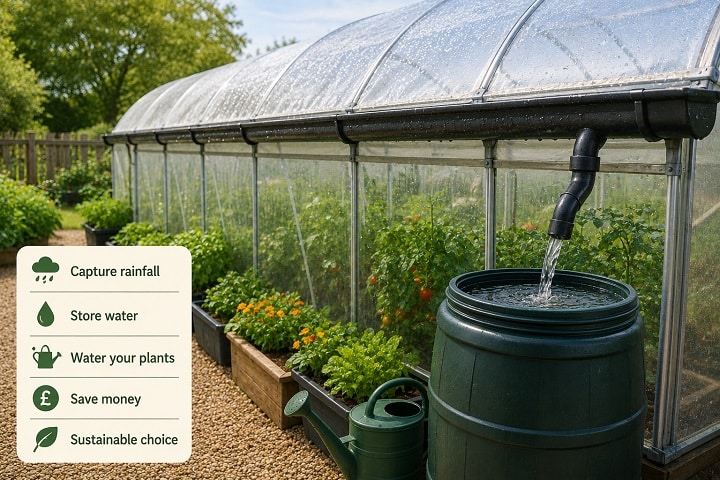
A polytunnel roof collects a considerable amount of rainwater. Without guttering, that water falls around the perimeter of the structure.
This may not matter on a well-drained site, particularly if you have no need to collect water. But there are several good reasons to consider guttering.
Guttering can:
- Collect rainwater for later use.
- Reduce runoff around paths and entrances.
- Help prevent muddy areas around the tunnel.
- Direct water towards storage.
- Provide a useful source for irrigation.
For me, the biggest advantage is that guttering turns something that can otherwise be a nuisance into a resource. Rainwater can be collected when it is plentiful and stored for drier periods.
Think beyond the gutter: Guttering works best as part of a simple system: roof → gutter → downpipe → storage → irrigation.
What Makes a Good Polytunnel Guttering System?
Before choosing a particular type, consider the system as a whole.
A good option should be:
- Compatible: It needs to work with your tunnel.
- Durable: It must cope with rain, wind and changing temperatures.
- Secure: Poorly supported guttering can sag or pull away.
- Efficient: Water should flow towards the downpipe rather than pooling.
- Accessible: You should be able to clean and inspect it.
- Suitable: A small garden has different requirements from a commercial growing site.
There is little benefit in installing a system that is difficult to maintain or cannot be connected conveniently to water storage.
The Main Guttering Options for Polytunnels
There are several approaches, and each has its place.
| Option | Best For | Advantages | Limitations |
|---|---|---|---|
| Purpose-made guttering | New or existing tunnels | Designed for the structure | May cost more |
| uPVC adaptations | DIY projects | Widely available | May need modification |
| Flexible systems | Curved structures | Adaptable | Depends on the system |
| DIY guttering | Small-scale growers | Potentially inexpensive | Durability varies |
| No guttering | Well-drained sites | No installation or maintenance | Water is lost |
Purpose-made guttering is generally the simplest choice if you are building a new tunnel or want a system that integrates with the structure.
For an existing tunnel, a DIY adaptation may make sense if you already have suitable materials and are comfortable modifying them.
I would not choose purely on price. Consider how long you expect the system to last, how much water you want to collect and how easy it will be to maintain.
If you want to explore the options in more detail, choose the best guttering system for your polytunnel.
Purpose-Made vs DIY Guttering
Both approaches can work, but they suit different situations.
| Purpose-Made | DIY | |
|---|---|---|
| Installation | Generally straightforward | May require adaptation |
| Fit | Designed for the structure | Depends on construction |
| Cost | Greater initial investment | Can be cheaper |
| Longevity | Designed for outdoor use | Depends on materials |
| Maintenance | Generally straightforward | May need more checking |
| Best for | Long-term growers | Smaller projects and DIY growers |
A DIY system can be perfectly reasonable. There is no need to buy a specialised solution simply for the sake of it.
However, a makeshift gutter that repeatedly comes loose or overflows may not be economical in the long run. For a permanent polytunnel, I would put more emphasis on compatibility and reliability than saving a small amount initially.
How Guttering Improves Rainwater Harvesting
Once guttering is fitted, the next question is what you do with the water.
The basic system is simple:
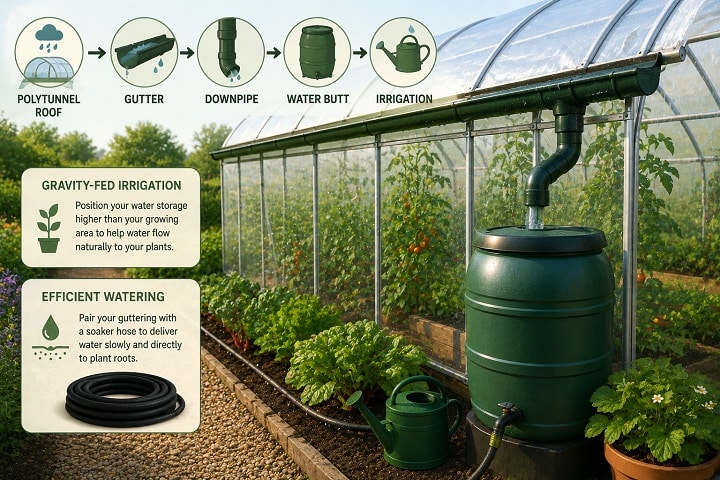
Polytunnel roof → gutter → downpipe → water butt → irrigation
A water butt beneath the downpipe can collect rainfall for later use. You can then use that water with a watering can or connect it to an irrigation system.
This is particularly useful during dry spells when water demand increases.
Gravity-fed irrigation
If water storage is positioned higher than the growing area, gravity can sometimes help move water towards crops.
For smaller gardens, this can be a simple way to distribute collected water without a pump.
You can also pair your guttering with a soaker hose for efficient watering, allowing water to be delivered close to plants rather than across the whole bed.
Match the irrigation system to the scale of your growing space. A water butt and hose may be all that is needed for a small garden.
Choosing the Right Guttering for Your Tunnel
Before buying anything, consider:
The tunnel
- Is it new or existing?
- What is the shape of the sides?
- How large is the roof area?
- Are there suitable fixing points?
The site
- How much rainfall does your area receive?
- Where does water currently drain?
- Does runoff create muddy areas?
- Is there somewhere suitable for a water butt?
How you grow
- Are you growing for household use?
- Do you have several tunnels?
- Do you already use irrigation?
- Will collected water be used regularly?
Your budget
A basic system may be sufficient for a small garden. Larger growing operations may benefit from a more robust system that forms part of the wider irrigation infrastructure.
The best solution is the one that fits your tunnel, site and growing system, rather than a universal recommendation.
Installation Tips for Better Performance
Getting the installation right makes a considerable difference.
1. Create a slight fall
Guttering needs to direct water towards its outlet rather than allowing it to sit in the channel. Follow the manufacturer’s instructions for the correct installation.
2. Secure the guttering
The gutter needs enough support to hold water without sagging. This becomes particularly important after heavy rainfall.
3. Position downpipes carefully
Think about where the water is going before fixing the downpipe. Ideally, it should lead towards storage or an appropriate drainage point.
4. Plan water storage
Position your water butt somewhere secure and accessible. If you have several collection points, you may be able to use more than one storage container.
5. Connect irrigation thoughtfully
Once you have collected water, consider how you will distribute it. You can build a custom irrigation system with LDPE pipe if you need a more flexible arrangement.
Looking After Your Guttering
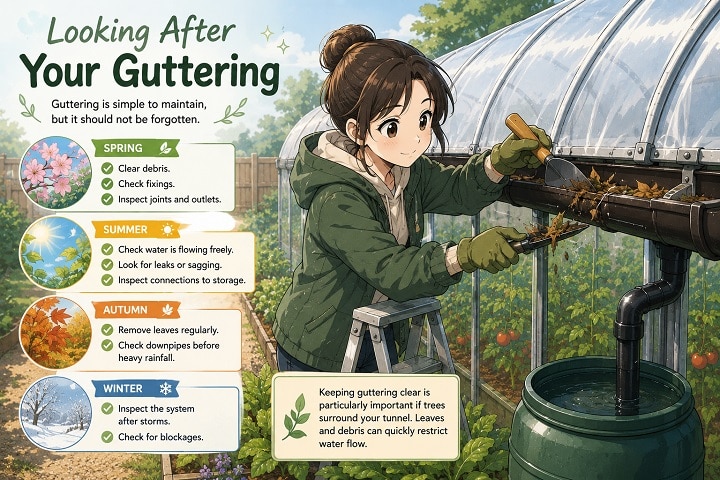
Guttering is simple to maintain, but it should not be forgotten.
Maintenance checklist
Spring
- Clear debris.
- Check fixings.
- Inspect joints and outlets.
Summer
- Check water is flowing freely.
- Look for leaks or sagging.
- Inspect connections to storage.
Autumn
- Remove leaves regularly.
- Check downpipes before heavy rainfall.
Winter
- Inspect the system after storms.
- Check for blockages.
Keeping guttering clear is particularly important if trees surround your tunnel. Leaves and debris can quickly restrict water flow.
When Might You Not Need Guttering?
Guttering is useful, but it is not essential for every polytunnel.
You might decide against it if:
- The tunnel is small.
- The surrounding ground drains well.
- You have no use for collected rainwater.
- Runoff does not cause problems.
- Installation would outweigh the benefits.
There is no reason to add an accessory simply because other growers have one. The best growing systems solve an actual problem.
Conclusion
The best guttering for a polytunnel is the system that fits your structure, site and way of growing.
Purpose-made guttering can offer a straightforward and durable solution, while carefully planned DIY systems may suit smaller projects or existing tunnels. Whichever approach you take, installation matters. The gutter needs to be secure, water needs to flow towards the outlet and the downpipe needs to lead somewhere useful.
Most importantly, think of guttering as part of a wider water-management system. By directing rainwater into storage, you can make better use of rainfall and return that water to your crops when needed.
If you are considering adding guttering, choose the best guttering system for your polytunnel before deciding which approach is right for you.
Frequently Asked Questions
Is guttering worth adding to a polytunnel?
It can be, particularly if you want to collect rainwater for irrigation or reduce runoff around the tunnel. It is less important if your site drains well and you have no need to harvest water.
Can you fit guttering to an existing polytunnel?
Yes, depending on the tunnel design and guttering system. Existing structures may need suitable fixing points or adaptations, so check compatibility first.
What is the best guttering option for a curved polytunnel?
This depends on the tunnel design and particular guttering system. Purpose-designed options can simplify fitting, while flexible or adapted guttering may work for some DIY installations.
Does polytunnel guttering need much maintenance?
Not usually. Remove leaves and debris, check fixings and make sure downpipes remain clear. Inspect the system after storms and during autumn leaf fall.
Can guttering feed an irrigation system?
Yes. Collected rainwater can be stored and distributed using suitable irrigation equipment. For a simple setup, a water butt and hose may be enough, while larger growing areas can use more extensive systems.
Sources
University of Maryland Extension (2026) Rainwater Harvesting on Urban Farms: Adding Gutters to Collect Rainwater from a High Tunnel. Available at: University of Maryland Extension (Accessed: 28 August 2026)