Common UK Weeds To Consider in Your Garden
Today, we’ll take a look at some common UK weeds. Weeds are simply plants that arise where they are not wanted. What is a weed in one location can be a useful wild plant in another location. What we call a ‘weed’ when it is growing in vegetable beds or garden pathways might be a very beneficial plant elsewhere.
So when talking about weeds, it is important to remember that it is all a matter of perspective. Whether a plant is truly a ‘weed’ or not depends entirely on where it is growing, and how we ourselves view it in that given situation.
In order to understand how and where we need to deal with weeds in our gardens, we need to learn more about the various plants we might encounter. So here is some information that might help you in determining whether or not you have a problem with a particular plant that pops up in your garden.
Very often, you may find that plants considered ‘problem weeds’ are not really a problem at all with the right perspective, and can be contained, and bring benefits in your garden.
Types of Common UK Weeds
Weeds is not a special botanical term, and so any plant growing where it is not wanted can be called a weed.
These plants are often not ones you have planted yourself. They can grow from the seed bank in the soil, from seeds dispersed by wind or wildlife, be introduced through compost or alongside new plants, or creep in via roots from the edges of your garden.
Understanding the characteristics and lifecycles of different plants commonly described as weeds is important in learning their downsides and benefits.
Weeds can be either annuals, biennials or perennials. Annual weeds have a single year lifecycle, and propagate by seed. Biennials have a two year life cycle, setting seed in the second year. Perennial weeds – often the most challenging to deal with – live for several years and often have deep tap roots and may spread below the soil, as well as producing seed.
Common Garden ‘Weeds’ Found in UK Gardens
Though the plants on the list below are certainly not always a problem, and can be extremely beneficial to have in your garden, here are some of the plants commonly considered to be weeds when they grow in the UK garden, in lawns or in cultivated beds:
Bindweed – Calystegia sepium/ Convolvulus arvensis

Bindweed is the name given to two problematic garden weeds. The first is Hedge bindweed and the second is field bindweed – Convolvulus arvensis. Both of these plants are trumpet-flowered perennials, which can actually look rather attractive in the right setting.
Unfortunately, both can be a bane for gardeners, since they twine around other plants, smothering them and affecting their growth, or even killing them. So while they may be welcome if not excessively growing in your garden, they are commonly a major issue where they grow more prolifically.
These plants can, however, be beneficial in a garden. The flowers provide pollen for bees and other pollinators, and are a source of food for lepidoptera species such as convolvulus hawk moths, for example.
Bird’s Foot Trefoil – Lotus corniculatus
Bird’s foot trefoil is a perennial nitrogen-fixing legume that is sometimes considered a weed in manicured lawns. But as you are no doubt aware, a wild lawn is a wonderful thing for garden wildlife.
So really, this relatively slow growing plant is not one to eradicate but one to welcome, along with the bees and other pollinators that will love these flowers.
Bittercress – Cardamine hirsuta
Though small and short-lived, hairy bittercress is a common UK garden weed that self-seeds prolifically and can spread quickly through a garden.
Hoeing and hand weeding are best if this weed encroaches on beds or borders, before the seed capsules form and burst open.
But it is also worth noting that this ‘weed’ is a useful wild edible – the leaves and flowers have a peppery cress-like taste and can be added to salads. And a range of beneficial insects will visit the blooms.
Bugloss – Lycopsis arvensis
This pretty blue-flowering plant is not always considered a weed, but can sometimes be unwanted when it occurs on disturbed ground or in lawns, which it can do on light or sandy soils. It is in the borage family and propagates by seed.
This plant, however, while not always wanted, is great for wildlife gardens and wildflower meadows, as it is wonderful for bees and other beneficial wildlife as a source of nectar in the summer months.
Cat’s Ear – Hypochaeris radicata
Sometimes also known as false dandelion, or flatweed, this is a low lying perennial herb found commonly in lawns. It is commonly mistaken for the dandelion, but has a forked and slid stem, unlike the true dandelion which has a single, unforked and hollow stem.
Again, while sometimes considered a lawn weed, this plant has edible leaves and roots. Unlike the dandelion (see below) the leaves do not usually have any bitterness and are pretty bland. Roots can be used as a coffee substitute.
Cleavers – Galium aparine
Cleavers have a lot of different names, most of which refer to the way in which the stems, leaves and seeds stick to clothing as we pass by. This weed grows quickly and spreads rapidly by seed, so can become a problem ‘weed’ in gardens.
But this plant is also great for wildlife, is edible when young before the stickiness arrives, and also has wonderful medicinal properties.
Clovers – Trifolium
Clovers are sometimes considered to be ‘weeds’ in lawns.
But both annual and perennial clovers bring wonderful benefits in a garden – for wildlife and for us – and even for the other plants growing around them since they are nitrogen fixing. They can be a very useful and effective ground cover in the right setting.
Common Chickweed – Stellaria media

Common chickweed is an extremely common weed that can thrive in a wide range of environments. It is a pretty annual with small white flowers, which spreads to create ground cover. In fact, while often thought of as a weed in vegetable gardens, it can be a useful companion plant, and also provides an edible yield for salads in its own right.
Couch Grass
This grass spreads by means of wiry underground stems and often encroaches on beds and borders. It can be difficult to eliminate but you can reduce it by raking out all the rhizomes and hand weeding where there is only a minor problem. You can also use ground covers and border beds with plants that restrict its growth into growing areas.
Cow Parsley
Cow parsley is an umbellifer also known as Queen Anne’s lace. It may grow abundantly in shade along hedgerows or under trees and can be pretty in a wildlife-friendly space. But it spreads quickly and can colonise large areas so may sometimes be considered a weed when it pops up in gardens.
Creeping Buttercup
Thriving in gardens with wet soil, and spreading quickly, this plant with its bright and cheerful yellow flowers can look lovely, but does have a tendency to take over.
It can be a great addition, however, to a moist, flower-rich lawn, but can be annoying in a garden when it spreads prolifically with its long runners underground. You can dig it out if it is unwanted, and hoe repeatedly in summer, but could also leave it in many places for the pollinators to enjoy.
Creeping cinquefoil – Potentilla reptans
This is another lawn ‘weed’ that has taproots that need to be dug up to eradicate it where it is not wanted. But it can be extremely beneficial for butterflies and other wildlife so it is often best to leave this plant in place when it appears in a lawn. And it can be a good ground cover to consider in a dry and free-draining site.
Cuckoo Flower – Cardamine pratensis
Related to hairy bittercress, mentioned above, is another wildflower sometimes considered to be a weed in lawns. But it, like so many other plants considered ‘weeds’ in the UK, it is great for butterflies, bees and other insects. It is also edible and was also once used as a substitute for watercress.
Daisies – Bellis perennis
The lawn daisy is a pretty flower that many are perfectly happy to have in their lawns but sadly, it is still considered a weed by some who want manicured grass. Again, this is a pretty flower, great for wildlife, and is another edible wildflower in the UK.
Dandelion – Taraxacum
The dandelion is perhaps one of the most well known ‘weeds’ found in gardens. But while many are perfectly happy to have these plants, some don’t like them in the lawn.
Dandelions are great for wildlife and once again, also have a range of important edible uses for us.
Dock – Rumex crispus/ Rumex obtusifolia

Curly dock and broad-leaved dock can, with their deep tap roots, be a pain for gardeners who wish to remove them.
But dock is useful (and not just for its purported use when stung by nettles). It is also an edible weed. The leaves can be cooked and eaten when young, and the seeds are extremely useful for making a dock seed flour which, like buckwheat flour, can be used in a range of ways.
Fat Hen/ Lambsquarters – Chenopodium album
This plant is grown in cultivation in some areas, but is often considered a weed in spite of its many uses. The leaves and young shoots can be eaten in moderation, and the flower buds and flowers can be cooked and eaten too. The seeds can be used like those of the related quinoa plant.
Ground Elder – Aegopodium podagraria
Ground elder spreads rapidly by underground runners and by seed and can quickly take over an area of your garden. It can indeed be very difficult to get rid of. But one good way to weaken it and halt its spread is to eat it! Yes, you can indeed cook and eat the young leaves and stems, which have a slight celery taste.
Groundsel – Senecio vulgaris
This is a common annual weed that often pops up in disturbed ground. This wildflower may seem a pain as its seeds prolifically. But it is typically rather easy to remove, and can be beneficial in a wilder, wildlife-friendly space.
Hogweed – Heracleum sphondylium
Common hogweed, not to be confused with the dangerous giant hogweed, is also known as cow parsnip, for its deep tap root that also makes it very hard to remove. While some care is definitely required with this plant and its identification, it can be useful as a fast-growing mulch plant for your compost heap or forest garden, and the seeds and young shoots and leaves are used as edible yields.
Nettles – Urtica dioica
Easily recognised by all, the stinging nettle can be annoying in a garden. But both annual and perennial types are very useful – as edible, medicinal and fibre plants. They have many uses for us and of course are also wonderful for a range of wildlife.
Plantains – Plantago major/ Plantago lanceolata
These are also common UK weeds of lawns, pathways and disturbed ground. But again, though they can pop up prolifically, they can be more of a boon than a problem.
Plantains are edible, and have many important uses in herbal medicine too.
Ragwort – Senecio Jacobaea
Ragwort is a biennial weed that is not typically a major problem in gardens – but can be a serious problem for paddocks, and for gardens backing onto fields with livestock, as the plant is poisonous to cattle and horses. Where livestock do not roam, however, it is great for wildlife, and is a bee and butterfly friendly flower.
Rosebay Willowherb
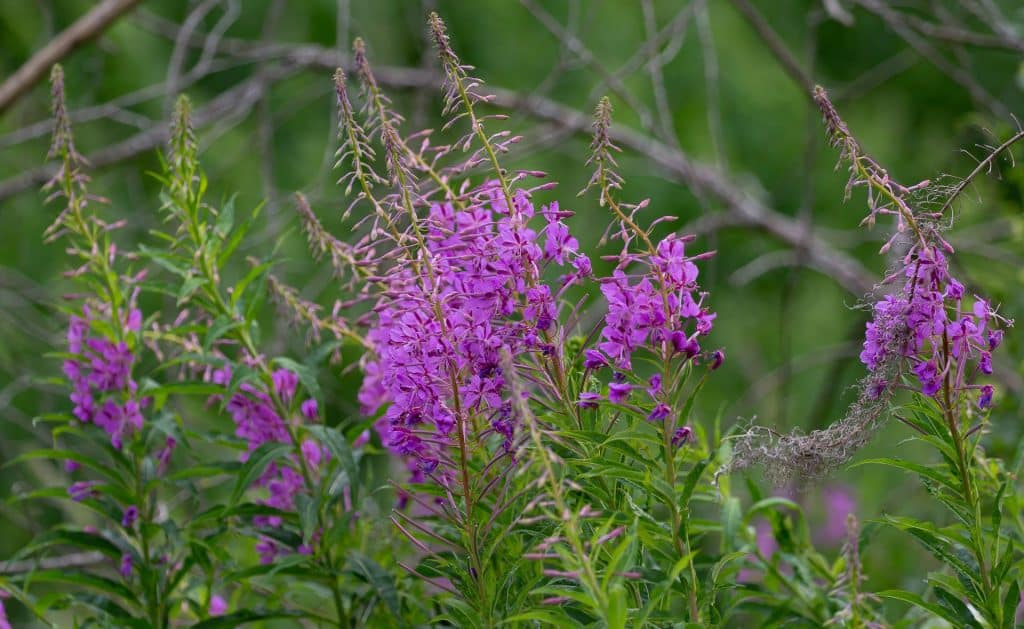
Rosebay willowherb are prolific and dramatic wildflowers and common UK weeds that can look beautiful, but can also have a tendency to colonise large areas of disturbed ground. It is easy to pull up, however, so not a major issue. And also has edible uses.
Thistles – Cirsium arvensis/ Cirsium vulgare
Thistles can quite literally be a pain in many gardens, with their sharp spines and deep tap roots that make them difficult to remove. But live so many other plants considered ‘weeds’ these can be very useful in a wildlife-friendly garden.