

If you have just purchased a polytunnel, you are no doubt focussed on what you will grow within it. But what you plant around a polytunnel can also be important.
You might not have really thought much, if at all, about the edge spaces around your new undercover growing area. But no matter how large or small the area where you have placed the polytunnel may be, you should think about making the most of the space.
A polytunnel does not only affect the environment within it. It can also enhance the area in its immediate vicinity. It can make a difference to the heat adjacent to it, and shelter those plants grown behind it. (Sheltered from prevailing winds, which typically come from the south west in the UK).
Whether we are talking about a domestic polytunnel, or a larger commercial structure, making the most of edge spaces can make a big difference. Plant wisely around a polytunnel and you can really make the most of all the land available to you.
Careful exterior planting can also allow the polytunnel to settle more harmoniously into its surroundings. And stop it from sticking out like a sore thumb. It can make the polytunnel nestle more into its environment, and make it more attractive as a feature in your garden, allotment, or in the wider landscape.
Key Considerations When Choosing What to Plant Around a Polytunnel
Of course, when you plant around a polytunnel, you need to think carefully about what you place around the structure. The first and most important thing, of course, is not to plant anything that could grow and damage the polytunnel cover.
Another thing to think about is that you do not want to plant anything which will spread too easily. Don’t plant anything that might creep in under the edges to invade your main growing areas. In fact, if you make the right choices, you can plant to avoid weeds from doing so.
You will also need to think carefully about light and shade. And not plant anything that will overly cut the amount of light that reaches plants growing inside. This usually means that, especially to the south of the structure, you should not plant anything too tall. Planting to the north, however, might be somewhat taller without ill effect.
Remember, the south side of a polytunnel will usually be far sunnier, while the north side will be much more shaded. The amount of light received by each edge of the polytunnel is one of the most important things to think about when choosing what to grow.
What To Plant Around a Polytunnel
So, taking these key considerations in mind, what options are there when it comes to what to plant?
Leafy Vegetables
In a garden, on an allotment, or on a farm, your first option is to grow more edible crops in beds around the boundary of the structure. Which crops will suit will of course depend on the climate, conditions and other characteristics of the site. It will also depend on the structure itself, and whether the cover is buried in a trench, or held down with solid base bars.
Typically, in any scenario, growing leafy lettuce and other quick growing salad crops in a narrow bed around the edge of the polytunnel can be a good option. In certain locations, you may be able to grow leafy greens in these beds throughout the year, especially if a little extra protection is provided with cloches or row covers over the winter months.
Usually, it will be best to avoid growing root crops, or tubers which will involve disturbing the soil and to stick to vegetables which provide a yield from above the ground, and which will not grow too tall.
When choosing edible crops for an edge bed around a polytunnel, it is also a good idea to consider perennial leafy greens, which will return and provide a yield with far less effort on your part year after year. Other smaller edible perennials like perennial onions, for example, might also be worth considering for these small edge spaces.
Strawberries
Another option might be to grow strawberries (either the garden varieties on sunnier sides, or the alpine/ woodland strawberries where there is more shade. Growing these in a thin strip around the structure could allow you to make the most of every inch of space.
Plant Herbs Around a Polytunnel
Of course, you could also use the edge space around a polytunnel to create a herb garden. You could grow a wide range of the lower growing annual, biennial or perennial culinary or medicinal herbs. Chamomile, and thyme, for example, are two lovely options, which can stand occasional food traffic.
Nitrogen Fixing Cover Crops
When choosing what to plant, it is important to remember that while the polytunnel divides the space above the ground, the soil ecosystem below continues beyond the edge of the structure. Even with the polytunnel in place, the rhizosphere continues unbroken underground. Soil biota can transport nutrients and water from outside your polytunnel to the interior – and vice versa.
So if you are growing food within your polytunnel, it could be a good idea to companion plant even when there is a polytunnel cover between crops grown inside and those grown just outside. Planting a nitrogen fixing cover crop just outside the polytunnel could potentially bring benefits to those growing just inside.
Clover is, in the UK, one of the most obvious choices. It is hard to beat for a low maintenance cover crop. And it can be mowed/ strimmed and the material used as mulch or in compost creation. If allowed to flower, it will also bring other benefits – attracting pollinators and predatory insects to keep pest numbers down.
Flowering Plants
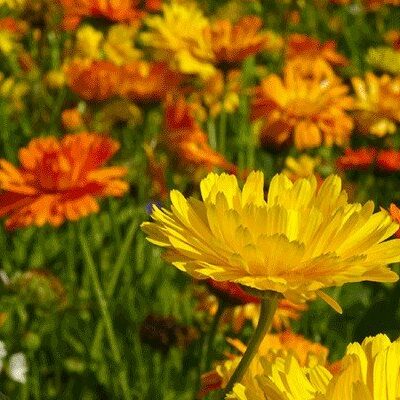
You might also consider planting a range of different flowers around your polytunnel – ones which will not grow too tall. You could, for example:
-
Choose a range of annual bedding plants.
-
Sow annuals each year, either garden flowers or annual wildflowers/meadow flowers. Some may even be selected which will self-seed readily each year.
-
Select low-growing herbaceous perennial flowers that will come back each year.
There are, of course, a wide range of low-growing flowering plants to consider which will enjoy the conditions around all the different sides of your polytunnel, from the sunnier, hotter south side to the shadier and cooler, but sheltered north. Any flowering plants that you might consider for the front of a herbaceous border could be ideal to plant around a polytunnel without any detrimental effect on the plants grown within.
Of course, you could simply have grass or a pathway along the edge of a polytunnel. But making the most of these marginal spaces and taking the time to plant around a polytunnel in more interesting ways could be a very good idea.
What have you planted around your polytunnel? Let us know in the comments below.