What is Salsify and Why Grow It in Your Garden?
If you want a good producing garden that also looks good, salsify is one interesting and useful option to consider. There is a growing interest in growing ‘edimental’ plants – or plants that are edible and ornamental. And salsify, with its edible yields and pretty flower, is a plant that definitely fits the bill.
What is Salsify?

Salsify is one of the common names given to Trapogon porrifolius. This is a biennial wildflower native to southeast Europe and North Africa but naturalized in parts of southern and central England, and elsewhere, and now found growing wild in almost every state of the US.
This plant grows around 1.2m in height. It has a long and typically unbranched stem, and somewhat grass-like leaves. In its first year, it will root, and produce edible leaves. Then, between May and September, in its second year, it produces a flowering head around 5cm across, with a purple bloom surrounded by green bracts.
In the British Isles it was initially grown for its flower, but became a fairly popular root vegetable in the 18th Century before largely falling out of favour until a resurgence of interest in the present day.
Why Grow Salsify?

Salsify is primarily grown for its edible root, or its attractive flower. The root has a delicate, sweet flavour said to resemble the taste of an oyster, hence other common names for this plant, such as oyster plant and vegetable oyster.
However, salsify is one plant that can do ‘double duty’ as both a root vegetable and as a plant for asparagus-like spring shoots. By planting some salsify to harvest the roots and some to harvest the shoots, you can get two useful yields from one plant species.
Of course, if you overwinter the roots in your garden, you can enjoy the blooms in the second year. You can also eat the flowers in a salad. And save seeds to sprout. Sprouted salsify seeds are great for salads or sandwiches.
Raw salsify is 77% water, 19% carbohydrates, 3% protein and contains negligible fat. In a 100 gram reference amount, raw salsify supplies 82 calories and moderate contents of riboflavin, vitamin B6, vitamin C, manganese and phosphorus.
Sowing Salsify
If you would like to grow salsify, the first thing you will need to do is source some salsify seeds. You might like to consider growing a named cultivar, which tend to have slightly bigger roots. Options include, for example ‘Sandwich Island’ and ‘Scorzobianco’.
Seeds are best sown where they are to grow in spring, between March and May. It is best to get the seeds into the ground as early as possible for the best results. So those with a polytunnel will be at an advantage.
The key things to remember when choosing where to grow salsify is that it likes similar conditions to root vegetables like parsnips and carrots with which you may be more familiar.
Salsify seed must be fresh as the seeds quickly lose viability. Germination can be erratic, so it is best to sow more seeds than you need as as to increase the chances of success. A sunny, warm site is essential, and light, free-draining, not-stoney soil with plenty of organic matter is ideal.
You can either sow 2-3 seeds in holes 1-2cm deep at a spacing of around 10cm, traditionally with 30cm between rows, or slow along rows then thin to create a spacing of 10cm between plants as they grow.
After the seeds germinate and the plants begin to grow, it is a good idea to lay a mulch of good quality homemade compost around your salsify. This provides some nutrients for the growing plants, and helps conserve water in the soil.
But it also, crucially, helps to suppress weeds in the bed where salsify is growing, which is important, especially when they are in early growth. Remove any weeds that do occur carefully by hand to avoid damaging the roots.
Companion Plants for Salsify
Salsify likes its space, and needs an airy and open environment in which to grow. Overcrowding can increase the prevalence of fungal infections like rusts and powdery mildew.
However, there are a number of companions that can be beneficial, reducing the incidence of fungal infection for salsify plants. Vetch (Vicia sativa) and Phaecelia tanacetifolia can be good companion plants.
In a vegetable garden, good companion crops include carrots, parsnips, radishes and mustard greens.
Caring for Salsify
The most important thing when growing salsify is to provide consistently moist conditions, but to avoid any waterlogging or compaction. The taproot will develop best in moist conditions, in a loose, friable soil with plenty of organic matter.
It is only a moderate feeder and not a particularly ‘thirsty’ plant, however, so it is relatively easy to grow. So making sure that the soil remains moist is the key job.
If a drought does set in, and soil moisture is not maintained, the plant can bolt (flower and set seed prematurely).
If you do not plan on harvesting roots in the autumn or winter, then you can protect the tops with a layer of straw or bracken so that it gets through the winter months without frost damage. However, in very cold areas, or where waterlogging can be an issue in winter, you may be better to carefully lift the roots and store them in sand or sawdust in a cool, frost-free location.
Harvesting Salsify
Remember, there are two main harvests that can be obtained from these plants – the roots, and the young shoots, which are typically blanched and then eaten like asparagus in spring. Of course, if you harvest all of the roots, you will not be able to obtain the shoots. Nor will you be able to enjoy the flowers the following year.
So consider harvesting some salsify roots, but allowing some to remain in the ground to produce different yields the following year. And remember that you might also enjoy other secondary yields from these useful plants.
Harvesting Salsify Leaves
If you are planning on harvesting the roots or allowing the plants to enter a second season, then you will not want to take too many. But you can harvest leaves every now and then during the first summer if you wish. These leaves are good in salads and have a mildly sweet taste.
Harvesting Salsify Roots
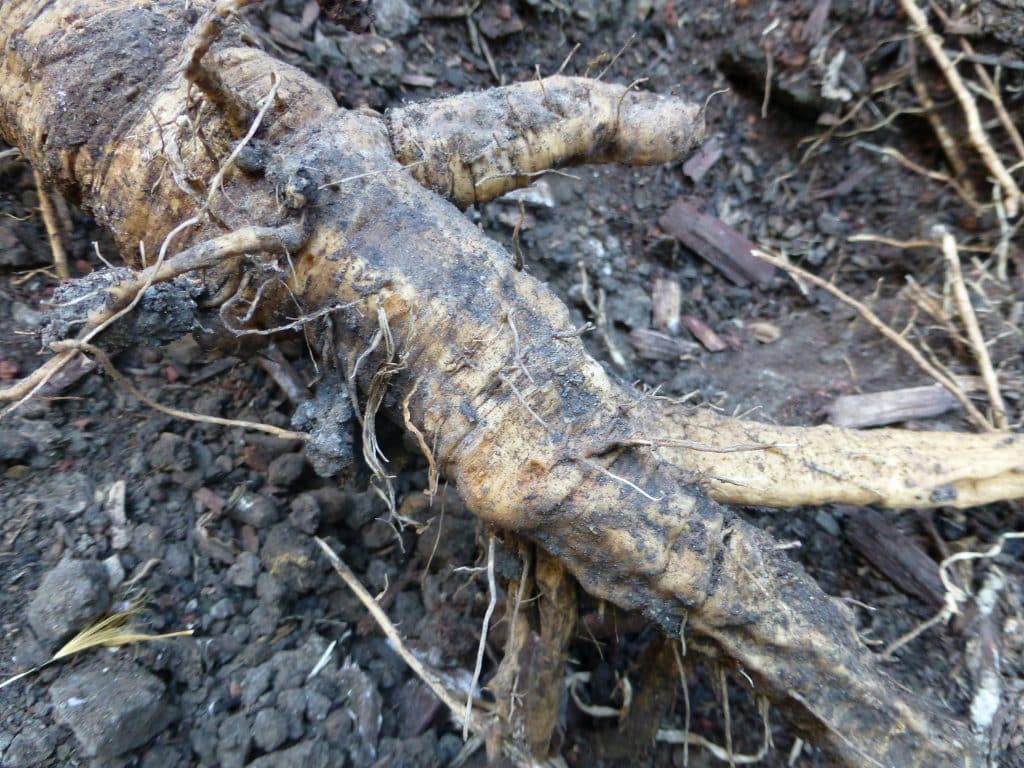
Salsify roots will be ready to harvest from the end of September through to December. The roots taste better after the first frosts, and in much of the UK, you can leave the roots in the ground and harvest as required, as long as waterlogging is not an issue.
If waterlogging is an issue, you can simply lift the roots in autumn, and store them as you would store carrots inside your home.
To harvest the roots, take a garden fork and very carefully ease the roots up and out of the ground. You have to be careful when harvesting as the roots snap easily.
Raw young roots can be grated for use in salads, but older roots are better cooked. They can be added to soups, stews or stir-fries. They are also good pureed, either on their own or with potatoes.
Harvesting Salsify Shoots in Spring
When roots are left in the ground all winter, in spring, new shoots will begin to grow in spring. If you wish to harvest these shoots to use like asparagus, then you should cut back old foliage to within 2.5cm of the soil in the early spring.
When the new shoots emerge, you should earth them up, as is common with potatoes, or mound mulch of straw or bracken around them. The idea is to blanch the shoots by excluding light. Blanching makes these shoots more tender.
Aim to mound up over the new shoots to a height of around 12-15cm.
When the shoots appear above the mound, you can carefully clear back the soil or mulch and cut off the blanched shoots at the base.
Spring leaves can also be cut when 15cm tall, without blanching, but these are not so tender.
If you leave the plants to grow into their second year, you can enjoy the flowers, and put the flowers in salads if you wish. You can also allow the plant to set seed, then collect and sprout those seeds as a healthy addition to your homegrown diet.
As you can see from the above, this is a very useful plant that could be an interesting addition to your garden.
References:
https://pfaf.org/user/plant.aspx?LatinName=Tragopogon+porrifolius