Square foot gardening is a concept designed to help beginners find some order when designing the layout for a vegetable bed, and to grow more food in less space. However, a square foot garden plan is vital to ensure it all goes right.
This type of gardening is not for everyone, and you should remember that these are simply guidelines for one particular method of growing, and not hard and fast rules that you must follow. However, thinking about square foot gardening can help you to think more about plant spacing, and what to plant where within raised beds in your garden.
What Is Square Foot Gardening?
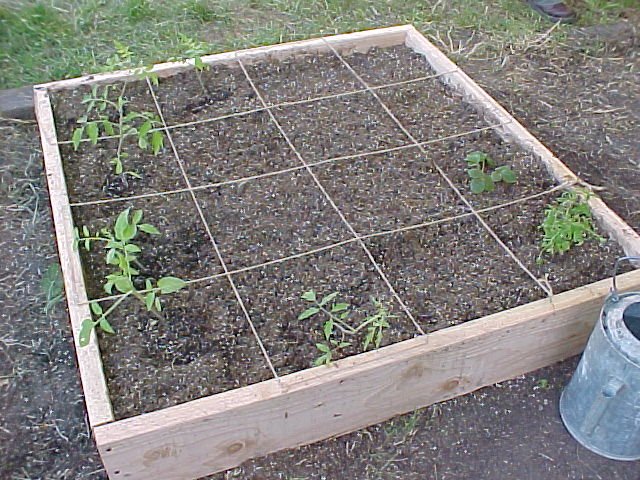
Square foot gardening is a concept and system for raised bed growing and plant spacing created by retired engineer Mel Bartholomew in the late 1970s. This concept and system was created to enable more plants to be grown in less space.
In this system, raised beds that are 4ft square are created. These beds are then separated into sixteen one foot squares, forming a grid.
Each of these squares is then planted with a different crop. The number of plants in each square depends on the size and requirements of the crop planted in each. Once each square foot is harvested, another, different crop can be planted within it, allowing for a continual harvest.
Others have since built on these ideas to create a range of different types of small-space ‘grid’ type gardening. Colloquially, all of these systems are referred to as ‘square foot gardening’. In essence, the idea is to do away with the measurement between rows, and look only at the plant spacing requirements. The idea is to determine how many of each will fit within smaller (often raised) beds.
What Are The Benefits of A Square Foot Garden Plan?
One of the main benefits of putting together a square foot garden plan or intensive bed gardening is that it can give you high yields in small spaces. This means that it can be a great foundation on which to plan a small domestic garden.
The orderly nature of the system also makes it easier to stay on top of things. You can easily create a good plan for the whole gardening year. This means that it is a great choice for those who are just learning about gardening, and for those new to growing their own food.
Growing a variety of different crops close together is a neat form of companion planting, which increases biodiversity. Again, this helps to reduce the threat posed by pests and disease.
Intensive planting also minimises bare soil and acts like a cover crop to protect the important soil ecosystem that lies below. Closely planted crops also help to minimise the number of weeds that germinate and establish in the beds.
Intensively planted smaller beds (either in the ground or raised beds) can also easily be covered. You can use cloches, cages or cold frames to protect your plants more easily than you can do if growing in rows.
However, these smaller beds may not be the best choice for all plants. Some, more sprawling plants will do better with more space than is generally available.
Another thing to consider is that if you are square foot gardening in raised beds, these will require more water, as they will dry out more quickly than in in-ground growing growing areas.
Fewer weeds develop in square foot gardens. But those that do establish are harder and more time consuming to remove. You will have to weed little and often, by hand, rather than going between traditional rows with a hoe.
Those who like order may find it beneficial to adhere to the principles and rules of a square foot garden plan to get started, as this can help tame the chaos of a more free and natural garden design.
However, I generally feel that having a square foot garden plan is beneficial as a starting point rather than an end destination – know the rules, in other words – but know when you might be able to break them and when to adjust things to suit your own particular situation.
Rules For A Square Foot Garden Plan
So, let’s examine the rules of the original square foot garden plan concept and take a look at where we need to adhere to these rules, and where we might deviate from the original concept in order to have a more sustainable, natural and eco-friendly garden.
What Size Is A Square Foot Garden?
The original concept calls for the creation of raised beds for gardens that are 4ft by 4ft. This means that there are 16 grid squares in total, each of which can be planted up with a specific number of plants.
However, while beds with sizes of 4ft are the norm for this gardening strategy, you might make beds of any size and shape, as long as you can reach all the squares easily without stepping on the soil, and as long as the bed has sides with a certain number of whole feet.
For example, you might create a raised bed that is 4ft wide and 8ft long. Or even longer. But to maximise edge (the most productive and biodiverse part of a system) you might prefer to have more smaller beds rather than fewer large ones.
How Deep Should A Square Foot Garden Bed Be?
How deep your raised beds need to be depends on the plants that you wish to grow in them. Generally, however, the recommendation is that the beds should be at least 15cm deep (for shallower rooted plants) and ideally at least 30cm deep if you are growing most common crops.
Personally, I prefer to make sure that my raised beds are more like 35cm deep, as this means that they are better able to accommodate a wider range of plants.
What Soil To Use In A Square Foot Garden?
The original square foot gardening methods involves the use of a very specific growing medium to fill the beds. Mel Bartholomew recommended using a mix of 1/3 compost, 1/3 peat, and 1/3 vermiculite.
However, today, many of us, myself included, understand that both peat and vermiculite are materials that come at too great a cost.
Peat comes from peat bogs – immensely valuable and precious carbon sinks and biodiversity hotspots and peat should therefore not be used in an organic and earth-friendly garden. And as a mined material, vermiculite is also a material that I and many others prefer to avoid in our gardens.
Instead, I prefer to utilise natural and swiftly renewable materials when filling raised beds.
The mix above is good for vegetable growth. But a better solution for sustainable gardeners today is to use the lasagna bed method to fill raised beds – ideally using materials sourced from the garden itself, or as locally as possible.
Here is my recipe to fill raised beds:
- Start with a layer of cardboard over the existing lawn or soil.
- Next, layer wood chip or other carbon rich material around 5cm thick.
- Cover this with a c.5cm layer of green, leafy material.
- Create another carbon rich layer (such as a layer of autumn leaves).
- And another nitrogen rich layer – such as green mulch or well-rotted manure.
- Repeat until the layers bring your bed almost to the required height.
- Finally, top your bed with a layer of loam, homemade compost, or leaf mould.
How To Create A Square Foot Garden Plan
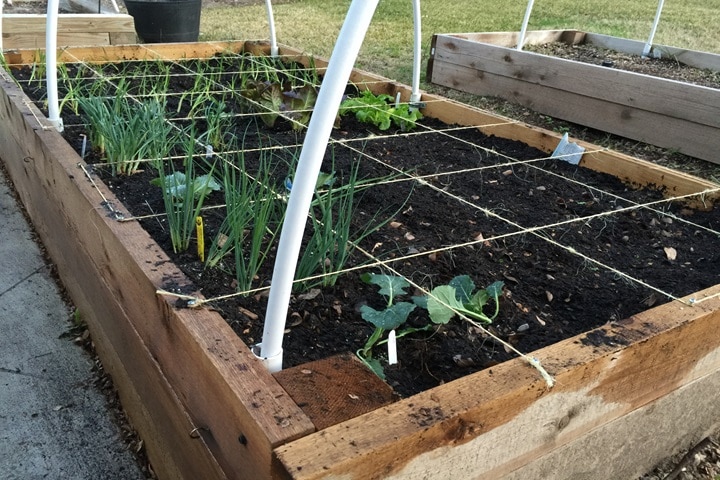
If you are planning on creating a new raised bed and growing your own for the first time, before you even make your new bed you should get the basics in place so that it is easier for you to grow food successfully and keep the garden healthy over time.
Set up a rainwater harvesting system so that you can always keep your bed well watered. Remember, growing in raised beds likely means that you will need to water a little more frequently than you do when growing in the ground.
If you do not already have one, you should also make sure before you begin that you set up a home composting system. There are a range of different options to choose from, but having your own homemade compost is essential because you will need to keep top dressing the bed with this each year to keep the plants within it growing well.
Positioning Raised Bed Gardens
Once you have the basics in place, you need to make sure that you place your square foot garden bed in the right location for the needs of the plants you wish to grow. Remember, most common crops will require a sunny and relatively sheltered location.
Plants For A Square Foot Garden Plan
Spacing in a square foot garden involves determining how many plants of each type can be planted in each square foot. Usually, for common crops, this will be a number between 1 and 16. Occasionally, however, you will find a recommendation to use one than one square foot for a plant.
Personally, I often begin by thinking about either row crop or square foot garden spacing for particular plants, then play around with this a little as I work to create polycultures with beneficial companion plants. Don’t be too tied to the rules as you think about beneficial practices like companion planting and successional sowing in your organic garden.
FAQs
How big is a square foot garden?
A square foot garden is typically organized in blocks that are 1 square foot each. The total size can vary based on the number of blocks used.
How do I figure out the square footage of my garden?
To calculate the square footage of your garden, measure the length and width of the area in feet and multiply these numbers together to get the total square feet.
How many square feet is a 4×4 garden?
A 4×4 garden is 16 square feet, calculated by multiplying the length (4 feet) by the width (4 feet).
Sources
Roberts, S., (2016) Mel Bartholomew, an Engineer Who Popularized Square Foot Gardening, Dies at 84. New York Times. [online] Available at: https://www.nytimes.com/2016/05/08/nyregion/mel-bartholomew-an-engineer-who-popularized-square-foot-gardening-dies-at-84.html [accessed 20/09/24]