

A favourite flower for many, roses are the epitome of romance, and exude an old-fashioned charm. Rose gardens make these attractive flowering plants the stars of the show. Designing and creating the perfect rose garden is a goal for many gardeners, who wish to grow and show their favourite flowers.
What is a Rose Garden?
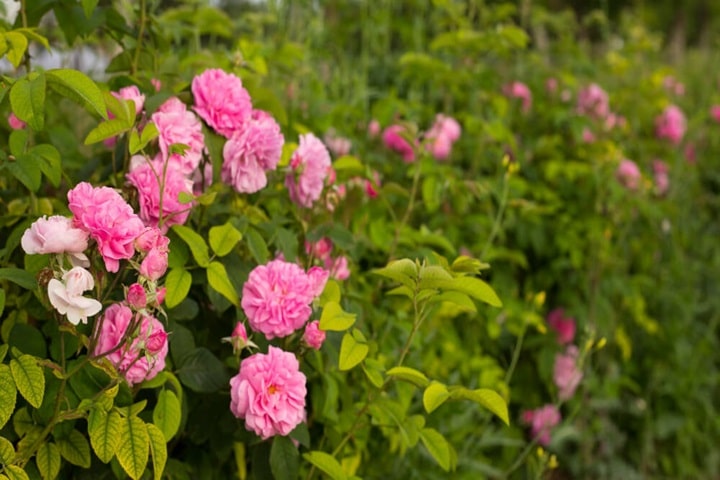
A rose garden is simply a garden or public park where various different garden roses and species roses are grown and displayed.
The origins of this type of garden go right back to at least the middle ages in Europe, and elsewhere, cultivation has a much longer history.
Roses have been bred in China for over a thousand years and it is believed that the rose was first cultivated in Babylonia, Assyria and China around 5,000 years ago.
In the 19th Century, hybridisation of roses began, after cultivated roses from China were introduced to European growers. A boom in cross breeding meant that many new rose varieties were created. Rose gardens became very popular as a means of showing off these new varieties.
Rose Garden Ideas
You might use roses:
- As key elements in beds or borders in gardens of a range of different styles.
- As a hedgerow or as part of a mixed hedge.
- On pergolas, arches, obelisks or other structures in a garden.
- Around a doorway or key seating area.
- On or around a balcony or terrace.
- Trained along fences or walls to soften those structures.
- In containers in even the smallest of spaces.
While they do have specific environmental needs, roses are versatile plants that can work very well in a wide range of different settings as long as you make the right choices.
1. Roses in Beds and Borders
Roses can be used as prominent shrubs, as backdrop, or as groundcover near the front of beds and borders, since there are so many different roses to choose from of different sizes and habits of growth.
No matter what overall style and theme you are going for in your garden as a whole, roses can frequently be important elements within it.
Think about how you can use roses of different shapes and sizes to create a lush and layered impact in your garden beds and borders – to make the most of their beauty and versatility. By combining different roses, as well as combining roses with other plants and elements, we can create a truly astounding range of very different gardens.
2. Roses for Hedging
One great way to incorporate roses into a garden design is to use them for hedging, or as part of a mixed hedgerow scheme. Native roses such as Rosa canina can work wonderfully for a wildlife-friendly hedgerow alongside other native shrubs and trees. This type of hedge can be pruned and trimmed more neatly, or left to develop a more natural shape and form where space allows.
Cultivated garden roses – shrub roses and hybrid tea roses, and smaller patio roses, might also be used to create low hedges, or partitions between paths and beds, or between different parts of your garden.
3. Roses on Garden Structures
Climbing roses and rambling roses open up a whole new range of options for your rose garden design. They offer the chance to use roses up a range of different support structures that can serve to define different areas of the garden, or work as focal points.
For example, you might grow roses up the vertical posts of a pergola or gazebo in your garden. It can be especially lovely to use fragrant roses for the purpose, especially if there is a seating or dining area below the structure where you plan to spend plenty of time.
Smaller seating areas and nooks with benches can also have roses on a structure over them to create an arbour for rest and relaxation. Such a seating area, cleverly placed, can help you to feel fully immersed in your beautiful rose garden.
4. Roses Round the Door
When you think of a quaint cottage, roses around the door may be a key part of the picture. Growing some climbing or rambling roses up and over a porch structure, or simply on the walls of your home to either side of the front or back door, could be an important step in turning your garden into what you want it to be.
Roses round the door might also help in blending the inside and outside areas of your home – making your home interior feel part of the rose garden outside.
5. Roses on a Balcony
If you do not have a lot of outside space, even a balcony could become a rose garden if you grow roses up the wall and around the balcony railing, or if you keep roses in pots on the balcony itself. Small patio roses are ideal for small spaces and container cultivation.
6. Roses Trained on Walls or Fences
Climbing or rambling roses are ideal for those who have walls or fences that they wish to hide or disguise. A rose garden can extend beyond the beds onto the boundary structures of the space, where they can help to blur the boundaries – potentially helping to make the space feel bigger than it actually is.
As long as you choose a rose variety that is well suited to the specific aspect and to the space available, this is another key way to introduce more beautiful roses to your garden.
7. Roses in Containers
Roses can be relatively easy to grow in containers, though of course you will likely need to water more frequently than you would when growing roses in the ground. You also need to make sure that you choose the right growing medium, and pay attention to maintaining fertility over time.
How to Start a Rose Garden
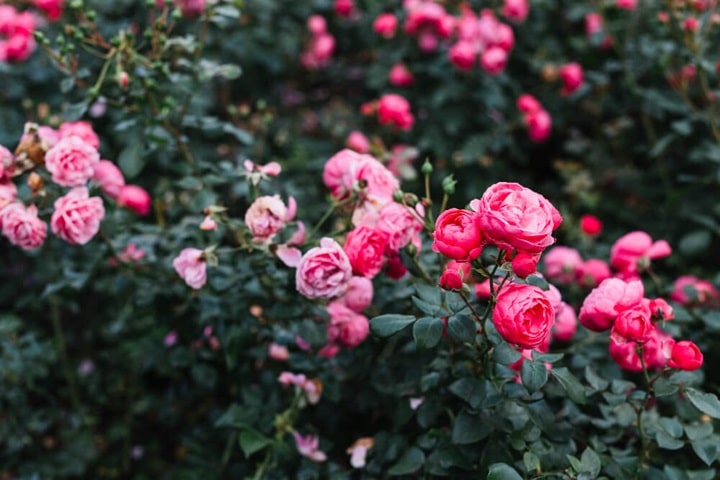
What you can see from the ideas above is that anyone can start a rose garden, as long as they have a small outdoors area to play with – no matter how large or how tiny that space may be.
- Choose Your Site
The first stage is to select a suitable site for a garden dedicated to roses. Of course, a rose garden need not be a place that is only ornamental. Roses might also find their places in edible planting schemes, in different situations around your garden. Where we wish to have roses as the focus, however, we need to make sure that we have a site that is suited to their needs.
Roses usually do best in a sunny position, though some are suited to light shade. Most roses will flower best in full sun.
The soil or growing medium is also very important for success. Roses do best with a fertile, humus-rich, moist yet well-drained soil. They cannot do well in soil that is too dry, and poor, nor in soil that becomes waterlogged.
- Make a Plan
To get the best results in any garden, it is always best to make a plan before you actually begin planting. You need a good plan for the overall layout of your rose garden and the elements that will be included within it, as well as a plan for specific planting of individual roses and other plants.
- Consider Style and Colour Scheme
Before you choose specific roses, make sure you have a clear idea of the style and colour scheme that you are going for.
Once you have decided what you want your garden to look like, you can begin to hone in on the more specific details and determine which roses you will actually grow – there are of course many different cultivars to choose from.
- Prepare the Soil
Roses respond very well where attention has been paid to the health of the soil. Where roses are being grown in the ground, make sure that the area has been well-prepared before planting. Weed well to reduce any potential competition in the area, and enrich the area with thick mulches of organic matter – replenishing the mulch upon planting and again annually each spring.
- Select Plants
Choosing specific roses can be challenging as the selections on offer can be somewhat overwhelming – especially if you are new to the world of roses. There is just a staggering number of roses to choose from.
Some of the key things to think about when choosing roses include:
- Type of rose, size and growing habit. (Are you looking for a shrub type, a climber or rambler? Etc. How much space is available?)
- Bloom characteristics. (Repeat flowering, continuous flowering or single flowering? Size, single or double blooms, shape, colour, fragrance?)
- Tolerant of poorer soils/ shade or other adverse conditions?
- What features are offered other than blooms? (Decorative foliage/ stems/ thorns/ hips?)
- Is the rose you are considering suited to the location and way in which you wish to use it?
- Care for Your Roses
Roses have relatively deep roots so those in the ground typically do not need additional watering. But they may need a drink during prolonged dry spells and you should take care not to let the soil or growing medium dry out entirely.
Feeding roses is typically a good idea – as well as mulching each year, feed roses with a potassium rich liquid plant feed while they are in bloom, and you may also fertilize with organic fertilizer each spring.
Deadhead roses to encourage more blooms, but stop from mid-summer if you would like the hips to form. The hips can also be decorative and are a useful food source for birds and other wildlife in winter.
Prune roses according to their type – pruning instructions differ for different species and varietals.
Look out for pest and disease problems.
Rose Garden Design Tips
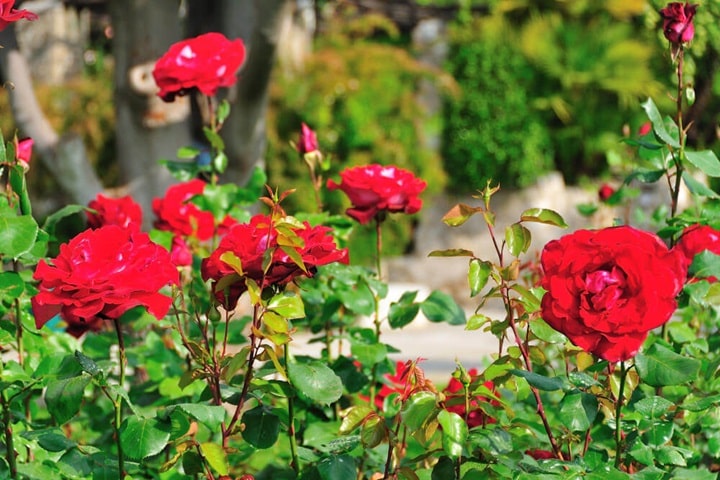
Here are a few tips to help you with the design of your rose garden:
Keep Scale in Mind: Rose Gardens for Different Sized Gardens
Rose gardens can have different looks and different considerations to bear in mind depending on whether they are large or small. When making your choices about layout and specific plants, always bear scale in mind.
Tips for a Large Rose Garden
- Plant roses in groups of 3-5 for greater impact.
- Select larger species to that are not lost in the shuffle and can stand out as the stars of the show.
- Layer roses (and other plants) for a lush and diverse look, with climbers or ramblers up walls or fences at the back of borders, shrubs in the middle, and smaller shrubs and groundcover roses to the front.
- When planting many different roses, keep a colour scheme in mind and do not select roses with too many different hues or the garden can look cluttered and busy.
Tips for a Small Rose Garden
- Make sure you know how large the roses you are considering will grow – some may quickly take over the place.
- Grow roses vertically (climbers or ramblers) to make the most of the space.
- Take a look at little patio roses and small groundcover roses that work well in containers in even the smallest of gardens.
Make the Most of Vertical as well as Horizontal Space
Making the most of the vertical as well as the horizontal space is a good idea not just in the very smallest of garden spaces but in larger gardens too. Make sure that you consider how to make your rose garden reach for the skies.
Utilise the Characteristics of Different Roses to Your Advantage
Remember that different roses suit different applications. Make sure that you consider the characteristics of different roses you are considering and match those characteristics to those needed for your perfect garden.
Rose Garden Combinations: Companion Planting and Polyculture Creation
Bear in mind that while roses are the stars of the show in a rose garden, the most effective gardens typically combine roses with a range of other plants that grow well alongside them. Companion planting will not only serve aesthetic function, it can also help keep roses in tip top condition.
FAQs
How do you make a perfect rose garden?
The perfect rose garden can look different to different people. But the main thing is to make sure you select the right roses for the right locations and care for those roses correctly over time.
How do I arrange roses in my garden?
Roses can be arranged in many different ways. Make sure you adopt holistic design processes to make sure you get the perfect scheme for you, practically and visually speaking.
How to plan a rose border?
Plan out the border holistically, thinking about diversity, suitability of plants, size of plants (larger to the back, shorter to the front on the whole), textures, colours etc…work from broader patterns to smaller details.
How to plant a rose garden in the UK?
Plan out the garden, select the right roses, prepare the site, enrich the soil, then plant the roses carefully, watering them in well and adding an organic mulch to get the new roses off to the best possible start.
Sources
Jackson & Perkins. (2020) The Different Types of Roses. [online] Available at: https://www.jacksonandperkins.com/ultimate-guide-rose-types/a/types-of-roses/