

So, you want buzzing pollinators in your polytunnel all season long? Choosing the right plants for pollinators not only helps bees and other insects thrive—it also boosts your own harvest.
Bees are more than charming garden visitors—they’re vital pollinators whose work directly affects fruit, vegetable, and flower yields.
Polytunnels, with their controlled microclimates, offer gardeners an opportunity to extend flowering seasons, protect tender plants, and create a reliable haven for pollinators.
In this guide, you’ll discover which plants for bees are the best for attracting them from winter through autumn, how to design your polytunnel for maximum pollinator activity, and simple practices that support thriving bee populations.
KEY TAKEAWAYS
- Season-round nectar sources: Carefully selected flowers ensure bees have pollen and nectar from early spring through late autumn.
- Planning for bloom sequence: Successive planting keeps flowers in bloom continuously.
- Polytunnel-specific plant selections: Thrive in warmer, protected environments while providing abundant nectar.
- Design and layout: Colour blocks, plant zones, and flower shapes attract and guide bees efficiently.
- Pollinator-friendly practices: Avoid pesticides, provide suitable habitat for different British bees, and use succession planting for constant forage.
SEASONAL FLOWER CHOICES FOR WINTER TO AUTUMN
Polytunnels give you the unique advantage of extending bloom times and protecting sensitive plants from frost. Here’s a seasonal breakdown of plants for pollinators that support your bees year-round.
Winter
Even in colder months, early blooms provide critical food for emerging pollinators.
- Pansies (Viola tricolor) – Hardy, colourful flowers, particularly purple varieties favored by bees.
- Early Crocuses (Crocus vernus) – Offer early pollen; purple and blue shades are especially attractive.
- Snowdrops (Galanthus nivalis) – Tiny yet vital sources of nectar in late winter.
- Pulmonaria (Lungwort) – Early bloomers with spotted leaves; flowers in shades of pink and blue are highly attractive to bees.
- Primula vulgaris (primrose) – Low-growing, bright blooms; one of the first pollen sources in early spring, supporting emerging pollinators.
- Hellebores (Helleborus spp.) – Winter-flowering perennials; nectar-rich, long-lasting blooms provide food when little else is available.
- Lesser Celandine (Ficaria verna) – A native early-flowering perennial; bright yellow flowers bloom late winter into early spring, providing one of the first nectar and pollen sources for emerging bees.
Spring/Summer
This is when nectar is most abundant and pollinator activity peaks.
- Lavender (Lavandula angustifolia) – Long bloom, aromatic, drought-tolerant.
- Chives (Allium schoenoprasum) – Hardy, edible, and packed with pollen.
- Comfrey (Symphytum officinale) – Deep roots, prolific nectar.
- Cosmos (Cosmos bipinnatus) – Bright flowers that thrive in polytunnel conditions.
- Calendula (Calendula officinalis) – Continuous bloom, easy to grow, vibrant orange blooms.
- Borage (Borago officinalis) – Continuous, nectar-rich flowers; self-seeds readily.
- Viper’s Bugloss (Echium vulgare) – Blue spikes of nectar-rich flowers, very attractive to bees.
- Red Clover (Trifolium pratense) – Excellent pollen and nectar source; fixes nitrogen in soil.
- White Clover (Trifolium repens) – Low-growing, abundant nectar; perfect for underplanting in beds.
- Wild Marjoram (Origanum vulgare) – Aromatic, nectar-rich flowers; supports a wide range of pollinators.
- Foxglove (Digitalis purpurea) – Tubular flowers loved by long-tongued bees; thrives in sheltered conditions.
- Selfheal (Prunella vulgaris) – Compact, easy-to-grow nectar source; flowers over a long season.
- Honeysuckle (Lonicera periclymenum) – Twining plant with fragrant nectar-rich blooms; suitable for tunnel trellises.
- Meadow Cranesbill (Geranium pratense) – Hardy perennial with nectar-rich purple flowers.
- Common Thyme (Thymus vulgaris) – Aromatic ground cover; flowers attract a variety of pollinators and thrive in warm polytunnel corners.
Autumn
Late-flowering plants help pollinators store energy before winter.
- Echinacea (Echinacea purpurea) – Drought-tolerant, attracts bees and butterflies.
- Rudbeckia (Rudbeckia fulgida) – Golden blooms extend nectar availability.
- Asters (Aster spp.) – Star-shaped flowers in blues and purples, ideal for autumn forage.
- Michaelmas Daisy (Symphyotrichum novi-belgii) – Late purple or blue blooms; excellent for nectar.
- Sedum ‘Autumn Joy’ (Hylotelephium telephium) – Thick, succulent leaves; clusters of nectar-rich pink flowers.
- Goldenrod (Solidago virgaurea) – Bright yellow flowers, highly attractive to bees in late season.
- Field Scabious (Knautia arvensis) – Pale lilac flowers; long-lasting nectar source.
- Common Ivy (Hedera helix) – Evergreen climber; blooms late autumn, essential for overwintering bees.
- Heather (Calluna vulgaris) – Small pink/purple flowers; ideal for polytunnel microclimates.
- Sage (Salvia officinalis) – Aromatic, nectar-rich, can extend flowering into mild autumns inside tunnels.
- Marjoram (Origanum vulgare) – Aromatic flowers; extends into early autumn, great for pollinators.
- Buddleia (Buddleja davidii, small potted variety) – Butterfly bush; late blooms attract bees and butterflies.
- Chives (Allium schoenoprasum) – Flowers can persist into early autumn, adding late pollen sources.
- Hemp Agrimony (Eupatorium cannabinum) – Clusters of pinkish-purple flowers; late-season nectar source for bees.
- Wild Marjoram (Origanum vulgare, late-blooming varieties) – Extends flowering into autumn, aromatic, highly attractive to pollinators.
| Bee Species | Preferred Flowers | Bloom Time (Polytunnel) | Nectar/Pollen Notes |
| Honeybee (Apis mellifera) | Lavender, Borage, Chives, Cosmos | Spring–Autumn | Open flowers, abundant nectar, long bloom periods |
| Bumblebee (Bombus spp.) | Foxglove, Comfrey, Red Clover, Viper’s Bugloss | Spring–Late Summer | Tubular/deep flowers; long-tongued bumblebees can access deep nectar |
| Solitary Bees (Osmia, Andrena, Megachile spp.) | Primrose, Pansies, Pulmonaria, Asters | Late Winter–Autumn | Shallow, open flowers; early and late nectar sources crucial |
| Mining Bees (Andrena spp.) | Snowdrops, Crocus, Hellebores | Late Winter–Early Spring | Early bloomers; shallow flowers for easy pollen access |
| Leafcutter Bees (Megachile spp.) | Calendula, Cosmos, Meadow Cranesbill | Summer–Autumn | Bright, open flowers; easy pollen collection; continuous bloom preferred |
POLYTUNNEL-FRIENDLY NECTAR-RICH SPECIES
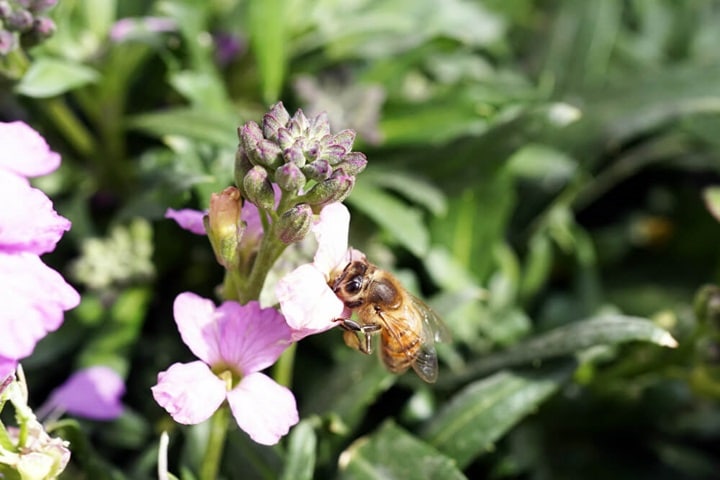
Some plants thrive particularly well in the warmer, more controlled environment of a polytunnel, providing consistent, rich nectar sources for bees.
Not all flowers are created equal when it comes to nectar. Some species produce more abundant nectar, offering a richer food source for bees, while others provide only small amounts or less accessible pollen.
Flowers with simple, open shapes—like lavender, calendula, and borage—allow bees to forage quickly and efficiently, whereas deeply tubular or complex blooms can be more challenging for smaller pollinators. Single rather than double blooms are generally best.
Another important factor is nectar refill rate: some plants replenish their nectar frequently throughout the day, providing continuous feeding opportunities, while others produce nectar more slowly, leaving bees to move on to other blooms.
By choosing a mix of nectar-rich and fast-refilling plants, particularly in the controlled environment of a polytunnel, gardeners can ensure that pollinators have constant access to food, supporting healthy bee populations and consistent pollination for crops.
Lavender, borage, and yarrow are proven performers: their blooms are busy with pollen and flowers continue producing over months. Cosmos and calendula do exceptionally well in polytunnels, giving gardeners continuous mid-season colour and nectar.
Top Performer Callouts:
- Lavender: Drought-tolerant, fragrant, prolific mid-summer blooms.
- Borage: Star-shaped flowers; attracts bees continuously; leaves are edible.
- Cosmos: Easy succession planting; thrives in protected environments.
- Calendula: Bright orange blooms; continuous flowering; dual-purpose as edible petals.
These are also companion planting stars – helping many common crops when planted alongside them. Companion plants not only attract bees and other beneficial pollinators, they can also help with pest control, natural predation, and more.
Tip: Common Edible Crops You Should Let Flower for Bees
Many common edible crops also produce flowers that are a nectar and pollen bonanza for bees. Allowing crops like lettuce, kale, chard, broccoli, and peas to flower provides early-season food for pollinators. In a polytunnel, leaving a few plants to bloom alongside your main crops creates a continuous nectar source, supporting bees while enhancing your own harvest.
DESIGNING FOR BEE VISITS (LAYOUT + COLOURS)
Bees are highly attracted to blocks of colour, particularly in the purple and blue spectrum. By planting in zones and using blocks of colour, you guide pollinators efficiently across your polytunnel. Mixing native and non-native species adds ecological diversity while keeping the visual display rich and functional.
Tips:
- Avoid pollen-free hybrids that don’t provide nectar (some lilies or ornamental sunflowers).
- Use simple flower shapes for easier access.
- Plant in clusters rather than scattered individual plants.
POLLINATOR-FRIENDLY PRACTICES INSIDE YOUR POLYTUNNEL
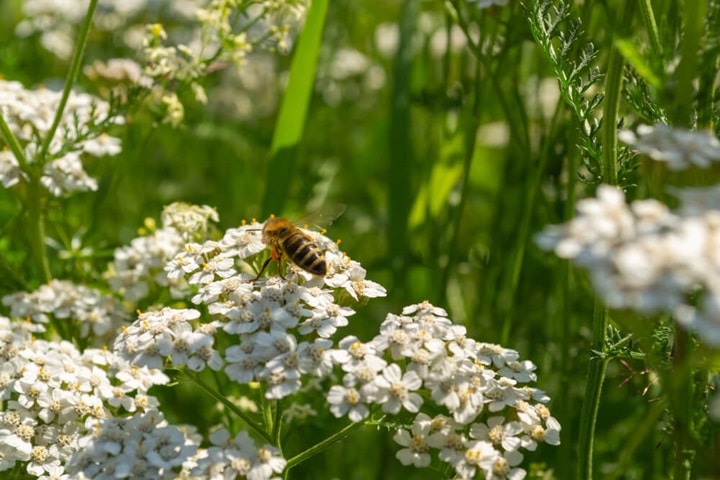
Planting the right flowers is just one of the steps to take to create a truly bee-friendly polytunnel garden.
Gardening Organically
Chemical pesticides, herbicides, and synthetic fertilizers can be highly toxic to bees, damaging their nervous systems, reducing foraging efficiency, and even causing colony collapse. By avoiding these products in your polytunnel, you create a safe environment where bees can feed, breed, and thrive.
Organic gardening also promotes soil health and plant diversity, which benefits both pollinators and your crops. Healthy soil supports strong, nectar-rich flowers, while diverse planting attracts a wider range of insects.
Companion planting, mulch from organic matter, and natural pest controls not only protect bees but also encourage natural predators that keep pests in check.
In essence, every organic decision you make—whether leaving a patch of soil undisturbed, growing native or nectar-rich plants, or using natural fertilizers—helps sustain the very insects that keep your polytunnel garden productive.
Supporting bees organically ensures a flourishing ecosystem and better harvests year after year.
Encouraging Biodiversity
Planting a diverse range of bee-friendly flowers in your polytunnel is key to attracting and sustaining pollinators. Include early bloomers, mid-season nectar producers, and late-flowering plants to provide continuous forage.
Combined with nesting spots and safe water sources, these measures create a mini ecosystem that supports bees year-round—benefiting both the insects and your harvest by ensuring effective pollination.
It is a good idea to think holistically and to integrate ornamental and food producing parts of your space. Polytunnels don’t need to produce food or welcome wildlife – they can of course do both.
Creating Bee-Friendly Habitat
Even inside a polytunnel, you can give different bee species safe spaces to shelter during colder months. Leave sections of soil or compost undisturbed, and create small piles of twigs or brush in a corner of your polytunnel or adjacent sheltered area.
Another highly effective option is a bee hotel—perfect for solitary bees and other beneficial insects. You can buy ready-made versions or easily make your own using hollow bamboo canes placed in a small, waterproof-roofed box. These provide a secure retreat when hives aren’t available.
Providing Water Safely
Bees need water to drink and to help cool their nests, but they can easily drown in open dishes. In a polytunnel, a small bowl filled with pebbles up to the surface allows bees to safely perch while drinking. Alternatively, a shallow tray or miniature pond with gently sloping edges and embedded stones can provide a safe water source without the risk of drowning.
First Tunnels polytunnels create the perfect microclimate for bee-friendly planting, providing protection from frost and wind while extending bloom periods. Accessories like companion planting kits, raised beds, and custom pollinator zones make it easy to attract and support pollinators while enhancing crop productivity. With First Tunnels, your garden becomes a haven for both bees and your harvest.
By planning for seasonal blooms, choosing polytunnel-adapted nectar-rich plants, and implementing bee-friendly practices, you can create a thriving pollinator environment all year round. Start planting now, design your polytunnel with bee visitation in mind, and enjoy the benefits of healthier pollinators and higher yields with First Tunnels.
FAQs
When should I plant for continuous blooms in a polytunnel?
Plan succession planting from late winter through autumn, staggering seed sowing and transplants to maintain flowers throughout the year.
Can I attract bees into my polytunnel year-round?
Yes! Include early crocuses and snowdrops in winter, followed by spring/summer nectar-rich plants, and finish with autumn bloomers like echinacea and asters.
What’s a simple DIY bee hotel for a polytunnel?
Use a small wooden box filled with hollow stems, bamboo canes, or drilled logs. Place it near flowering plants and away from strong winds.
Are any of these plants edible or dual-purpose?
Yes. Chives, calendula, and borage are all edible and also attract pollinators. Lavender flowers can be used in cooking, and comfrey leaves can be used for compost or mulch.
How do I rotate crops to support bees and my food plants?
Rotate flowering companion plants with vegetables to ensure soil health, while maintaining continuous bloom patches to support pollinators.
Sources
RHS.org.uk, ‘Plants for Pollinators’ Available at: https://www.rhs.org.uk/education-learning/school-gardening/resources/planet-friendly/plants-for-pollinators, [accessed 21/08/2025]