Modern garden paving ideas certainly do not have to be a boring grey expanse. For sustainable gardeners, making the right decisions about paving or decking can be integral to the overall design of a garden – but garden paving must be used wisely and in moderation to serve our needs without overwhelming the overall garden design.
1. Know When to Place Garden Paving, and When Not To
The first thing to think about when we think about modern garden paving is whether it is really a good idea to install paving or decking in a particular location at all. This should of course be considered with reference to the overall design of the space, and its characteristics.
Increasingly, contemporary gardeners are opting to forgo areas of lawn. But replacing lawns entirely with paving or decking is neither sensible nor sustainable.
While people often include more paving for a lower maintenance garden, paving in the wrong places is often not really low-maintenance at all, and it can cause a wide range of problems now and in the future.
The key, then, is to know when and where to place paving or decking, and where and when it is not a good idea to do so.
Remember, when it comes to garden paving, less is often more. Aim for quality, not quantity, and make sure that a good proportion of the space is given over to plants. Plants should be, after all, the most important elements in any garden.
2. Where to Add Garden Paving
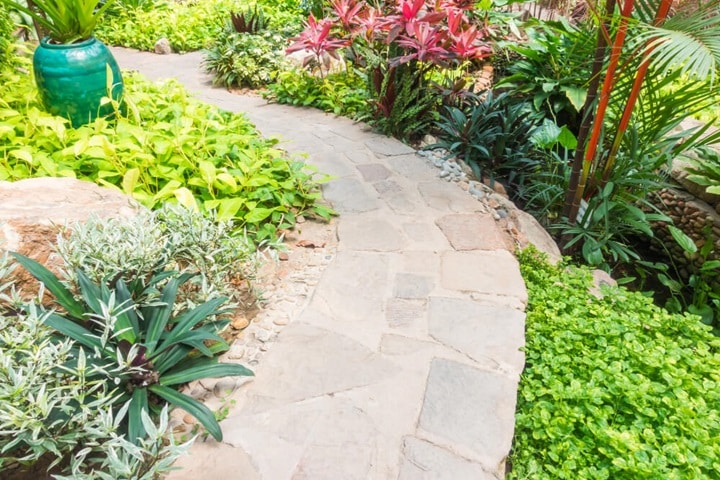
Of course, garden paving or decking can be extremely useful. It is this kind of feature in a garden that allows it to become an extension to a home – in effect an extra room where you can sit and relax, socialise, cook outdoors and/or dine al fresco.
When thinking about where to add garden paving or decking, it is important to think about where the sun falls within the space throughout each day and throughout the year. While many will simply place paving or decking directly outside their back door, sometimes it may be best to have these areas elsewhere in the garden.
Consider where you might like different areas for seating or outdoor dining to be, based on when you and your household plan to use the space and other practicalities, as well as the sun-map and other environmental factors like the prevailing wind direction, views and privacy, etc…
By weighing up all the information you can find the optimal spot for different recreational spaces within your garden, as well as for the different growing areas and any other structures like polytunnels or greenhouses, sheds or summerhouses you plan to have.
3. Think About Water When Paving a Garden
When deciding where to place garden paving, another of the most important things to think about is water. When things go wrong with paving, water is frequently the issue involved.
3a. Consider Water Flow and Drainage
Whenever an area of paving is created, it is vital to think about how water will flow in the garden and to where water will drain. Sadly, all too often, paved areas are created which accidentally channel water towards the foundations of the home rather than away from it, which can have catastrophic results.
Of course, any paved areas adjacent to the house should slope away from your home. Beyond this, however, it can be useful to consider what happens to the rain that falls on paved areas, and where that water drains to.
Though clever design, paved areas can be made permeable, so that water can still seep down into the soil, or the water that falls on hard surfaces and runs off can be caught and turned to your advantage – used to create rain garden areas, wildlife ponds, and more…
3b. Include a Water Feature
Thinking about water in patio design is not just about practicalities. By catching water and keeping it around you might also create a range of cool, different water features to enhance the sensory appeal of the space and bring something extra visually, and to the soundscape of your garden.
When you are thinking about paving, you should also think about how you can have some water close by seating areas, to enhance the experience of spending time there.
Thinking about water carefully when considering garden paving options can save a lot of hassle later on.
4. Consider Paving Materials Carefully
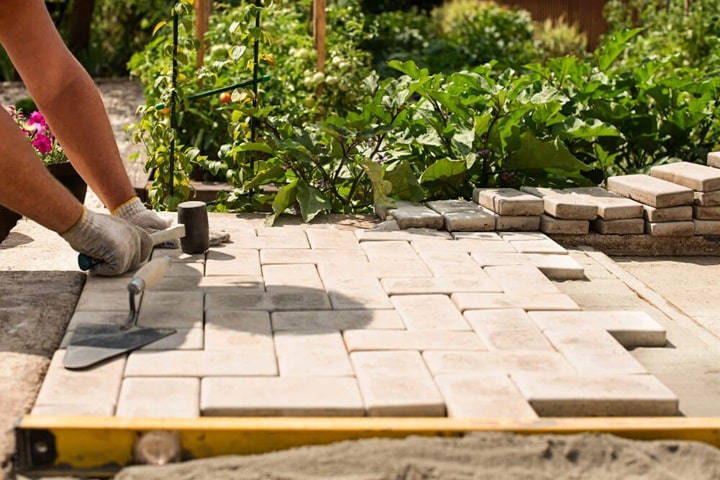
Of course, as well as thinking about where to place a patio or paved area and how it will work within the bigger picture of your garden, you also need to think about what material or materials you will use.
In a sustainable, modern garden it is always best to consider natural materials for the space, and always to look at reclaimed options before you buy in anything new.
5. Consider Wood Decking Patio Designs
Wood decking can be a more sustainable choice than hard, impermeable paving – often sitting more lightly on the land and doing less damage to the soil and other features in the environment. Reclaimed wood is most sustainable of all.
One of the reasons people may be reluctant to consider putting wood in their gardens is that it does not last forever. And people are concerned either about it rotting, or about preserving it without introducing toxins to the garden.
The good news is that you can now purchase Organowood – a wood preservative to coat onto your decking, that basically fossilizes it, preserving it in a more sustainable and eco-friendly way.
Modern wood-effect paving is popular – but you cannot beat the look and feel of the real thing, not get much better when it comes to sustainability credentials, especially if the wood you use is reclaimed.
6. Opt for Natural Stone Patio Designs for a Timeless Space
Another option is to use natural stone pavers – these are perfect for a garden that feels timeless and natural and are understandably a favourite with many gardeners.
Though more expensive than concrete pavers, these are more eco-friendly – and are especially sustainable if you can find reclaimed natural stone pavers to use and more stone does not need to be quarried for the paving.
7. Choose Classic Cobbles
Natural stone cobbles rather than pavers could also be an option for a classic look – again, especially if you can source reclaimed cobbles to use. The natural material can help paved areas to blend in with planted areas in the garden.
8. Use Mosaic Paving Slabs for a Villa-inspired Garden Patio Design
A mosaic of stone pavers or ceramic tiles can also look great – bringing the feel of a relaxing villa to your home garden, perhaps, and also perhaps making use of materials that might otherwise have been thrown away.
In fact you might create mosaic paving using a wide range of different reclaimed materials, to suit your personality and the style and vibe of your home and garden. Using things that might otherwise have been thrown away can be an excellent idea.
9. Plant Between Pavers
Whichever pavers you choose, remember that these do not necessarily all need to butt right up against one another. Plants can also be part of the design. Groundcover plants of various kinds might form part of the patio or paved area.
You might deliberately leave cracks between pavers, or even larger planting areas here and there in paved areas, to bring plants right back into the heart of your design and help the paved area feel more integrated with the rest of the garden.
8 Garden Patio Design Tips
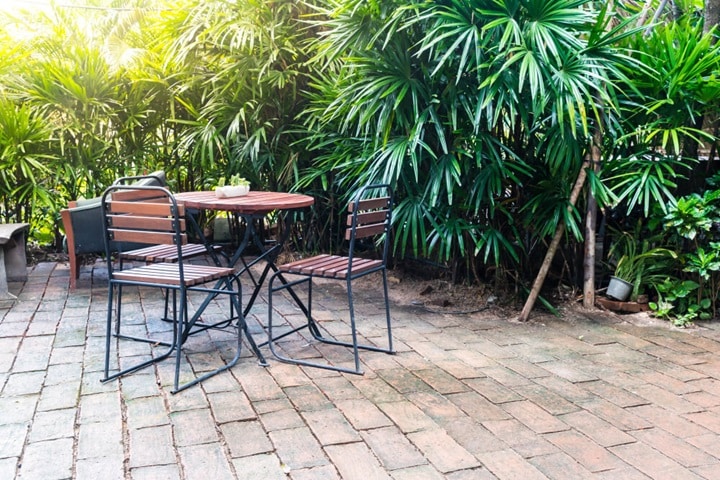
Here are some more garden paving design tips to help you make the right decisions for your garden:
10. Create zones in your garden patio design
Whenever you are designing patios and paved areas, it is important to think about how you plan to use the space.
It can be useful to zone paved areas according to need and intention, creating well-defined spaces for cooking outdoors, outdoors dining, seating areas and for all the different things you and your household want to do.
11. Your garden patio should reflect your home’s personality
When making patio or decking decisions, don’t be boring! Garden design fads and trends may come and go, but you need to create something that you, personally, will love, regardless of whether it happens to be in vogue or not.
Think about how you can create a seamless interaction between your home and garden and a flow between the two. Make sure that the garden, including any decking or paving, feels in keeping with your interior design aesthetic.
12. Use circular patio designs and naturalistic curves
Thinking outside the box can help make sure you garden is a cut above. Don’t be a square, think circles and sinuous curves, for a more naturalistic and organic feel that allows hard paved areas to blend in with your growing areas.
If everything is too rigid and linear, it can leave a garden space feeling sterile and forced. More flexible design, with natural shapes and forms, can help a garden feel comfortable and relaxed.
13. Choose bold coloured patio ideas to stand out from your neighbours
You do not need to be a sheep. Don’t be afraid to go against the crowd and try some paving ideas that might look and feel very different to those of most of your neighbours. Don’t be afraid to embrace bold colours in your design, as well as more interesting shapes and forms.
14. Consider different patterns of patio design
Even if you do choose fairly tame and neutral wood, stone pavers or tiles, the way in which you lay out the planks, pavers or tiles can make a big difference to how the area looks and feels.
Think about how you might lay things out in different patterns, to ring the changes and make your deck or paved area something a little special.
15. Add interest with height differences and consider cover
Paved areas, patios or decking can also add interest to your garden by being placed at different heights to suit the terrain and environmental factors. Authorities permitting, you might raise areas to take advantage of certain views, or create a sunken garden area for a cosy and intimate space.
Another thing to think about is whether you will add a pergola or other cover over the paved areas you create in your garden. Of course, covering certain areas can be a good idea to allow you to use your garden more frequently even when the weather is not entirely ideal.
16. Add pony and knee walling for interest and multi-functionality
Low walls might also be added when paving certain areas, not only to create some division between different garden rooms but also, perhaps, to add visual interest, and perhaps even to serve other functions, such as seating, or to create more and different habitat zones for planting.
17. Create garden paths to integrate with your patio choices
Remember, when designing paved areas and patios or decking, that you should also make sure that your choices blend in with the choices you make for your garden paths. Make sure that the materials for paved areas continue seamlessly onto paths, or that path materials work well with other paving or decking.
These are just some tips to help you make the right choices when it comes to analysing different modern garden paving ideas and finding the right option or options for you. Learn more from our gardening knowledge section on our blog.
FAQs
What can you use instead of paving slabs?
Instead of paving slabs you might use wood decking, reclaimed materials or even rubbish like glass bottles or broken tiles that would otherwise be thrown away.
Can you lay paving slabs on soil?
It is best to prepare the area by creating a flat bed of sand before laying paving slabs to prevent any issues down the line.
How do you pave a garden on a budget?
Keep paving to a minimum, thinking quality rather than quantity. Choose reclaimed items or things that would otherwise be thrown away.
What is the cheapest form of paving?
Items or materials you already have might be used to create paving for free. Otherwise, reclaimed materials for paving can often be picked up very cheaply.
What is the best low maintenance paving?
Properly preserved wood decking or reclaimed stone pavers are often low-maintenance as well as being sustainable ideas.
Sources
Hodge, A., (2024) Best materials for paving – The expert guide to choosing the perfect surface for your patio. Ideal Home. [online] Available at: https://www.idealhome.co.uk/garden/landscaping/best-materials-for-paving [accessed 22/07/24]