

Understanding the type of soil available in your area will help you determine the type of plants to plant, how to prepare it for planting, ways to care for it, things to avoid and even ways to improve it for maximum benefits. You should also consider the factor of garden pests and their ability to target your plants; make sure to protect your crops using fruit cages.
Clay soil is one very particular, and common, type of soil used in gardens, but it is important to be aware of its properties. In this article, we answer the query – is clay soil acidic – so that you know whether or not you should use it for your crops in gardens and polytunnels, and what benefits it can bring.
Key points:
- Soils with clay composition have over 30 percent of tiny clay particles.
- Certain clay types expand and contract with moisture changes, potentially enhancing soil fertility.
- Clay-rich soils require more time to heat up during spring.When wet, clay soils can be easily compromised if disturbed or tread upon.
- Clay soils are generally more resistant to drought compared to other soil varieties.
Where Is Clay Soil Commonly Found?
The soil composition in wetlands and areas with sufficient rainfall throughout the year consists of mostly clays and silts or a combination of both. The soil composition in the United Kingdom varies from province to province; Here are some of the regions and provinces whose predominant soil composition is clay in its various forms;
London– According to geological studies carried out by British Geological Survey and other institutions, the most common types of soil in and around the UK capital is clay with a few areas having some chalky based variants. This is perhaps why it can be difficult to maintain a decent garden in London without mixing the existing clay soil with other variants and organic matter. Raised gardens and polythene tunnels are also great gardening options in the city of London.
Part of the reason why the construction of the London underground was so successful was the presence of a thick layer of clay beneath the city. London clay has been used for centuries to make bricks, pottery, and many other clay byproducts and is still in use today.
Other regions with substantial amounts of clay include; the Northwest-Blackpool, parts of Carlisle, Manchester; Oxfordshire, the Cotswolds and around have patches of clay soils with large deposits in the wooded farmlands of Oxfordshire among others.
How to Identify Clay Soil?

There are more than a dozen ways of determining whether what you have is clay soil or not. Some are scientific, while others are based on observation. The latter is easier for urban farmers or those looking to set up gardens in an urban setup since you don’t need any specialized knowledge or equipment.
1. Identifying Clay Soil Scientifically
Given that soil is made up of tiny rock particles, a sample of soil collected from your garden can be tested in a laboratory to determine its texture and composition. This will inform the tester whether the sample contains particle sizes customarily used to identify clay soils.
2. Identifying Clay Soil with the “Jar Test”
This involves digging up a sample of soil for your yard and putting it in a jar then filling it with water. Leave the mixture to sit for a few hours and observe the arrangement of particles/minerals in the jar. Dense particles like rock and sand take the bottom part take the bottom layer while clay particles take the topmost layer. If the clay layer is significantly larger than the other layers, then you should conclude that your soil is predominantly clay.
3. Identifying Clay Through Hand Texturing
This is an easy test you can carry out on your own at home to find out if your soil is clay, loam or any other type. It involves digging up some of the soil, adding a bit of water and trying to form a few shapes with your hands with the mixture. You will find it easier to create more complex shapes like cylinders with clay soil while the other soil types will be more difficult and can disintegrate easily. This test is used to determine the plasticity of soil – clay has significantly higher plasticity than the rest.
4. Identifying Clay Soil Through Observation
There are ways to identify clay soil just by observing the soil under different conditions and also the kind of plants growing naturally. Here are some ways to identify clay soil through observation
- You observe stagnated water in your yard several days after heavy rains
- Your yard stays wet for long periods after it rains
Cracked surfaces in your grounds after long dry weather conditions- high density tends to have huge cracks after long dry conditions as it loses more water through evaporation. Clay particles can be liked to a sponge that expands and shrinks depending on the of water it which causes the clay to develop huge cracks and can also become hard as a rock depending on the density.
Observing plants and weeds growing in your yard- Certain weeds tend to flourish in clay soil. You can tell if you have clay soil when you observe the following weeds flourishing in your yard;
- Chicory
- Horse nettle
- Coltsfoot
- Mouse-ear chickweed
- Morning glory
- Quack grass
- Knotweed
- Dandelion
- Plantain
- Bermuda grass
- Among others
- Your yard becomes sticky and slippery in wet weather
The following are the observable properties of clay soil
- Clay soil is sticky and forms thick lumps when it gets wet
- Clay soil can become rock-hard in dry conditions
- Clay soil does not absorb water quickly leading to stagnation
- Clay soil is significantly harder to cultivate as compared to other soil types
- Clay soil warms quite slowly during spring but can retain more heat during winter.
- Holds plants firmly- It’s harder to uproot plants growing on clay soil as compared to other soils.
How to Improve Clay Soil?
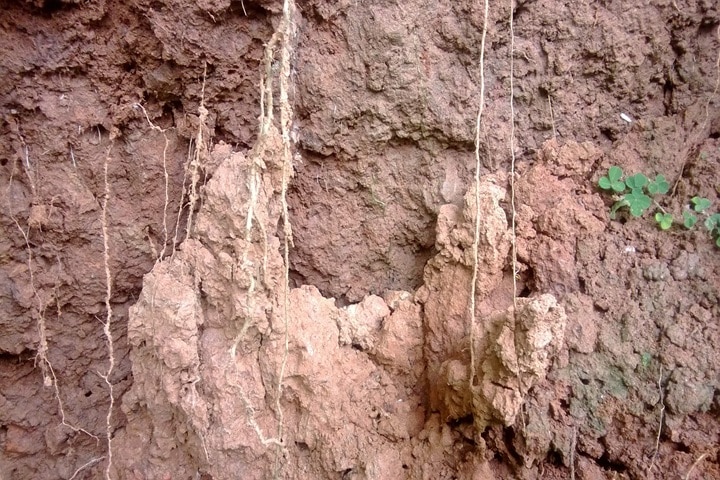
Clay soil can be hard to cultivate and maintain. It also creates problems with drainage, which is less than ideal, especially in an urban setup. However, there are ways to improve the clay soil in your grounds and maximise results should you choose to till it for gardening purposes.
- Introduce organic material to your clay soi l- You can gradually improve your clay soil and make it easier to work with by adding organic material such as farmyard manure, garden compost, among others. Mix the clay soil with organic material to change its composition over a few months.
- Test the PH levels and adjust accordingly- You can use home PH testing tools to determine PH levels in your clay so you can adjust them. Clay soil tends to retain a lot of nutrients and more often than not leads to overconcentration and PH imbalances that hurt soil health.
- Use raised beds – Clay soil drains poorly, by building a raised bed, you can find ways to channel excess water from the bed easily, e.g. through inclination.
- Planting cover crop and mulching can help regulate temperatures and improve the quality of your clay soil. Cover crops also improve the soil structure, suppress weeds and prevent erosions during those periods when you haven’t planted anything on the garden e.g. winter. Examples of good cover crop in the UK include; Timothy hay, Hairy vetch, clover, borage, rye and oats, alfalfa, peas among others.
How to Build a Soakaway In Clay Soil?
You can deal with drainage problems caused by dense clay soil easily using a well-constructed Soakaway. A Soakaway is a pit usually sank at the back of the house and filled with coarse stone and rubble or soakaway crates. It is meant to slowly drain excess surface water channelling it to surrounding areas in a more effective way.
How to Build a Soakaway-The Ultimate Guide
- Before you build a soakaway you need to do a percolation test to determine whether the water will be able to drain away as intended.
- Ensure there are safeguards around the pit location to prevent earth and other materials from collapsing and clogging it up.
- Now dig a hole/pit in the spot you identified- the pit should be strategically located to ensure unobstructed flow of water from the surfaces you want to drain. Ideally, pits should also be at last 5 meters from buildings or walls nearby,
- Now dig shallow trenches across the garden to channel the excess surface water into the pit. Ensure you follow a logical pattern that efficiently draws the water from the garden.
- Connect the trenches to the inlet of the pit you dug earlier and clear up any loose soil that may have fallen into the pit and trenches while you were digging
- Now fill up the pit with the coarse stone and rubble or soakaway crates that will slowly absorb the water that comes in and lets it slowly sip into the surrounding.
- Wrap the surface of the pit with fabric and fill up with loose topsoil and leave it unattended so grass and weeds can grow on top.
- Your Soakaway is now ready.
One last thing, even though most soakaways are built within the confines of your private compound, it is good to ensure you are complying with local building regulations to avoid problems with the authorities.
Is Clay Soil Acidic or Alkaline?
Unsure about your soil pH levels? Use a soil pH tester for this task.
Clay soil usually leans towards the alkaline side with PH levels ranging for 7.5 to 10 or so. However, PH levels on any type of soil tend to vary depending on environmental factors within a geographical. It is possible to find highly acidic clay soil in an area with high levels of acidity due to things like pollution, organic composition, acid rain, among others. You can always test PH levels on clay soil and make the right adjustments.
How to Break Down Clay Soil in A Garden
Clay soil is generally hard to dig up and break down for planting and weeding. How can you break up clay soil fast? You can make clay easier to break up by covering it with organic matter and leaving it to rest for days. Later you can dig up the organic material and mix it up with the already weakened top layer (about 10 inches) of the clay soil. Avoid creating huge lumps while digging up-try and keep the particles small and uniform
What Plants Grow Well in Clay Soil?
The following plants flourish in clay soil:
- Castor bean
- Iris
- Miscanthus
- Heuchera
- Crab apples (Malus)
- Bergenia cordifolias (elephant ears)
- Lonicera periclymenum
- Baptisia (false indigo)
- Hosta-great for foliage
- Black Eyed Susan
- And many more.
What Vegetables Grow Well In Clay Soil?
Looking to grow vegetables in your clay soil garden? The following veggies thrive in clay soil, according to growveg.com. (Pleasant, n.d.)
Summary
As you may have noticed by now, clay soil is probably one of the most cultivated soils in the UK and around the world today. UK weather tends to be rainy and wet throughout the year; hence the reason why most areas tend to have clay soil as the predominant soil. Clay soil can be good and bad, depending on how you approach it. By adopting clever methods to manage it, one can get to enjoy the benefits of this nutrient-rich soil variety in their farms and gardens.
Want to learn more about clay soil? Check out our guide on gardening tips for clay soil.
FAQs
What is clay soil good for?
Clay soil is excellent for water-loving plants due to its moisture-retention properties. It’s also beneficial for growing crops like rice that thrive in waterlogged conditions. Additionally, its nutrient-rich composition supports robust plant growth.
How do you fix clay soil?
To improve clay soil, you can mix in organic matter such as compost or aged manure, which enhances drainage and aeration. Adding coarse sand or gypsum can also help break up compacted clay and improve soil structure.
What are 5 characteristics of clay soil?
1. High nutrient content: Clay soils are usually rich in minerals essential for plant growth.
2. Dense texture: They have a heavy, compact structure.
3. Slow drainage: Clay soils have low permeability, leading to slower water drainage.
4. High water retention: They can hold a significant amount of water, reducing the need for frequent watering.
5. Cold nature: Clay soils tend to be cold and take longer to warm up in the spring.
References
Hanna Instruments. (2023) HI-981030 SOIL PH TESTER. [online] Available at: https://www.hannainstruments.co.uk/agriculture/2593-hi-981030-soil-ph-tester [accessed 19/07/24]