


A single frosty night can undo months of careful growing, particularly when tender plants are still outside in autumn or early spring. If you are wondering how to cover plants to protect from frost, the good news is that you do not need to buy a collection of disposable plastic covers. There are several practical, reusable and more sustainable ways to protect plants when temperatures are expected to fall.
The best approach is to work with your garden rather than against it. Choose plants suited to your conditions, make the most of sheltered microclimates, add thermal mass where useful, mulch the soil and use durable, reusable materials to protect plants when temperatures really drop.
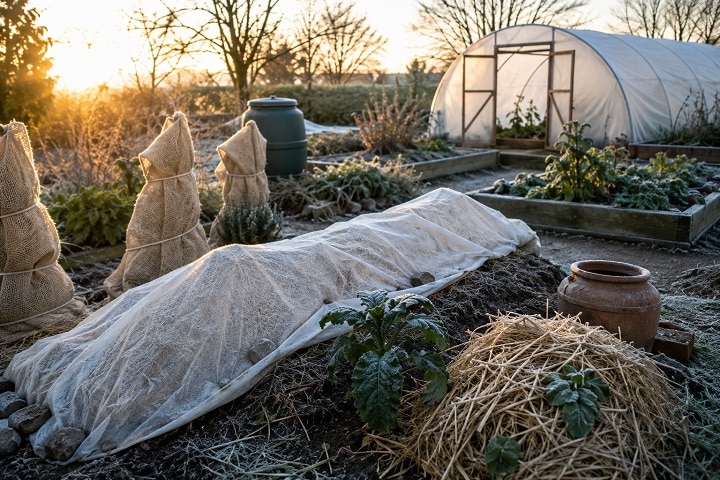
If you do need to cover a plant, an old sheet, hessian, straw or bracken can often be more appropriate than buying another plastic product. For larger-scale winter growing, a polytunnel offers a longer-term way to create a more sheltered growing environment.
Key Takeaways
- Cover vulnerable plants before a frost, but first consider whether a better planting position could provide protection naturally.
- Use existing, reusable or natural materials such as old sheets, hessian, straw and bracken where appropriate.
- Think about your garden’s microclimates, as a sheltered south-facing wall can make a considerable difference.
- Add thermal mass, such as water-filled containers or masonry, to absorb warmth during the day and release it gradually at night.
- A polytunnel can provide more reliable winter shelter and extend the growing season without requiring individual plants to be covered every night.
Why Frost Damages Plants
Frost occurs when temperatures fall below freezing. Ground frost develops when the ground surface falls below 0°C, while air frost occurs when the air itself reaches freezing point.
When water within plant tissues freezes, ice crystals can damage or destroy plant cells. Tender young growth, blossom and the foliage of tender vegetables are particularly susceptible. Repeated freezing and thawing can cause further damage.
Clear, still nights can be particularly risky. Heat escapes from the ground and plant surfaces, and cold air can settle in low-lying areas. This is why one part of a garden can escape frost while another, only a few metres away, is badly affected.
Wind matters too. Cold, drying winds can increase stress, particularly for evergreen plants, because foliage can lose moisture faster than roots can replace it.
Which Plants Need Frost Protection?
The first question I ask is not “What can I cover this with?” but “Does this plant actually need covering?”
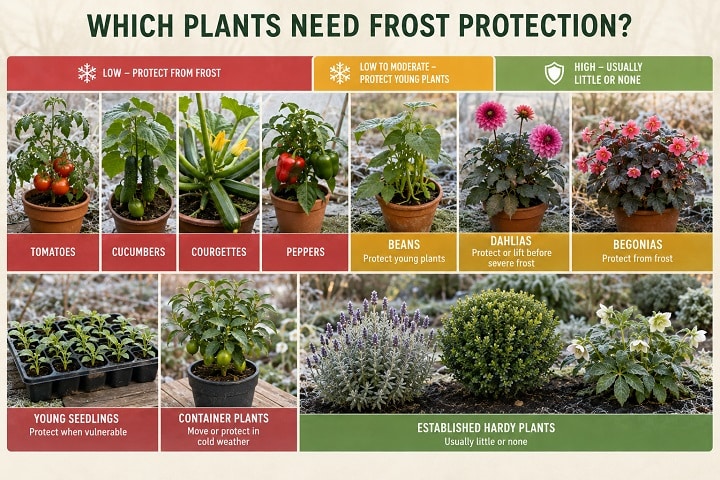
Hardy plants that are well suited to your local conditions may need little intervention. Tender plants, newly planted specimens and container-grown plants are more likely to require help.
| Plant | Frost Tolerance | Protection Needed |
|---|---|---|
| Tomatoes | Low | Protect from frost |
| Cucumbers | Low | Protect from frost |
| Courgettes | Low | Protect from frost |
| Peppers | Low | Protect from frost |
| Beans | Low to moderate | Protect young plants |
| Dahlias | Low | Protect or lift before severe frost |
| Begonias | Low | Protect from frost |
| Young seedlings | Variable | Protect when vulnerable |
| Container plants | Variable | Move or protect in cold weather |
| Established hardy plants | High | Usually little or none |
There is also a case for choosing plants that are naturally suited to your climate rather than trying to keep tender plants alive through every winter. Match plants to local conditions and use sheltered positions for plants that are only slightly tender.
Consider Your Garden’s Microclimate
Before covering a plant, look around your garden.
Every garden has its own collection of small microclimates. A south-facing wall may absorb sunlight during the day and release warmth after dark. A sheltered courtyard can be considerably warmer than an exposed allotment. Meanwhile, a hollow or low point may act as a frost pocket where cold air collects.
This is one of the most useful forms of frost protection because it costs nothing.
Look for:
- South-facing walls and fences that receive winter sun.
- Sheltered areas protected from prevailing winds.
- Higher ground where cold air is less likely to collect.
- Low spots where frost tends to settle.
- Areas beneath established trees or shrubs that offer some shelter.
- Walls, paving and other structures that absorb warmth during the day.
If you have a tender plant in a pot, simply moving it against a sheltered wall can sometimes make more difference than adding another layer of covering.
It is also worth observing your garden over several frosty mornings. Where does frost linger longest? Which areas thaw first? Where does snow melt first?
Over time, you can build up a much more useful picture of your garden than any general hardiness guide can provide.
Best Materials to Cover Plants
When covering is necessary, I prefer to use materials that can be reused year after year or that have another useful purpose in the garden.
| Material | Best For | Advantages | Limitations |
|---|---|---|---|
| Old sheets | Beds and individual plants | Reusable and readily available | Can become heavy when wet |
| Hessian | Shrubs and containers | Durable, breathable and reusable | Not completely waterproof |
| Straw | Tender plants and roots | Natural insulation | Can become wet and may attract pests |
| Bracken | Crowns and tender plants | Natural and insulating | Needs to be gathered responsibly |
| Cloches | Small plants | Reusable and effective | Limited coverage |
| Cardboard boxes | Emergency overnight protection | Free and easy to reuse | Not suitable in wet conditions |
| Bubble wrap | Containers | Useful for insulating pots | Plastic, so best reused |
| Polytunnel | Larger growing areas | Long-term shelter | Requires space and investment |
If you already own horticultural fleece, there is no need to throw it away. Reusing it for as long as possible is preferable to replacing it unnecessarily. If you are buying something new, however, consider plastic-free alternatives such as sheep’s wool or plant-based materials.
For woody plants and larger tender specimens, hessian, straw and bracken can be particularly useful. The RHS also recommends these materials as alternatives for wrapping vulnerable plants.
If you have a polytunnel, the cover itself is an important part of the winter growing environment. It is worth taking time to choose the right polythene cover for effective frost protection.
How to Cover Plants to Protect from Frost
Once you have decided a plant needs protection, the method is fairly simple.
Before sunset
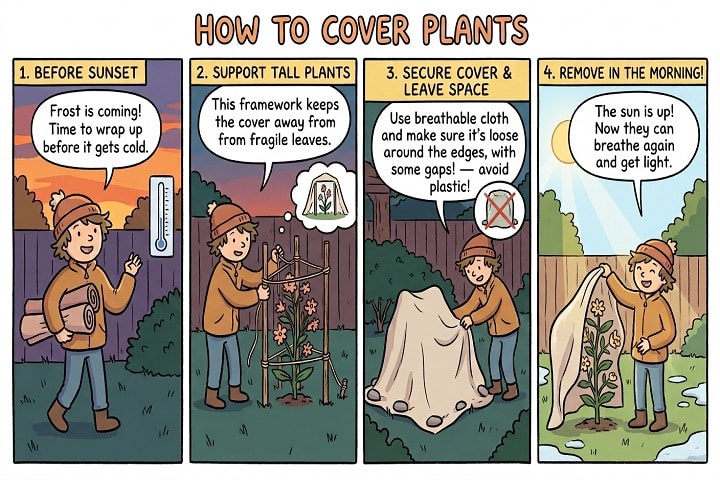
Put your covering in place before temperatures fall sharply.
The aim is to retain some of the warmth around the plant and protect it from the coldest part of the night. Covering a plant after frost has already settled is much less useful.
If a hard frost is forecast, I tend to make covering part of the late-afternoon routine.
Support taller covers
For larger plants, create a simple framework from canes, sticks, hoops or other materials you already have.
This keeps heavy coverings away from delicate foliage and creates a small pocket of protected air around the plant.
Avoid trapping wet foliage
A covering should provide shelter without creating a damp, stagnant environment.
Old sheets and hessian are useful because they are breathable. If using a waterproof material in an emergency, keep it above the plant rather than pressing it directly against foliage.
Secure the edges
Cold air can flow underneath a loose covering, particularly in windy gardens.
Secure sheets and fabric with pegs, stones, logs or other suitable weights. Avoid tying anything so tightly that stems are damaged.
Remove covers in the morning
Once temperatures rise, remove temporary coverings or open them up.
This allows plants to benefit from daylight and prevents unnecessary humidity and overheating. If another frost is forecast, cover them again later.
When should I cover plants? Ideally, before sunset when frost is forecast.
Should covers touch plants? Lightweight materials can rest over some low-growing plants, but heavier or waterproof materials are better supported above foliage.
What Should You Never Cover Plants With?
There are a few materials and methods I would avoid.
Plastic touching leaves
Plastic sheeting can become very cold and wet, and direct contact with foliage can increase the risk of damage.
Heavy tarpaulins directly on plants
Tarpaulins can be useful as an outer waterproof layer, but they are too heavy to place directly over delicate plants.
Wet blankets
An old blanket can provide insulation, but once saturated it becomes heavy and cold. Keep it supported and use it where it can dry between periods of wet weather.
Non-breathable coverings for prolonged periods
Plants still need air movement. Long-term enclosure in damp conditions can encourage fungal problems and may cause more harm than the original frost.
Add Thermal Mass to Store Daytime Heat
One of the simplest ways to make a sheltered growing space more frost-resistant is to use thermal mass.
Thermal mass means materials that absorb heat during the day and release it slowly as temperatures fall. Stone walls, brick paths and masonry structures can all do this naturally.
In a greenhouse or polytunnel, containers of water are sometimes suggested as a way to provide overnight warmth. The temperature benefit from water containers freezing is negligible and should not be relied upon as a substitute for proper insulation or heating.
Nevertheless, water and other dense materials can contribute to temperature moderation when they absorb warmth during the day. The greatest benefit comes from considering thermal mass as part of the whole growing environment rather than expecting a few containers to protect tender plants from a severe freeze.
Position thermal mass where it can receive sunlight during the day, while keeping enough growing space around it for good airflow.
Extra Ways to Protect Plants from Frost
Covering is only one tool. Often, combining several small measures works better than relying heavily on one.
Mulch the root zone
A thick layer of organic material can help insulate the soil and protect roots from severe cold. Well-rotted compost, leaf mould and other organic mulches can also improve the soil over time.
Mulch the root area of tender plants and evergreens to help prevent the ground from freezing.
Move containers
Containers are particularly vulnerable because their roots have less insulation than roots in the ground.
Move tender pots into a sheltered area, against a wall or into a greenhouse or polytunnel when necessary.
Group pots together
Grouping containers reduces their exposure to cold air and makes it easier to protect them collectively.
Create windbreaks
Hedges, fences and other shelter can reduce exposure to cold winds. If you are designing a new growing area, think about shelter before you think about buying protective materials.
Leave natural protection in place
Don’t always tidy plants completely for winter. The previous season’s stems and foliage can provide some protection to crowns and new growth. Leave the previous season’s growth on some tender perennials until spring for this reason.
Protecting Plants Inside a Polytunnel
A polytunnel gives you something that temporary coverings cannot: a larger, more stable sheltered environment.
It will not necessarily remain frost-free. A polytunnel is not a heated greenhouse, and on a very cold night temperatures inside can still fall significantly.
But it protects plants from direct exposure to wind and precipitation and gives you another layer between the crop and the outdoor conditions.
If you are using a polytunnel through winter, learn how to protect plants from frost by maintaining the right polytunnel temperature.
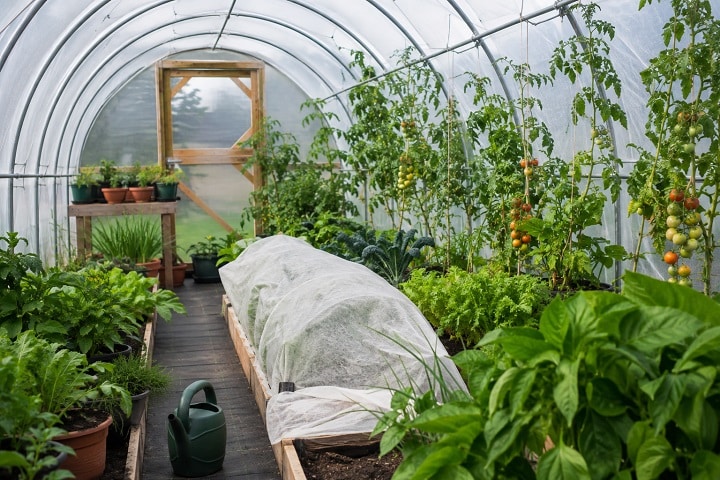
For me, this is where a polytunnel becomes more than a way of growing tomatoes in summer. It can form part of a whole-year growing system, reducing the need to protect individual plants every time the forecast changes.
What Can You Grow Through Winter?
Winter growing becomes much easier when you choose plants that actually like cooler conditions.
Rather than trying to keep tender summer crops going at all costs, I prefer to make space for vegetables that can tolerate cold weather.
Good options include:
- Spinach
- Kale
- Chard
- Winter lettuce
- Pak choi
- Winter salad leaves
- Garlic
- Onions
A polytunnel can provide enough shelter to keep these crops productive for longer while also protecting them from some of the worst winter weather.
If you want to plan a productive winter tunnel, grow cold-hardy vegetables that can withstand winter conditions.

Common Frost Protection Mistakes
Frost protection is often most effective when it is simple. Avoid creating unnecessary problems by:
- Covering too late: Put protection in place before temperatures fall.
- Forgetting to uncover: Remove temporary coverings when conditions improve.
- Using plastic against foliage: Keep waterproof materials supported above plants.
- Ignoring microclimates: A plant may need protection in an exposed bed but not beside a sunny wall.
- Protecting only the leaves: Remember roots and containers can also be vulnerable.
- Overlooking wind: Cold winds can increase stress even when temperatures are not exceptionally low.
- Overwatering protected plants: Damp, poorly ventilated conditions can create other problems.
- Using disposable materials unnecessarily: Reuse durable coverings and choose natural or plastic-free options where practical.
- Trying to grow unsuitable plants: Sometimes the most sustainable frost protection is simply choosing a hardier plant.
Conclusion
Frost protection does not have to mean wrapping every plant in plastic whenever the forecast turns cold.
The most resilient approach begins with the garden itself. Learn where your frost pockets are, make use of sunny walls and sheltered corners, choose plants suited to your conditions and protect the soil with organic mulch. Add thermal mass where it makes sense, particularly in a greenhouse or polytunnel, and use durable coverings only when they are genuinely needed.
When you do need to cover plants, old sheets, hessian, straw and bracken can all have useful roles. If you already have plastic-based fleece, reuse it rather than replacing it, and consider plastic-free alternatives when purchasing new materials.
For gardeners wanting more dependable winter protection, a polytunnel offers a longer-term solution. It creates a sheltered growing environment where you can combine protection, thermal mass, appropriate crops and good ventilation.
Ultimately, good frost protection is less about finding one perfect covering and more about understanding your garden. Once you know how cold moves through the space, where warmth is stored and which plants genuinely need help, protecting them becomes much simpler.
Frequently Asked Questions
Does covering plants with plastic protect them from frost?
It can provide some protection when used correctly, but plastic should not normally sit directly against plant foliage.
Will cardboard boxes protect plants from frost?
Yes, cardboard boxes can provide short-term overnight protection for small plants, but they are best used in dry conditions and removed in the morning. They are an emergency solution rather than a long-term covering.
What are the cheapest or DIY ways to protect plants from frost?
Start with methods that require no new materials.
Move pots against a sheltered wall, group containers together, mulch around vulnerable plants and make use of existing structures that provide shelter.
Old sheets, hessian, cardboard boxes and clean containers can also be repurposed. For larger plants, a simple framework of garden canes or prunings can support a covering without requiring a dedicated crop-cover system.
Can plants recover after frost damage?
Often, yes.
Do not assume a blackened or wilted plant is dead immediately after a frost. Some plants can recover from dormant buds or from growth below ground.
Wait until the danger of further frost has passed before cutting away damaged growth. Some plants can take until early summer to show whether they will recover fully.
This is another reason not to rush to clear away damaged plants. What looks finished in January may surprise you when spring arrives.
Sources
Royal Horticultural Society (RHS) (2026) Frost damage. Available at: https://www.rhs.org.uk/prevention-protection/frost-damage (Accessed: 28 August 2026).